Returning Flesh to the Mother, Bones to the Father
The deaths of Li Gen and Prince Ao Bing brought disaster upon Chentang Pass. Furious over the loss of his son, the Dragon King of the Eastern Sea united the Dragon Kings of the Four Seas and appealed to the Heavenly Court for justice. At the same time, they surrounded Chentang Pass and threatened to unleash devastating floods unless Li Jing surrendered his son. What had begun as a single battle now placed an entire city—and Nezha’s own family—in mortal danger.
Li Jing desperately sought a peaceful resolution, but the Dragon Kings refused every compromise. They demanded Nezha’s life in exchange for sparing the innocent. Faced with the prospect of countless civilians perishing because of his actions, Nezha began to search for another way to end the conflict.
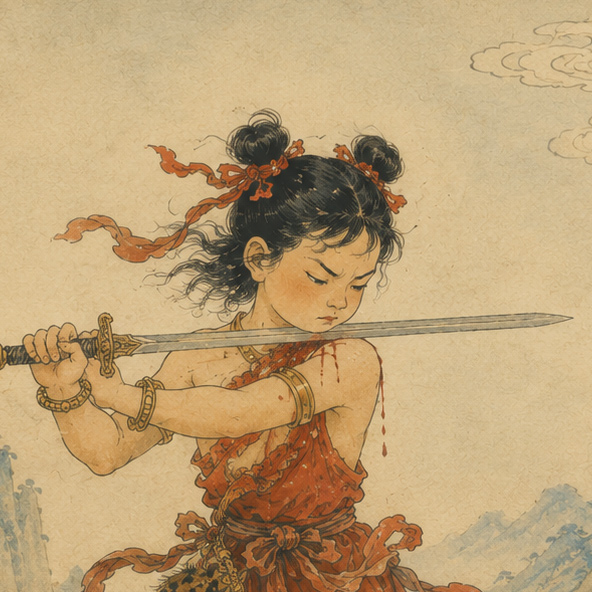
In one of the most dramatic scenes in Investiture of the Gods, Nezha declared that his body had been given to him by his parents. If the Dragon Kings sought retribution for the blood he had shed, he alone should bear the consequences. Standing before his family, he drew his sword and proclaimed that he would “return the flesh to the mother and the bones to the father,” repaying the debt of birth so that no grievance would remain between them.
He then cut away his own flesh and returned it to Lady Yin before breaking his bones and returning them to Li Jing. Through this unimaginable sacrifice, Nezha gave up the mortal body his parents had bestowed upon him. His death ended the immediate crisis and saved both his family and the people of Chentang Pass from the vengeance of the Dragon Kings.
Yet Nezha’s sacrifice was not simply an act of obedience. It embodied two seemingly contradictory ideals that would define his legend. By repaying the debt of birth, he fulfilled the Confucian virtue of filial piety. At the same time, by choosing death on his own terms rather than surrendering to overwhelming authority, he preserved his dignity and moral independence. The scene has therefore been interpreted not only as an expression of filial devotion, but also as one of the most powerful acts of personal sacrifice in Chinese literature.
Although his body had perished, Nezha’s spirit did not vanish. Freed from his mortal form but unable to enter the cycle of ordinary death, he wandered between the human and celestial worlds, awaiting the intervention of his immortal master. His extraordinary sacrifice thus marked not the end of his story, but the beginning of an even greater transformation.
Before long, Taiyi Zhenren would fashion a new body for his disciple from lotus flowers and lotus roots, allowing Nezha to return to the world no longer as an ordinary human child, but as an immortal warrior destined to fulfill heaven’s mandate.