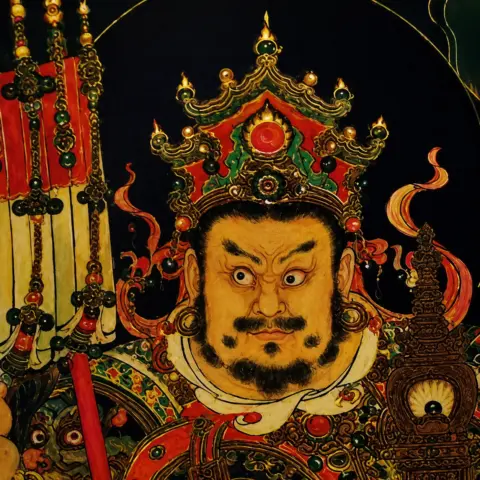
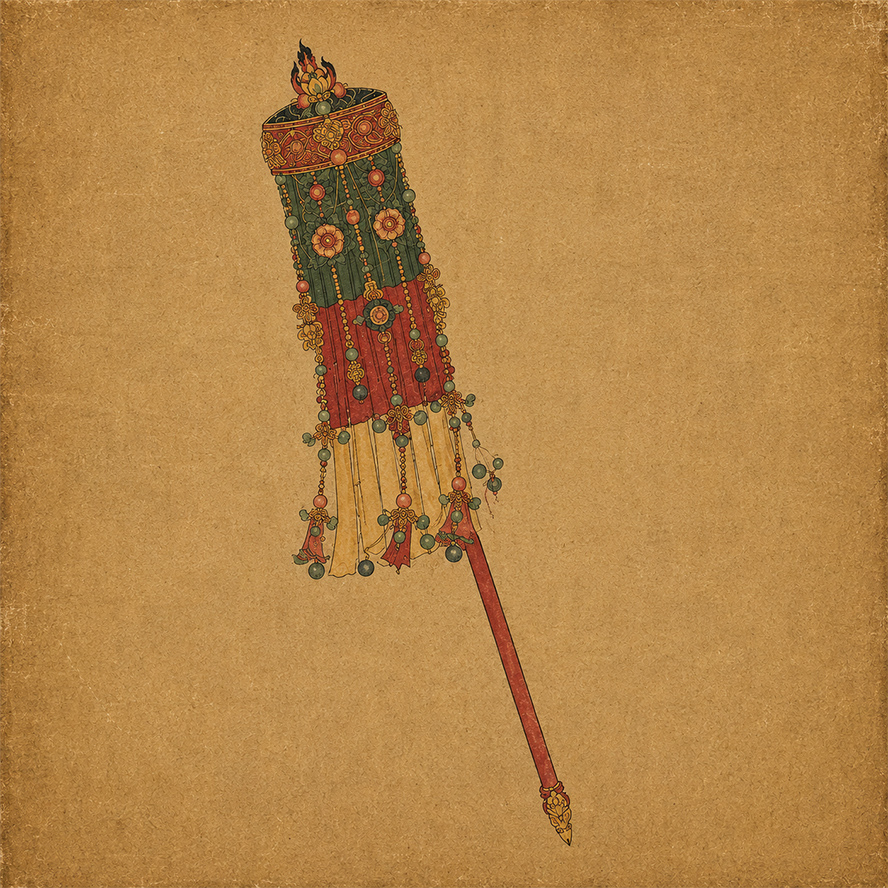
Duowen Tianwang, also known as the God of Wealth, was known as Mo Lihong before his deification in Fengshen Yanyi. He was one of the Four Generals of Jiameng Pass. Across Buddhist tradition, mythological legend, and Chinese folk belief, the sacred parasol in his hand has remained one of his most important attributes, accumulating layers of sacred meaning and legendary power over time.
Buddhism: The Parasol of Divine Protection
In Buddhist tradition, the sacred parasol (Sanskrit: chatra) symbolizes dignity, protection, and divine guardianship. Just as a parasol shields against the sun and rain, it represents protection from afflictions, obstacles, and harmful forces.
Duowen Tianwang guards the North and is one of Buddhism’s great protector kings. His parasol shelters living beings and wards off evil and spiritual obstacles. In Tibetan Buddhism, he is also widely revered as a deity of wealth, closely associated with prosperity, merit, and abundance. The parasol therefore also represents his power to protect blessings and prosperity and to deliver beings from hardship.
Fengshen Yanyi: The Hunyuan Pearl Parasol
In Fengshen Yanyi, before becoming Duowen Tianwang, he was known as Mo Lihong, and his sacred parasol was called the Hunyuan Pearl Parasol, a magical weapon of extraordinary power.
The parasol is adorned with precious pearls and jewels arranged in nine layers and contains the mysteries of the ever-changing forces of Heaven and Earth. When opened, it can darken the heavens, obscure the sun and moon, and unleash a tremendous power of capture, drawing an enemy’s weapons and magical treasures into the parasol.
In Mo Lihong’s hands, the parasol therefore becomes more than an instrument of protection. It is a formidable divine weapon capable of overwhelming the battlefield and seizing the treasures of his opponents. After Mo Lihong falls in battle and is deified as Duowen Tianwang, the parasol remains one of the defining symbols of his identity.
Folk Tradition: The “Rain” in “Favorable Winds and Timely Rains”
In Chinese folk belief, the Four Heavenly Kings and their attributes acquired another distinctly Chinese layer of symbolism: the blessing of “favorable winds and timely rains” (feng tiao yu shun).
Zengzhang Tianwang carries a sword, whose cutting edge (feng) evokes “wind” (feng); Chiguo Tianwang carries a pipa, whose strings must be tuned (tiao); Guangmu Tianwang holds a dragon or serpent, representing harmony and smoothness (shun); and Duowen Tianwang carries a parasol, an object associated with rain (yu).
Together, the Four Heavenly Kings embody one of the most enduring wishes of traditional Chinese society: favorable weather, abundant harvests, and peace throughout the land.
From the sacred parasol that shelters living beings in Buddhism, to the Hunyuan Pearl Parasol wielded by Mo Lihong as a weapon capable of shaking Heaven and Earth and capturing magical treasures, and finally to the auspicious parasol representing “rain” in Chinese folk tradition, this attribute has evolved alongside the legend of Duowen Tianwang and become one of his most recognizable symbols.