
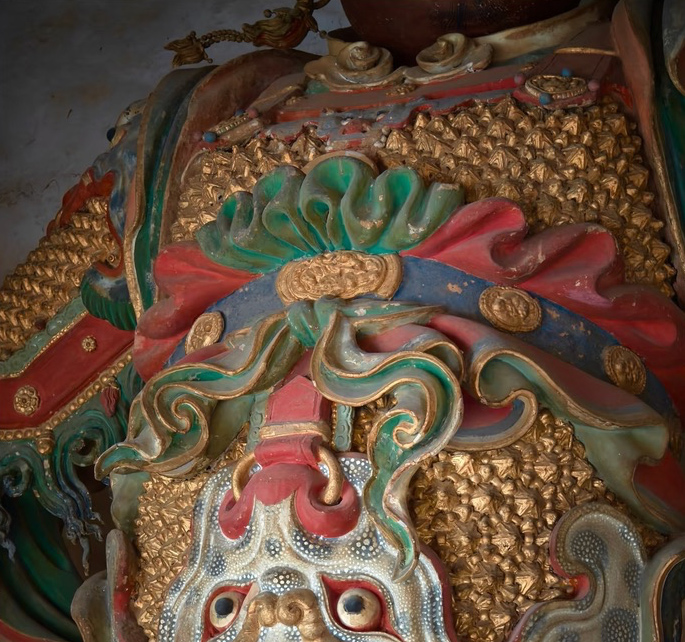
The visual differences between forms of Chinese armor do not come only from the shape of each plate. They also come from the way the plates are linked, overlapped, laced, and arranged.
The same metal plates can create entirely different surfaces when organized in different ways. One construction may look continuous, flexible, and finely worked; another may feel heavy, rugged, and forceful. Some emphasize order and institutional discipline, while others resemble a living field of scales.
Within the CG Armor & Attire system, Armor Surface Construction is therefore more than a technical classification. It is an important part of a figure’s visual identity.
Ring-Linked Construction
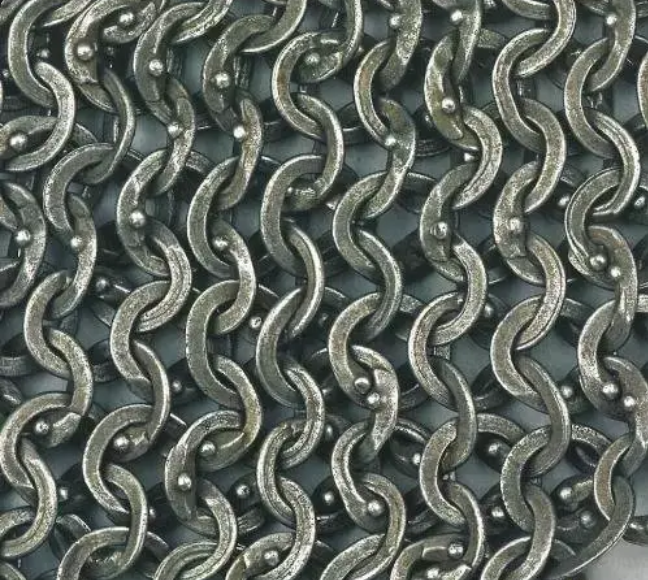
Ring-linked construction joins neighboring plates with metal rings, small linking loops, or comparable connectors.
The resulting surface does not become a completely rigid sheet. The connections preserve a degree of play, allowing individual plates to rotate or shift slightly as the body moves. This creates a metal surface that can appear continuous, dense, and flexible at the same time.
Visually, ring-linked armor most readily conveys a combination of overall density and local movement.
In CG Visual Language, it tends to express flexibility, continuity, fine detail, and technical sophistication.
It is especially useful when the armor needs to suggest complex workmanship, refined manufacture, or a high degree of mobility.
Y-Shaped Shanwen Interlocking Construction
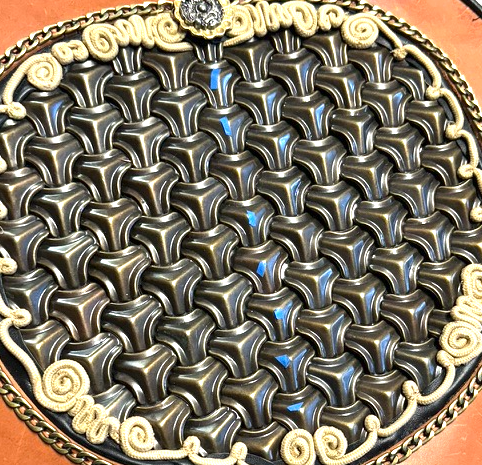
The defining visual feature of Shanwen armor is not only that an individual plate may resemble the character shan, a V, or a chevron. Its identity comes from the continuous interlocking surface formed when many plates engage with one another.
The viewer does not first perceive isolated plates. Instead, the eye reads a repeating geometric field that locks together and extends across the body.
This surface is distinctive. It does not emphasize each large scale individually, and it does not present the clear horizontal tiers of lamellar armor. It behaves more like a continuously generated metallic textile.
On a figure, Shanwen construction can therefore feel disciplined, steady, complex, ordered, and slightly mysterious.
In CG Visual Language, it tends to support a commanding, composed, strategic figure with a strong sense of rank and presence.
One boundary must remain clear. CG may discuss possible interlocking methods through physical reconstruction, visual observation, and structural logic, but a single reconstructed fastening method must not be presented as the universal historical solution for every period.
When the discussion moves into a specific connection mechanism, it should be identified as a CG Reconstruction Hypothesis rather than established historical fact.
Large Fish-Scale / Wuchui-Style Construction
A surface built from large scales moves in the opposite visual direction from Shanwen armor.
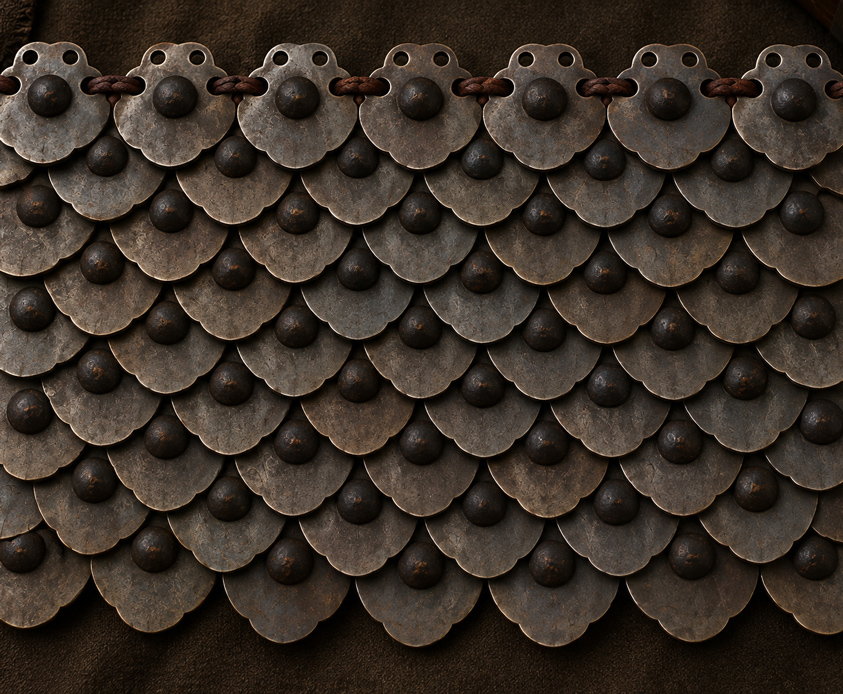
Here the viewer can clearly distinguish one plate from the next. The plates have greater area, a pronounced rhythm, and stronger overlap, giving the surface greater mass and volume.
When the scales are thick, sharply edged, dark in color, or strongly hammered in appearance, the armor communicates weight and power very directly.
This construction does not try to make the individual plate disappear. Each plate actively contributes to the figure’s shape.
The resulting character is more likely to feel rugged, fierce, heavy, and dramatically forceful.
In CG Visual Language, large fish-scale or heavy Wuchui-style surfaces suit figures who need frontal impact, the temperament of a fierce general, and an unmistakable physical presence.
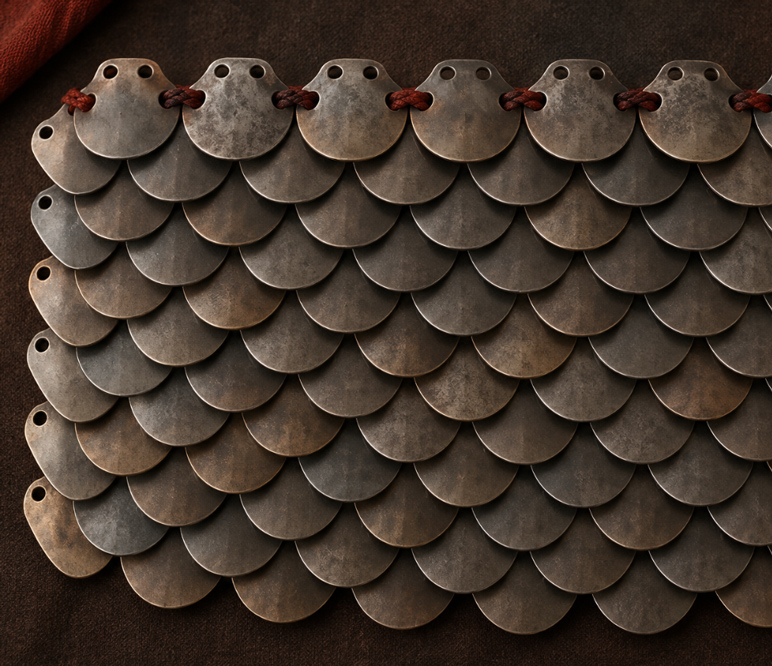
Small Fish-Scale Construction
Large and small fish-scale surfaces belong to the same broad visual family, but they create very different impressions.
As the plates become smaller and more densely arranged, the importance of each individual plate recedes. The overall field becomes more even, refined, and continuous.
The surface retains the directional overlap of scale armor without producing the same heavy blocks of mass associated with large plates.
Small fish-scale construction therefore tends to feel compact, agile, controlled, and reliable.
It does not overpower the figure. Instead, it works as a stable, mature, and highly resolved armor language.
Within CG character design, it is well suited to figures whose identity depends more on efficiency, technique, mobility, and steadiness than on exaggerated displays of brute force.
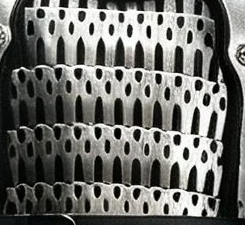
Lamellar Lacing Construction
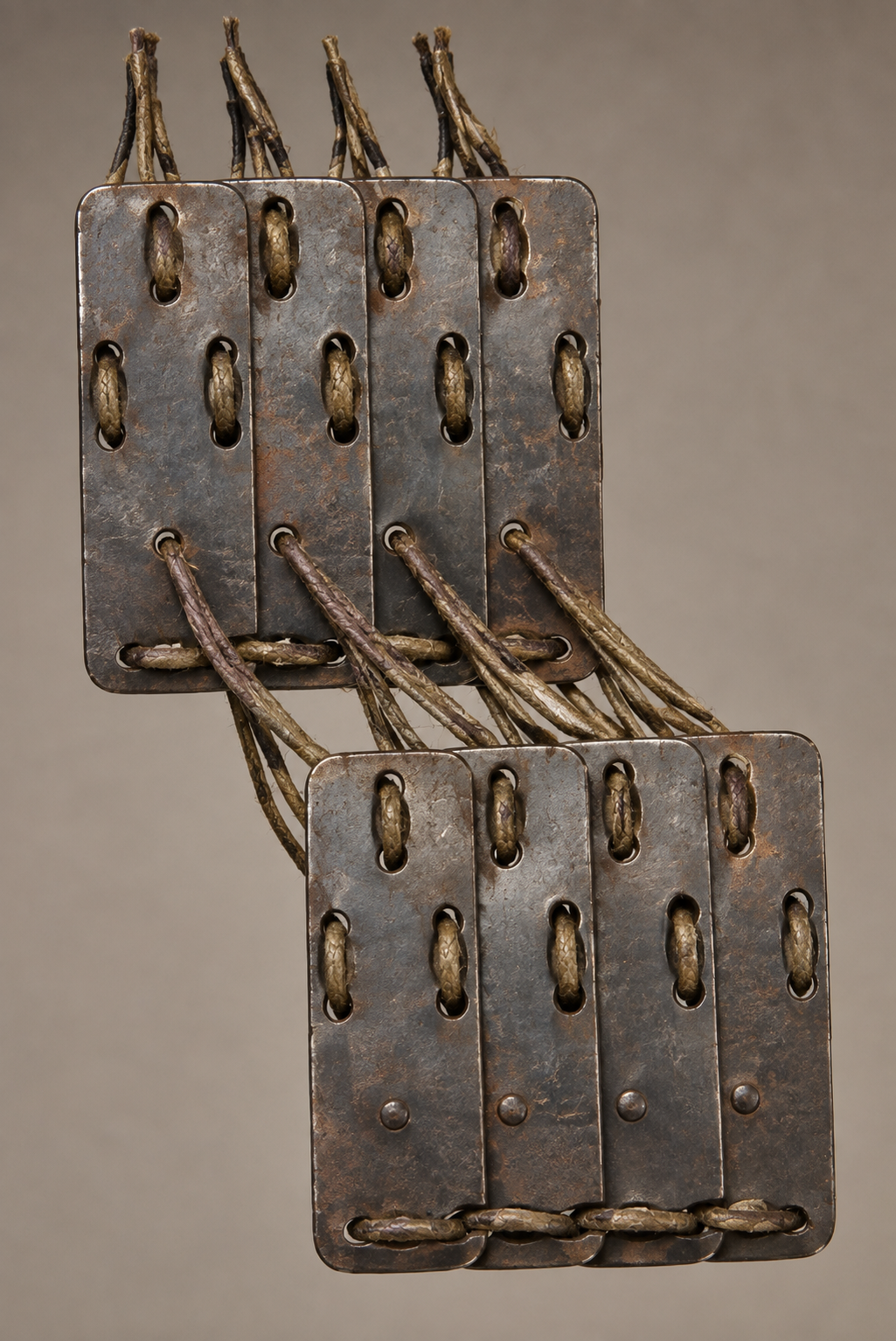
The visual core of lamellar armor is the organization of many narrow or regular plates into clearly ordered rows and columns.
Unlike the continuous interlocking field of Shanwen armor, lamellar construction usually makes its horizontal tiers, repeated rows, and lacing order easy to read.
The viewer can clearly sense that the plates have not grown together naturally. They have been organized, aligned, and connected into a system.
This gives lamellar construction a strong institutional visual character.
It often makes a figure appear properly equipped, orderly, well supplied, and part of a formal military structure.
In CG Visual Language, lamellar lacing tends to express a regular army, institutional order, organization, and heavy equipment.
The impression of a military system becomes especially strong when the plates are uniform, the rows are precise, and the edges remain clearly defined.
Armor Surface Is Character Language
From the CG perspective, the most important difference between these constructions is not which one is technologically “more advanced,” nor is it simply a question of which one is stronger.
What matters is how each surface changes the figure’s apparent speed, weight, rhythm, order, and identity.
Replace Shanwen with large fish scales and the same figure immediately becomes rougher and more forceful. Replace large scales with small scales and the figure becomes leaner and more controlled. Lamellar lacing strengthens the sense of military organization, rank, and standardized equipment. Ring-linked construction gives the armor greater continuity, flexibility, and a more technical finish.
Choosing an armor surface is therefore not a final layer of decoration in CG. It decides how the character occupies the image.
The governing principle is simple: armor surface construction directly shapes a figure’s visual weight, speed, rhythm, and identity.