Birth • Rebellion • Sacrifice • Rebirth • Apotheosis
For more than a thousand years,
the story of Nezha has been continuously retold through
religion, literature, theater, and popular imagination.
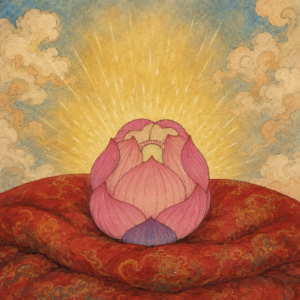
Birth of Nezha.
Lady Yin gave birth to a ball of flesh after carrying the child for three years and six months.
BIRTH
The Child Born from a Ball of Flesh
Keywords: Prophecy · Incarnation · Supernatural Birth
Nezha was born at Chentang Pass during the Shang dynasty as the earthly incarnation of Lingzhu Zi, destined to assist the Zhou conquest of Shang. After Lady Yin carried him for three years and six months, she gave birth not to a child, but to a ball of flesh. When Li Jing struck it with his sword, a fully formed boy emerged. Nezha could walk and speak immediately after birth and was later accepted as the disciple of Taiyi Zhenren.
Themes: miraculous birth, destiny, divine incarnation.
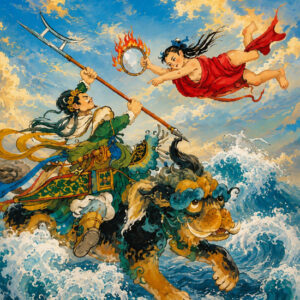
Rebellion in the Eastern Sea.
Soon after his miraculous birth, Nezha confronts Ao Bing, the Third Prince of the Dragon King, in one of the defining battles of his early legend.
REBELLION
The Battle of the Eastern Sea
Keywords: Defiance · Dragons · Violence
At the age of seven, Nezha disturbed the Dragon King’s underwater palace while bathing in the Jiuwan River. He killed the Yaksha Li Gen and later slew Ao Bing, the third son of the Dragon King of the East Sea, using the Qiankun Ring. This event triggered a conflict between Nezha, the Dragon Kings of the Four Seas, and the heavenly bureaucracy itself.
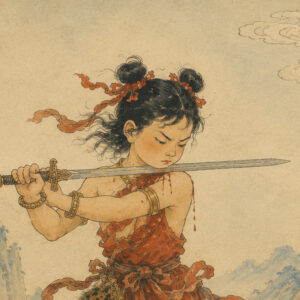
The Sacrifice of Nezha.
To protect the Li family from the vengeance of the Dragon Kings, Nezha cut away his own flesh and returned his bones to his parents, becoming one of the most iconic tragic heroes in Chinese mythology.
SACRIFICE
Returning Flesh to the Mother, Bones to the Father
Keywords: Filial Piety · Self-Sacrifice · Redemption
When the Dragon Kings demanded punishment and threatened the Li family, Nezha chose to sacrifice himself. In one of the most famous scenes in Chinese mythology, he cut off his own flesh and returned it to his mother, and broke his bones to return them to his father, repaying the debt of birth and saving his family from destruction.
Themes: filial piety, self-sacrifice, tragic heroism.
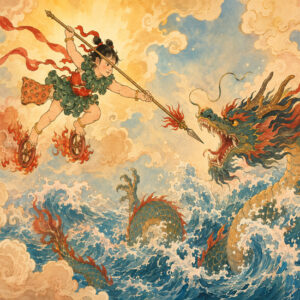
Nezha’s Lotus Rebirth.
Restored to life through a body fashioned from lotus roots, Nezha received the Wind Fire Wheels and the Fire-Tipped Spear from Taiyi Zhenren. Reborn with divine power, he resumed his legendary struggle against the Dragon Kings of the Eastern Sea.
REBIRTH
The Lotus Body
Keywords: Resurrection · Transformation · New Identity
After his death, Nezha’s spirit sought refuge through a temple secretly built by his mother. Following its destruction by Li Jing, the conflict between father and son deepened. Taiyi Zhenren eventually restored Nezha to life by constructing a new body from lotus roots and bestowed upon him the Wind Fire Wheels and Fire-Tipped Spear.
Themes: death and rebirth, spiritual transformation, divine empowerment.
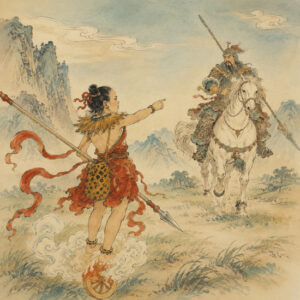
Nezha and Li Jing: Father and Son
Following his resurrection, Nezha openly defied his father, Li Jing, leading to one of the most famous father-son conflicts in Chinese mythology. Their eventual reconciliation became a lasting symbol of authority, family, and cosmic order.
Illustration based on the Ming-dynasty novel Fengshen Yanyi.
FATHER AND SON
The Conflict with Li Jing
Keywords: Authority · Family · Reconciliation
After his resurrection, Nezha repeatedly confronted his father, Li Jing. Their conflict escalated into open combat and could only be resolved through the intervention of powerful immortals and Buddhas. Different traditions explain this reconciliation differently, but most conclude with Li Jing becoming the Pagoda-Bearing Heavenly King and Nezha accepting the cosmic order.
Themes: father-son conflict, authority, reconciliation.
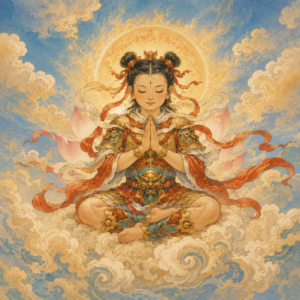
The Apotheosis of Nezha.
Having overcome death, rebellion, and suffering, Nezha attained his divine identity as the Celestial Marshal, becoming one of the most revered warrior deities in Chinese religion.
APOTHEOSIS
From Rebellious Child to Celestial Marshal
Keywords: Apotheosis · Command · Divine Order
Following his trials, Nezha emerged as one of the most important warrior deities in Chinese religion. In Daoist tradition he became the Marshal of the Central Altar (中坛元帅), while later traditions honored him as the Great God of the Three Altars and Seas (三坛海会大神), commander of heavenly armies and protector of cosmic order.
Themes: transcendence, military authority, divine kingship.