
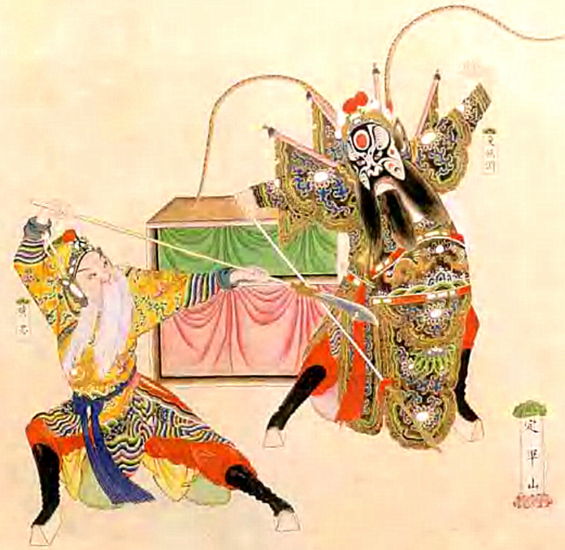
A Back Banner is a back-mounted banner or identifying flag carried behind an armored warrior.
It can support recognition within a formation, mark identity, transmit command, and display martial authority. In later opera, storytelling, and warrior painting, it developed into a highly conventionalized visual symbol.
The best-known form today is the group of banners carried behind the rigid armor costume of a traditional opera general.
That stage form is not a simple copy of an ancient military banner. It is the result of a long process of artistic development based on military back banners, command flags, identifying flags, and the broader visual tradition of the warrior.
Back Banners in Historical Armies
Chinese armies did use flags fixed behind soldiers or officers.
In the Ming military manual Lianbing Shiji, Qi Jiguang distinguishes identification devices used by different ranks in the cavalry.
These include:
- ordinary soldiers whose helmets carried tassels but no flag
- team leaders using small helmet flags
- banner leaders carrying one back flag
The text also specifies dimensions for the flag and its staff.
This evidence shows that by the Ming, a back banner could form part of a formal military identification system. It was not an ornament invented entirely by later opera.
In a historical military setting, the back banner should therefore be understood first as equipment within systems of battlefield recognition, rank, and command.
A Warrior’s Personal Identifier
In literature, a small flag carried with a warrior could also serve as a personal identifier.
Water Margin describes Dong Ping going into battle with small flags placed near his bow case and quiver, bearing words that identify him by title.
This is literary imagery rather than a military regulation, but it shows that Ming readers could readily understand a warrior carrying a small flag marked with a name, title, or other identifying information.
Such a flag differs from a large formation banner. It functions more like an individual marker, allowing viewers at a distance to recognize who the warrior is, which unit he belongs to, or what identity he represents.
Why Place the Flag Behind the Body?
Large battlefields are crowded, dusty, smoky, and filled with armored figures whose outlines may look similar.
Raising an identifying sign above shoulder level makes it easier for nearby soldiers to see than a small mark placed on the chest or waist.
Mounting or inserting a banner behind the body therefore offers an immediate practical advantage for visual recognition.
Comparable logic appears in other military cultures. Japanese sashimono of the Sengoku period placed a crest or other identifying sign behind the armor.
Sashimono is not presented here as the source of the Chinese Back Banner. It serves only as a clear comparison showing that lifting an identifying symbol above the body can have a practical battlefield function.
From Military Back Banner to Opera Banner
As martial figures moved onto the theatrical stage, back banners became increasingly conventionalized and exaggerated.
The rigid armor costume of Beijing opera often carries several triangular banners behind the performer.
These banners greatly enlarge the upper-body silhouette, allowing the performer to project the identity of a fully armed commander even at a distance.
Qing theatrical sources already use terms for back flags, back command flags, and quiver flags.
Later stage banners became more elaborate in number, scale, spread, and decoration.
Opera banners are therefore best understood as a conventionalized stage form produced by the long theatrical transformation of the military back-banner tradition.
Did the Back Banner Protect the Back?
The modern Chinese name hubeiqi can easily be read as a flag that protects the back.
Current evidence is not sufficient to establish that the banner itself primarily functioned like armor against weapons.
CG therefore does not classify it as actual defensive armor.
Historical records, literary descriptions, and theatrical traditions instead support a combination of functions:
- battlefield recognition
- identity marking
- command
- ceremonial display
- the visual identity of the warrior
Number and Form
Historical military back banners were not uniformly required to appear in sets of four.
Different traditions and images may show:
- one back banner
- two small flags
- helmet flags
- small flags near a bow case or quiver
- identifying flags mounted on a back frame
- ceremonial back banners
- several large opera banners
The four-banner arrangement is principally a mature form within later theatrical costume. It should not be treated as a universal historical standard for all armored warriors.
CG Interpretation
CG records the Back Banner as an independent Armor & Attire Subject.
Its core definition is a flag mounted, inserted, or fixed behind a warrior for battlefield recognition, identity marking, command, or the display of martial authority.
CG treats historical military back banners and later opera banners as different stages within one broad martial visual tradition, while keeping the two forms distinct.
A historically grounded character may carry one or two smaller identifying flags.
A character shaped more strongly by storytelling, romance, or opera may use a larger and more decorative group of banners.
Dong Ping already carries identifying flags in the novel. Multiple large banners used for Luo Cheng, Yang Zongbao, Mu Guiying, or similar figures belong more clearly to the legendary visual language developed through storytelling, opera, and traditional martial imagery.
CG Visual Language
One of the Back Banner’s most important visual effects is its ability to change the silhouette of the upper body.
One or two small flags can:
- remain close to military identification
- emphasize individual identity
- preserve a relatively realistic battlefield scale
Several large, widely spread banners can:
- expand the figure’s silhouette
- strengthen a sense of command
- increase ceremonial presence
- signal a fully armed state of battle readiness
- heighten theatrical impact
For CG, the Back Banner is therefore more than an ornament placed behind the body.
It is a component capable of changing the entire visual identity of a martial figure.
Short Definition
A Back Banner is a flag mounted or inserted behind a warrior. Historically it could support battlefield recognition, identity marking, and command; in later opera it developed into the banner arrangement that signifies a fully armed general prepared for battle.