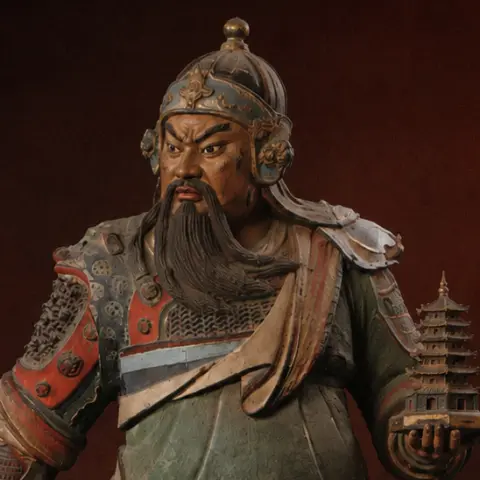
The Exquisite Pagoda is one of Li Jing’s most important signature treasures and the object that gives the Pagoda-Bearing Heavenly King his instantly visual identity. In Investiture of the Gods and later mythological narrative and deity imagery, Li Jing often appears as a commander or protector. The pagoda gathers his martial authority and suppressive power into one clear emblem.
How to Recognize It
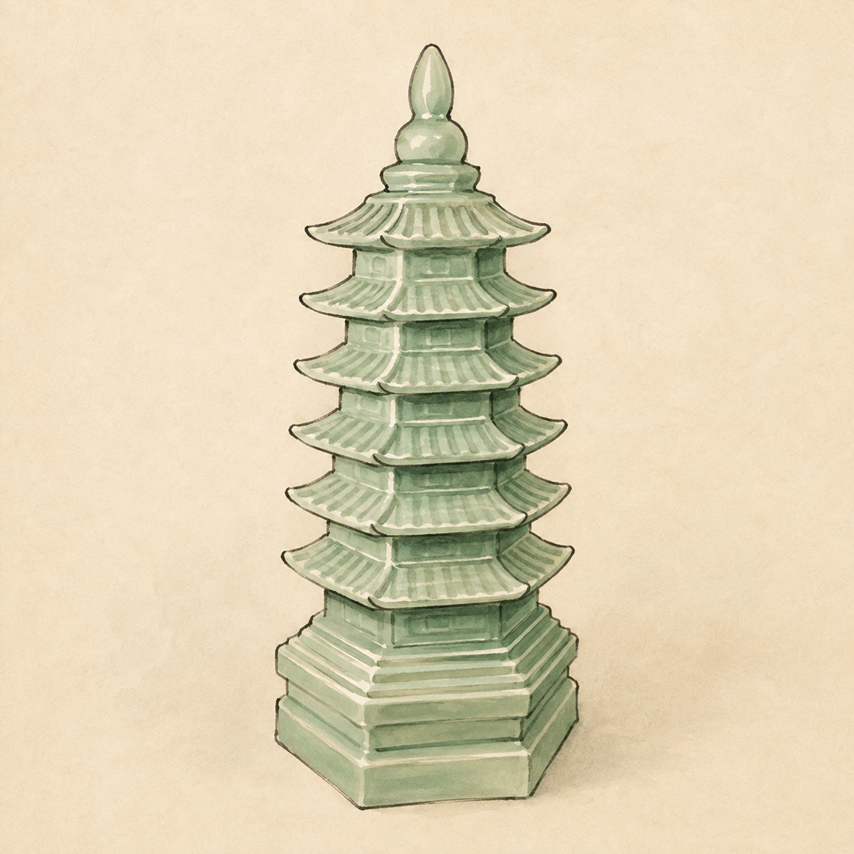
The Exquisite Pagoda is first of all a small, tiered tower that can be held in the hand or raised aloft. Look for a stable base, stacked projecting eaves, a body that narrows upward, and a finial at the top. It should retain the overall language of a traditional Chinese pavilion-style pagoda. No single number of stories needs to be fixed, and every architectural detail does not need to become canon. See the CG illustration for the selected structure and ornament.
The Pagoda’s Power
It is not an ordinary architectural model but a magical treasure associated with containment, suppression, and command. Individual stories do not always describe its use in exactly the same way, so this page keeps to the stable core. The pagoda turns Li Jing’s authority into visible divine power, presenting him not only as an armored general but also as a protector capable of maintaining celestial order.
Li Jing and the Pagoda
Many heavenly generals may wear armor, carry weapons, or wear formal headgear. A pagoda held in the hand immediately separates Li Jing from them. It functions almost as his visual name tag: even at a small scale, a clear tiered silhouette creates a direct connection between the pagoda and Li Jing. See the illustration for the CG visual interpretation.