Lotus Rebirth
After sacrificing his life by returning his flesh to his mother and his bones to his father, Nezha’s spirit did not perish. Instead, it found refuge within a small temple on Cuiping Mountain, where local people worshipped him as a protective deity.
Lady Yin, unable to forget her son, secretly continued to offer incense at the shrine. When Li Jing discovered this, he believed that Nezha’s spirit should no longer receive mortal worship. Viewing the temple as an act of defiance against heaven’s order, he destroyed the shrine and burned the statue that housed Nezha’s soul.
With his spiritual refuge gone, Nezha’s spirit wandered helplessly until he returned to his master, Taiyi Zhenren, at Jinguang Cave on Mount Qianyuan.
Knowing that Nezha’s destiny had not yet ended, Taiyi gathered lotus flowers and lotus leaves, constructing a new body from the sacred plant. Through Daoist magic, flesh grew from lotus petals, bones formed from lotus roots, and Nezha was reborn with an immortal body.
This miraculous resurrection became one of the defining moments of Nezha’s mythology. No longer bound to the mortal body given to him by his parents, he became known as the Lotus Incarnation, a celestial being whose existence transcended ordinary human birth.
Seeking Revenge
Upon receiving his new body, Nezha did not immediately join the campaign to assist King Wu of Zhou.
Instead, he sought revenge.
In his mind, he had already repaid his parents by returning the flesh and bones they had given him. The debt between father and son had been settled. Yet Li Jing had gone further, destroying the temple that preserved his spirit and nearly condemning him to eternal extinction.
To Nezha, this was no longer a family dispute—it was attempted murder.
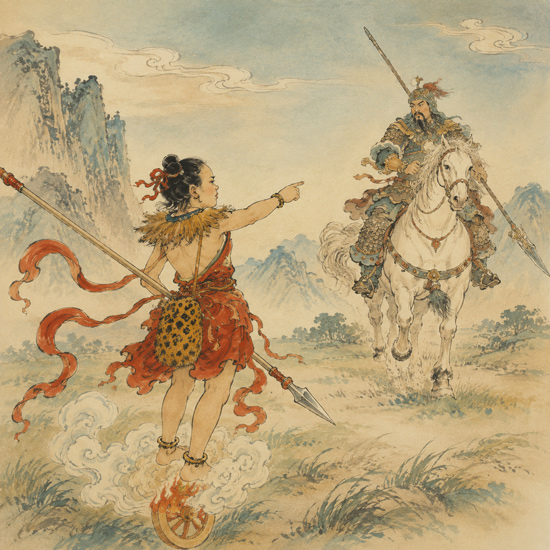
Armed once again with the Fire-Tipped Spear and riding upon the Wind-and-Fire Wheels, he descended the mountain in pursuit of his father.
The First Confrontation
By this time, Li Jing had already joined the forces of Western Zhou.
Their reunion was not one of reconciliation.
The moment Nezha found him, he attacked without hesitation.
Although Li Jing was himself a skilled warrior and cultivator, he was no match for Nezha’s newly acquired lotus body and supernatural powers. Forced into retreat, Li Jing fled while Nezha relentlessly pursued him.
Muzha’s Intervention
During Li Jing’s escape, Muzha arrived to stop the conflict.
As Nezha’s elder brother and a disciple of Manjusri Guangfa Tianzun, Muzha hoped to prevent further bloodshed within the family. He challenged Nezha in an attempt to protect their father.
However, Nezha’s powers had grown tremendously after his resurrection.
Even Muzha could not defeat him.
After a brief battle, Muzha was forced to withdraw, leaving Li Jing to continue his desperate flight.
The Pagoda
As Li Jing’s situation became increasingly hopeless, the immortal Randeng Daoren (Dipankara) appeared.
Rather than destroying Nezha, Randeng understood that both father and son were destined to play essential roles in the heavenly plan. Endless conflict between them would only disrupt the fulfillment of destiny.
To preserve that destiny, Randeng bestowed upon Li Jing a powerful magical treasure—the Golden Pagoda, later known as the Exquisite Golden Pagoda (Linglong Pagoda).
He instructed Li Jing that if Nezha attacked again, the pagoda alone could restrain him.
Soon afterward, Nezha confronted his father once more.
This time, Li Jing raised the pagoda.
Golden light poured from the treasure, trapping Nezha within its countless heavenly chambers. Though immensely powerful, Nezha found himself unable to escape its divine restraint.
For the first time since his rebirth, he had been completely subdued.
Taiyi Zhenren
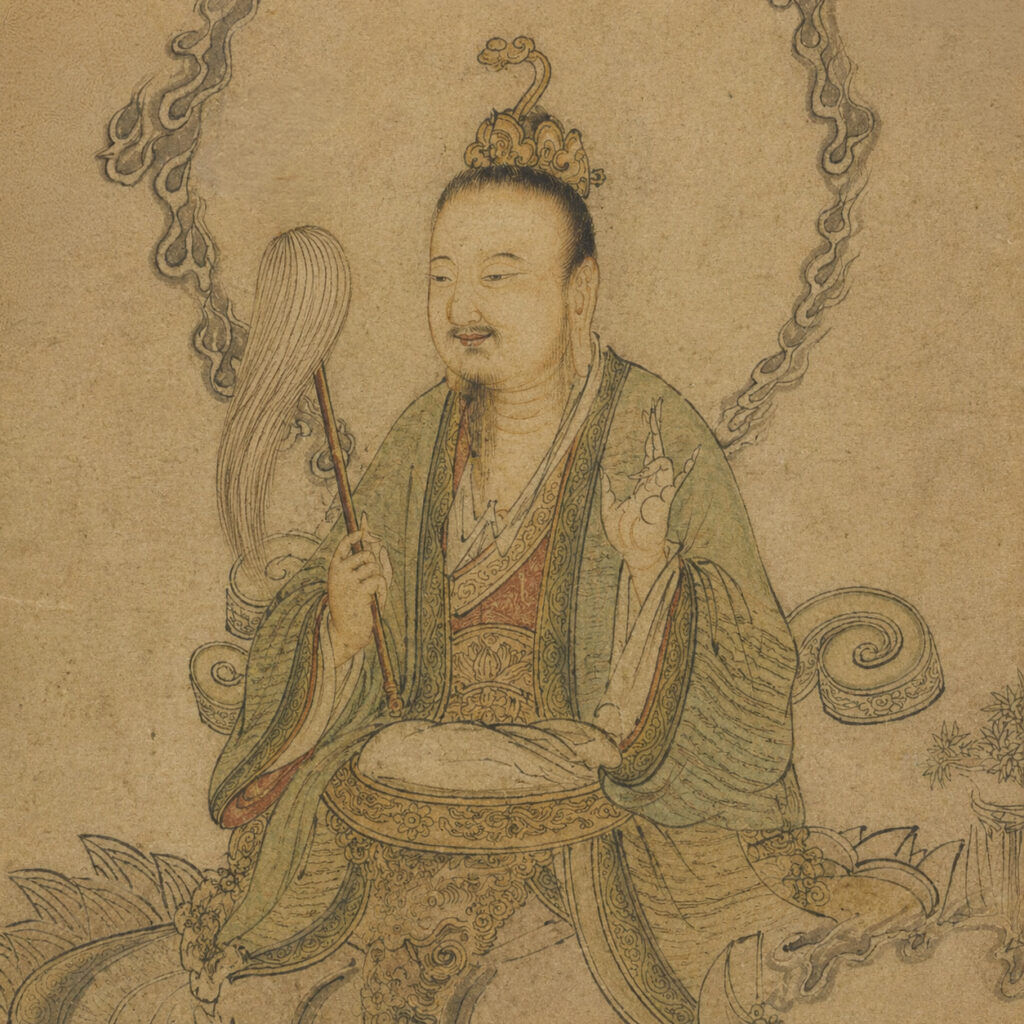
Nezha’s immortal master and unwavering protector. From bestowing divine treasures to restoring Nezha’s life with a lotus body, Taiyi Zhenren shaped every stage of his disciple’s legendary journey.
Reconciliation
Even after escaping the pagoda, Nezha remained unwilling to forgive his father.
At this point, Taiyi Zhenren intervened.
The immortal reminded his disciple that both he and Li Jing were bound by Heaven’s Mandate. Their destinies were intertwined in the coming war against the Shang dynasty. To continue pursuing vengeance would not only violate his master’s teachings but also oppose the greater order of Heaven.
At the same time, Randeng advised Li Jing that Nezha had already become an immortal and should no longer be judged as an ordinary son.
Gradually, the hatred between father and son subsided.
Nezha abandoned his pursuit of revenge and once again acknowledged Li Jing as his father. Li Jing, in turn, accepted Nezha not merely as the child he had once raised, but as a celestial warrior destined to fulfill Heaven’s will.
From that day forward, Li Jing carried the Golden Pagoda wherever he went.
Because of this sacred treasure, he came to be known throughout later Chinese tradition as the Pagoda-Bearing Heavenly King (Tuota Tianwang).
Significance
The conflict between Nezha and Li Jing is far more than a story of family discord. It marks one of the most profound transformations in Chinese mythology.
By receiving a lotus body, Nezha symbolically severed the physical bond between himself and his parents. His rebellion against Li Jing was therefore not merely an act of filial defiance, but a declaration of personal independence from the obligations of mortal birth.
Li Jing, meanwhile, embodies paternal authority, social order, and cosmic hierarchy. Their conflict represents the tension between individual freedom and established authority—a theme that has resonated through Chinese literature, theater, religious art, and popular culture for centuries.
Notably, The Investiture of the Gods does not allow either side to achieve complete victory. Nezha does not kill his father, nor does Li Jing truly conquer his son. Instead, the conflict is resolved through the intervention of higher spiritual authority, represented by Taiyi Zhenren and Randeng Daoren. Under Heaven’s Mandate, personal resentment ultimately gives way to cosmic order.
This reconciliation not only explains why Li Jing became the famous Pagoda-Bearing Heavenly King, but also marks Nezha’s first true step from rebellious child hero toward the celestial marshal and guardian deity he would later become.