
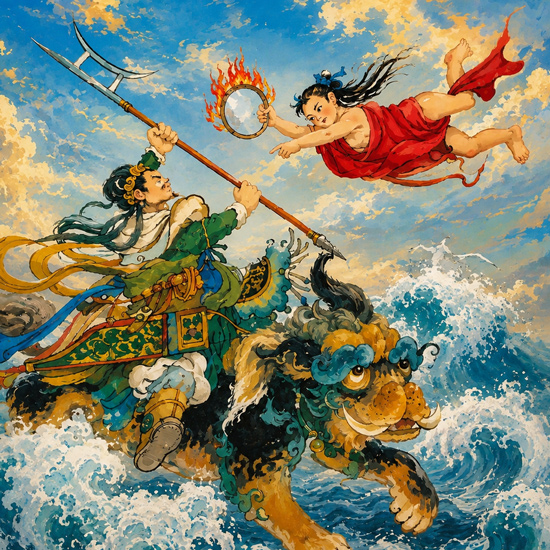
The Battle of the Eastern Sea
By the age of seven, Nezha had already spent several years studying under Taiyi Zhenren on Mount Qianyuan. Gifted with extraordinary strength and armed with the Huntian Ribbon and the Qiankun Ring, he possessed powers far beyond those of ordinary mortals. Yet despite his divine abilities, he remained an impulsive and fearless child, quick to confront injustice and never willing to yield to intimidation.
One summer day, Nezha went to bathe in the Jiuwan River near Chentang Pass. Amused, he cast the Huntian Ribbon into the water. As a celestial treasure, the ribbon stirred the currents with overwhelming force, sending waves surging through the rivers and into the Eastern Sea. The disturbance reached the underwater Dragon Palace, where the Dragon King of the Eastern Sea believed that an enemy had invaded his domain.
To investigate, the Dragon King dispatched the Yaksha general Li Gen. Upon arriving at the riverbank, Li Gen found only a young boy at play. Instead of seeking an explanation, he attempted to seize Nezha and bring him before the Dragon King. Nezha refused to submit, and a fierce fight broke out. Wielding the Qiankun Ring, he struck down Li Gen with a single blow.
When Li Gen failed to return, the Dragon King sent his third son, Prince Ao Bing, accompanied by dragon soldiers, to discover what had happened. Outraged by the death of the Yaksha, Ao Bing challenged Nezha to battle. Although the Dragon Prince was a formidable warrior, he proved no match for the disciple of Taiyi Zhenren. After a violent duel, Nezha hurled the Qiankun Ring, killing Ao Bing. He then removed the dragon prince’s sinew and carried it home, intending to use it as a belt for his armor.
The death of his son plunged the Dragon King into grief and fury. He immediately joined forces with the Dragon Kings of the South, West, and North Seas and appealed to the Heavenly Court for justice. At the same time, the Four Dragon Kings descended upon Chentang Pass, demanding that Li Jing surrender his son. Should he refuse, they threatened to unleash floods and tidal waves that would destroy the city and drown its innocent inhabitants.
Li Jing found himself trapped between two impossible responsibilities. As Nezha’s father, he wished to protect his son. As commander of Chentang Pass, he bore responsibility for the lives of countless civilians. Desperate to prevent disaster, he sought to appease the Dragon Kings and contain the growing conflict.
Nezha, however, saw the matter differently. In his eyes, both Li Gen and Ao Bing had initiated the violence, and he had merely defended himself. He refused to admit wrongdoing simply because his opponents were powerful. His uncompromising sense of justice and fearless defiance would become defining traits throughout his legend, but they also pushed the conflict far beyond a personal dispute.
What had begun as a confrontation between a child and the Dragon King’s servants soon escalated into a crisis involving the Four Seas, the Heavenly Court, and the fate of an entire city. For the first time, Nezha realized that his actions could determine not only his own destiny, but also the survival of everyone around him.
To end the catastrophe threatening Chentang Pass, Nezha would soon make one of the most extraordinary sacrifices in Chinese mythology—returning his flesh to his mother and his bones to his father. That decision would forever transform both his destiny and his relationship with his family.