The Lotus Body
After returning his flesh to his mother and his bones to his father, Nezha’s mortal body perished, but his spirit endured. No longer bound to the physical form into which he had been born, his soul wandered the world without a place to rest. Though he had sacrificed himself to save his family and Chentang Pass, his journey was far from over.
Lady Yin, unable to forget her son, secretly built a small shrine on Mount Cuiping, where local people began offering incense to Nezha’s spirit. As word of his miracles spread, the shrine gradually became a place of worship. Yet Li Jing believed that his son’s restless spirit should no longer receive mortal devotion. Fearing that continued worship would invite further disaster, he destroyed the shrine and burned the statue that sheltered Nezha’s soul.
Homeless once again, Nezha’s spirit wandered until it returned to his immortal master, Taiyi Zhenren, at Jinguang Cave on Mount Qianyuan. Having foreseen that Nezha’s destiny had not yet reached its end, Taiyi resolved to restore his disciple to life.
Gathering lotus flowers, lotus leaves, and lotus roots from a sacred pond, Taiyi Zhenren constructed an entirely new body through Daoist magic. Flesh grew from lotus petals, bones formed from lotus roots, and the spirit of Nezha entered this newly created form. Through this miraculous rebirth, he was freed forever from the mortal body given by his parents and became a celestial being with an immortal body.
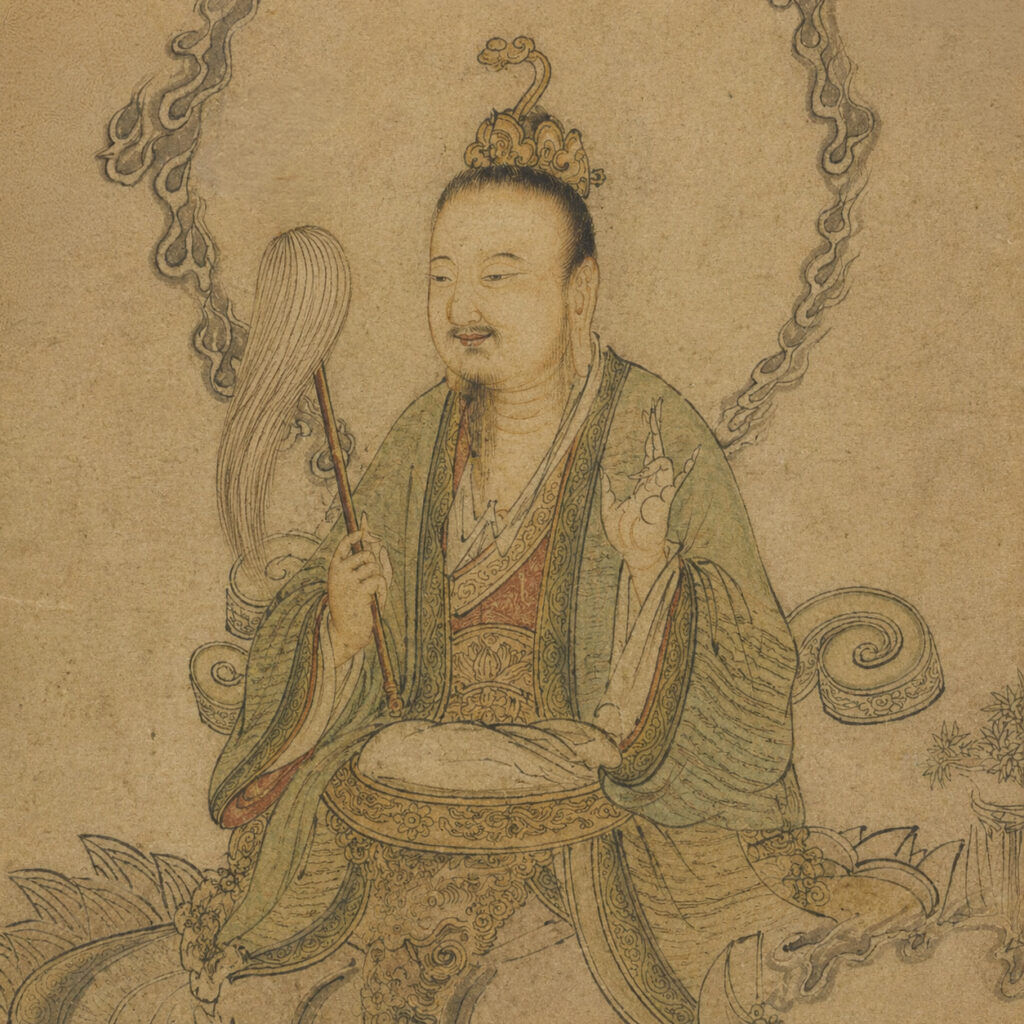
Taiyi Zhenren
Nezha’s immortal master and unwavering protector. From bestowing divine treasures to restoring Nezha’s life with a lotus body, Taiyi Zhenren shaped every stage of his disciple’s legendary journey.
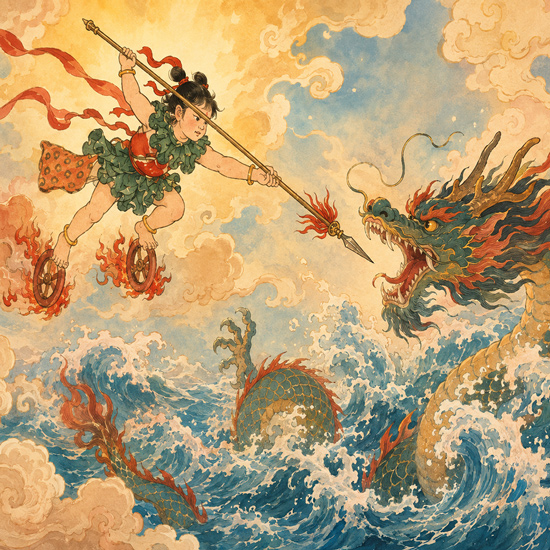
Taiyi Zhenren then bestowed upon Nezha two additional divine treasures: the Wind-and-Fire Wheels, which allowed him to soar through the heavens, and the Fire-Tipped Spear, which became his principal weapon in battle. Together with the Huntian Ribbon and the Qiankun Ring, these sacred weapons completed the iconic image that has defined Nezha in Chinese religious art for centuries.
Nezha’s resurrection marked far more than a return to life. It represented the creation of an entirely new identity. No longer an ordinary child of Li Jing’s household, he became a warrior whose body belonged neither to the mortal world nor to his parents, but to heaven itself. This transformation lies at the heart of Nezha’s enduring symbolism as a deity of rebirth, spiritual renewal, and self-transcendence.
Although reborn with divine power, Nezha had not forgotten the destruction of the shrine that had sheltered his spirit. His conflict with Li Jing remained unresolved, and the father and son would soon meet again in one of the most dramatic confrontations in Chinese mythology.