I. Outside Changsha
Liu Bei had taken two of the commanderies in southern Jingzhou. Changsha still held out. He meant to secure all four, and could not leave this city behind him. Its governor, Han Xuan, would not surrender. Guan Yu asked his elder brother for the command to take it.
Zhuge Liang warned him about the man guarding Han Xuan’s city. Huang Zhong was nearing sixty. He had once defended Changsha alongside Liu Pan, and knew his blade and bow as well as any younger officer. Guan Yu bristled at the warning. “Five hundred of my own swordsmen will be enough.” Liu Bei urged him to take more. Guan Yu refused, so Liu Bei followed with another force in case he needed help.
Han Xuan was watching from the wall when his commandant Yang Ling rode out to meet the attackers. Yang Ling leveled his spear at Guan Yu. In fewer than three exchanges he fell beneath Guan Yu’s blade. His men fled toward the drawbridge, shouting for it to be lowered and the gate secured. Han Xuan looked from the broken ranks to the single horse pursuing them. He ordered Huang Zhong out.
Huang Zhong took up his saber. Yang Ling had died too quickly; fear was already moving through the city. A soldier brought Huang Zhong’s horse. He checked the reins, slung his bow behind him, and led five hundred cavalry across the bridge.
Guan Yu saw the older rider at their head and called for his name. Huang Zhong gave it. Several dozen paces still lay between them when Guan Yu pointed his long blade toward the gate. “I have come for Changsha.”
“Then you must pass me first,” Huang Zhong said.
II. The First Day: A Measure of Each Man
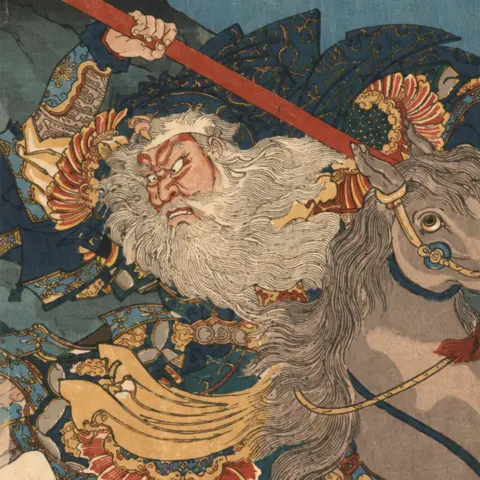
The horses gathered speed. Guan Yu’s long blade came down from above his right shoulder. Huang Zhong moved his mount just outside its direct path and caught the blow at an angle. The steel slid away to his left, but the force stung the hand on his hilt. He turned with his horse and cut at Guan Yu’s forward arm. Guan Yu drew his elbow in, brought the long handle across, and kept Huang Zhong from entering the space beside his horse.
After that first pass, Guan Yu ceased looking at Huang Zhong’s white hair.
He approached more slowly the next time and held something back from his cut. Huang Zhong waited until Guan Yu’s horse turned its head, then came in outside the blade. Guan Yu swept upward from below. Huang Zhong leaned away; his answering cut dropped toward the space before Guan Yu’s horse and made him pull the reins. Both riders went on several lengths before turning. Their soldiers heard steel strike steel, but could scarcely tell which man had changed the attack.
Guan Yu’s longer weapon gained force when horse and rider came together behind it. Huang Zhong could not meet every blow squarely. He let the heaviest edge pass, caught the rest from the side, and tried to attack before Guan Yu could recover. Once Guan Yu’s blade had just passed in front of him, Huang Zhong urged his horse toward the side of its handle and cut back toward Guan Yu’s ribs. Guan Yu could not bring the full length around for another sweeping blow. He drew in the handle to block, turned his mount outward, and only then escaped the close cut. Huang Zhong did not hack after the retreating horse. He wheeled and waited for Guan Yu to set his weapon again.
Guan Yu learned from it. He no longer let his blade travel so far that Huang Zhong could enter before its return. One cut drove Huang Zhong back; the next was already guarding the opening Huang Zhong meant to use. Huang Zhong nearly reached him once inside the long blade’s strongest arc. Guan Yu shifted his horse and the edge passed before Huang Zhong’s shoulder. When Huang Zhong came clear, one fastening on his armor had been severed.
He glanced at it and laughed. “A fine blade.”
“You know its worth, then.” Guan Yu came on again. Huang Zhong met him closer, pushing against the long blade until their horses almost passed shoulder to shoulder. Huang Zhong tried to turn his saber over for a cut, but Guan Yu drove the handle toward him and forced his wrist back. The horses separated. Neither man had taken that exchange.
The sun passed the tower. They had fought for more than a hundred exchanges. Huang Zhong felt the weight in his shoulders; Guan Yu’s hands no longer moved as freely as they had at dawn. Afraid Huang Zhong might fall, Han Xuan sounded the recall from the wall. Huang Zhong lowered his blade and went back over the bridge. Guan Yu did not pursue. He watched the old soldier enter the gate before lowering his own weapon.
That evening Guan Yu marked two paths in the dirt with his scabbard. Huang Zhong had entered beside the strongest part of his blade more than once. Another direct assault might give him the same opening. Tomorrow Guan Yu would turn away, let Huang Zhong follow, then strike as he turned his horse back. Inside the city, Huang Zhong replaced the broken armor tie. To Han Xuan he said only, “He will fight differently tomorrow.”
III. The Second Day: The Fall
Huang Zhong first pressed toward Guan Yu’s left, trying to make him turn his horse. Guan Yu kept the blade between them. The day before he had wanted Huang Zhong to bear the weight of his attack. Now he waited for Huang Zhong to commit himself. Several attempts failed to draw him out.
After fifty or sixty exchanges, both armies were cheering. Guan Yu suddenly turned his horse away, his blade carried low along its side. Huang Zhong could see that the retreat was too orderly to be flight. If Guan Yu opened enough ground and came back at speed, his next cut would be harder to meet. Huang Zhong followed, hoping to close before the turn.
Guan Yu heard the hooves nearing and tightened his grip. He was about to cut back with the movement of his horse when a startled neigh sounded behind him. He looked back. Huang Zhong’s horse had stumbled on its forelegs and pitched its rider to the ground. Huang Zhong reached for his fallen blade. The animal struggled to stand. By the time Guan Yu had turned, Huang Zhong had raised himself halfway.
Guan Yu stopped his horse and lifted his blade with both hands. One stroke could end the defense of Changsha. Huang Zhong looked up without begging and kept hold of his own hilt.
Guan Yu looked at the stumbling horse and stayed his hand. “Change horses. Your blade has not finished with mine.”
Huang Zhong rose. His eyes moved from Guan Yu’s weapon to his face. He caught the frightened horse, mounted it again, and rode back into the city. Only there did he replace the animal, which had long been out of battle.
Han Xuan asked why Huang Zhong had not used his bow. “Tomorrow I will draw him toward the bridge and shoot,” Huang Zhong answered. Han Xuan gave him the green horse he himself rode and ordered him not to fail again.
That night Huang Zhong took down his bow and inspected the feathers on his arrows. Guan Yu had held back a killing stroke, though he had lacked neither strength nor opportunity. The gate would open again in the morning, and Han Xuan would be watching from above. If Huang Zhong obeyed and killed Guan Yu, perhaps Changsha would hold for another day. If he let him ride away, Han Xuan would see no honor in the restraint. Huang Zhong put the arrows aside. Even as the lamp guttered, he had not decided how to draw.
IV. The Third Day: The Helmet Tassel
Huang Zhong rode out on Han Xuan’s green horse. Guan Yu was waiting. Two days without a victory had made him impatient; he attacked first and forced Huang Zhong to turn again and again. Before they had fought thirty exchanges, Huang Zhong lowered his saber and rode toward the gate.
Guan Yu followed hard. Huang Zhong held his saber close and reached back for his bow. The string snapped. Guan Yu moved aside, but no arrow came. He urged his horse on. The string sounded a second time. He dodged again and saw nothing fly. Huang Zhong kept riding toward the bridge.
The first empty draw had made Guan Yu wary. The second made him doubt the archer. Was Huang Zhong only trying to frighten him off? Guan Yu pressed closer. Huang Zhong’s horse had reached the planks. The shouts of the cavalry behind them were lost beneath the hoofbeats.
Only then did Huang Zhong set a real arrow to the string and turn. The green horse jolted on the boards. He waited for its stride to steady and loosed. The arrow passed Guan Yu’s face and struck the base of the tassel on his helmet. Guan Yu pulled his horse to a stop. The arrow remained lodged in the helmet; the tassel hung askew. His face and throat were untouched.
Huang Zhong took no second arrow. He led his men inside. Guan Yu returned to camp with the arrow still in his helmet. There he removed it and examined where the shaft had struck. A poor shot could never have found so small a mark. A man bent on killing him would not have made those two empty draws. Guan Yu understood at last what Huang Zhong had given back for the stroke he had withheld the day before.
Han Xuan had watched the same encounter from the wall. He saw an enemy commander ride away alive. For three days Huang Zhong had failed to defeat him; yesterday Guan Yu had spared him; today Huang Zhong had twice drawn an empty bowstring and then aimed only at a tassel. To Han Xuan, these were three parts of the same accusation.
When Huang Zhong reported back, Han Xuan ordered him seized. He recited everything he had seen. “An inch lower,” Huang Zhong said, “and Guan Yu would not have reached his camp.”
“You knew that,” Han Xuan said. “Why did you not aim lower?”
Huang Zhong looked at him and gave no answer. Han Xuan ordered him taken outside the city gate for execution. The other officers dared not plead for him.
V. The Gate Opens
The executioner had raised his weapon when a man burst from the crowd and cut him down. Huang Zhong broke free and recognized Wei Yan. Wei Yan had once sought Liu Bei, then entered Han Xuan’s service, where he had found little favor. Now he stood between Huang Zhong and the guards and called to the people around them: if Huang Zhong died, who would defend Changsha?
Huang Zhong caught his arm. “Do not turn the whole city against itself.”
“He has already ordered your death,” Wei Yan said.
People followed Wei Yan up toward the wall. Huang Zhong tried to stop them, but could not. Wei Yan killed Han Xuan and opened the city to Guan Yu. Guan Yu entered, calmed soldiers and townspeople, and forbade his men to prey on them.
He sent for Huang Zhong. The marks of the execution rope were still red on Huang Zhong’s wrists. He could hear men in the street speaking of Han Xuan’s death. He sent word that he was unwell and could not come.
Liu Bei and Zhuge Liang, already on the road with the supporting force, arrived after news that Changsha had fallen. Guan Yu told Liu Bei what had happened over the three days. Liu Bei went to Huang Zhong’s house himself.
VI. Old Lord, New Comrades
Huang Zhong opened the door. Liu Bei asked him to serve, but Huang Zhong first asked what would be done with Han Xuan’s body. He wished to bury his former lord east of Changsha. Liu Bei agreed.
Huang Zhong glanced at the saddle in the courtyard. Three days earlier he had set it there, expecting to ride out for Han Xuan for many days to come. He bowed and accepted Liu Bei’s service. Liu Bei bowed in return, left men to help arrange the burial, and departed.
On the day of the funeral, Huang Zhong walked beside the bier, leading his horse toward the city gate. Guan Yu waited there with his own horse. A new tassel hung from his helmet. Huang Zhong saw it and paused.
Guan Yu nodded to him and came alongside. The drawbridge lowered, and they followed Han Xuan’s bier out of the city together.