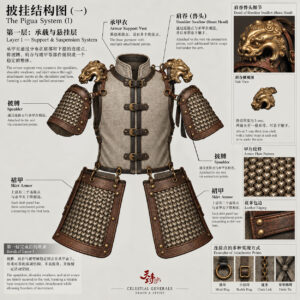
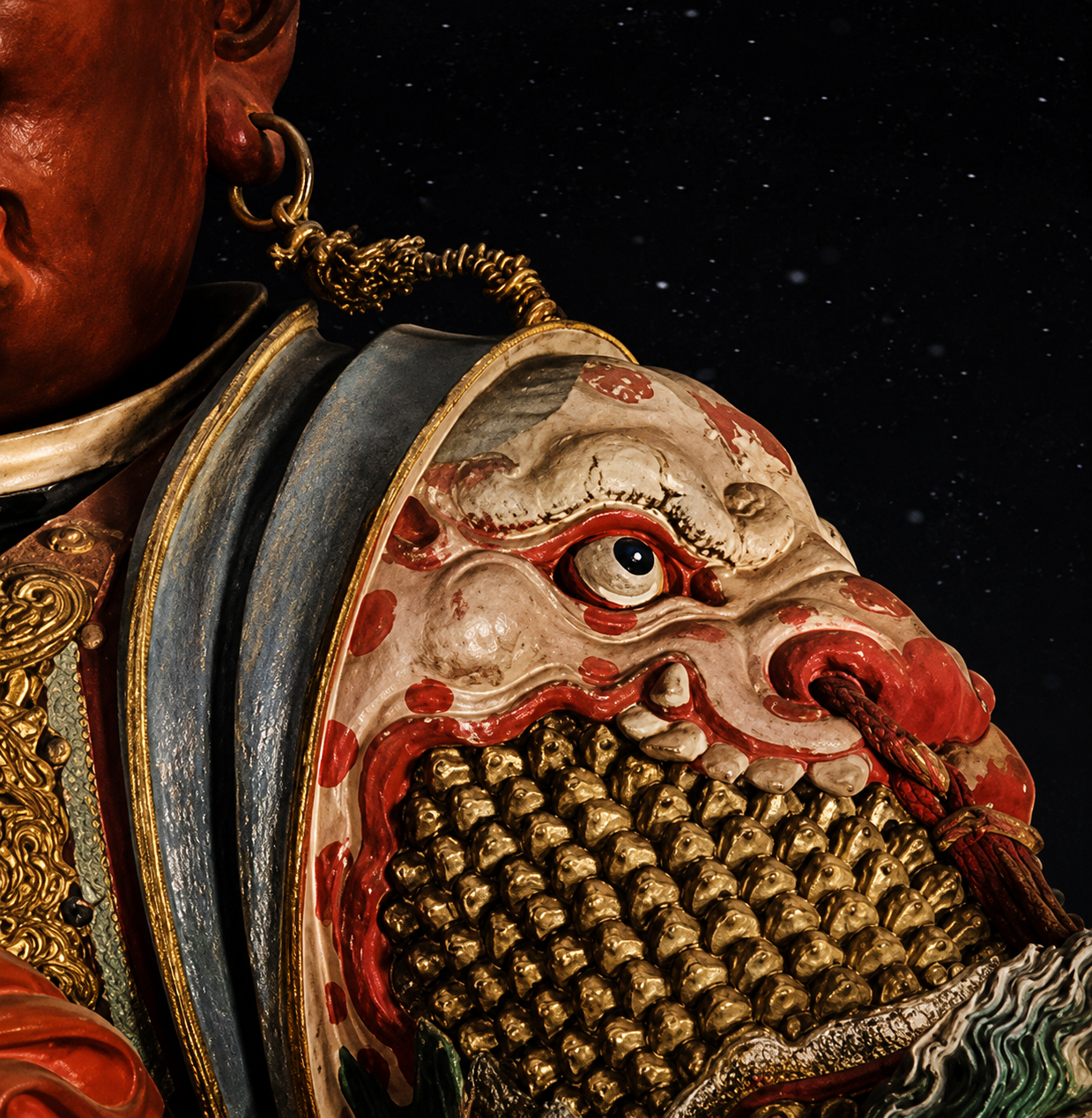
Shoulder Swallow is the beast-head component positioned over the shoulder, often appearing as though the arm emerges from an open mouth. It combines local protection with a strong visual marker that broadens the shoulder line.
Independent Attachment and Mobility
In the approved CG system, Shoulder Swallow is definitely not attached directly to Upper-Arm Armor. The two parts remain mechanically independent so the arm can rise, the shoulder can rotate, and a weapon can move without one component forcing the other.
The Shoulder Swallow connects upward to the Armor Support Vest through an iron ring or iron buckle and is additionally stabilized by an underarm tie. The upper connection carries and positions it; the tie resists unwanted lifting or displacement. Together they secure the piece without locking the shoulder.
CG Reconstruction Interpretation: Composite Construction
The complex beast-head shell need not be one fully formed piece of thick metal. Shaped, stitched, or assembled hard leather can form the primary sculptural shell, with internal metal shells, liners, or localized reinforcing plates adding protection and stiffness. This can be easier to shape, lighter, and less costly while remaining protective. It is a CG reconstruction interpretation, not universal historical certainty.
Visual Identity and Evidence
The defining visual evidence is shoulder placement, the open swallowing mouth, upper connection, and underarm stabilization. Animal type, scale, materials, and hidden reinforcement can vary.