
Chinese armor is best understood as a wearable system rather than a single rigid shell. Separate pieces are draped, suspended, fastened, bound, and attached until they work together as one stable arrangement.
This guide follows the Owner-approved Celestial Generals reconstruction shown in the two diagrams below. It explains that structure without claiming that every historical suit used the same components, names, or fastening method.
I. What “Pigua” Means
Pigua describes both the act of equipping a warrior and the structural principle behind the equipment. Armor parts are placed over the body, hung from supporting layers, secured with straps and ties, and allowed enough controlled movement to follow the wearer.
The important idea is balance. Connections must keep parts from detaching or shifting too far, while still allowing the shoulders, torso, waist, and hips to move. Because the parts remain distinct, they can also be repaired or exchanged individually.
II. Layer I — Support and Suspension
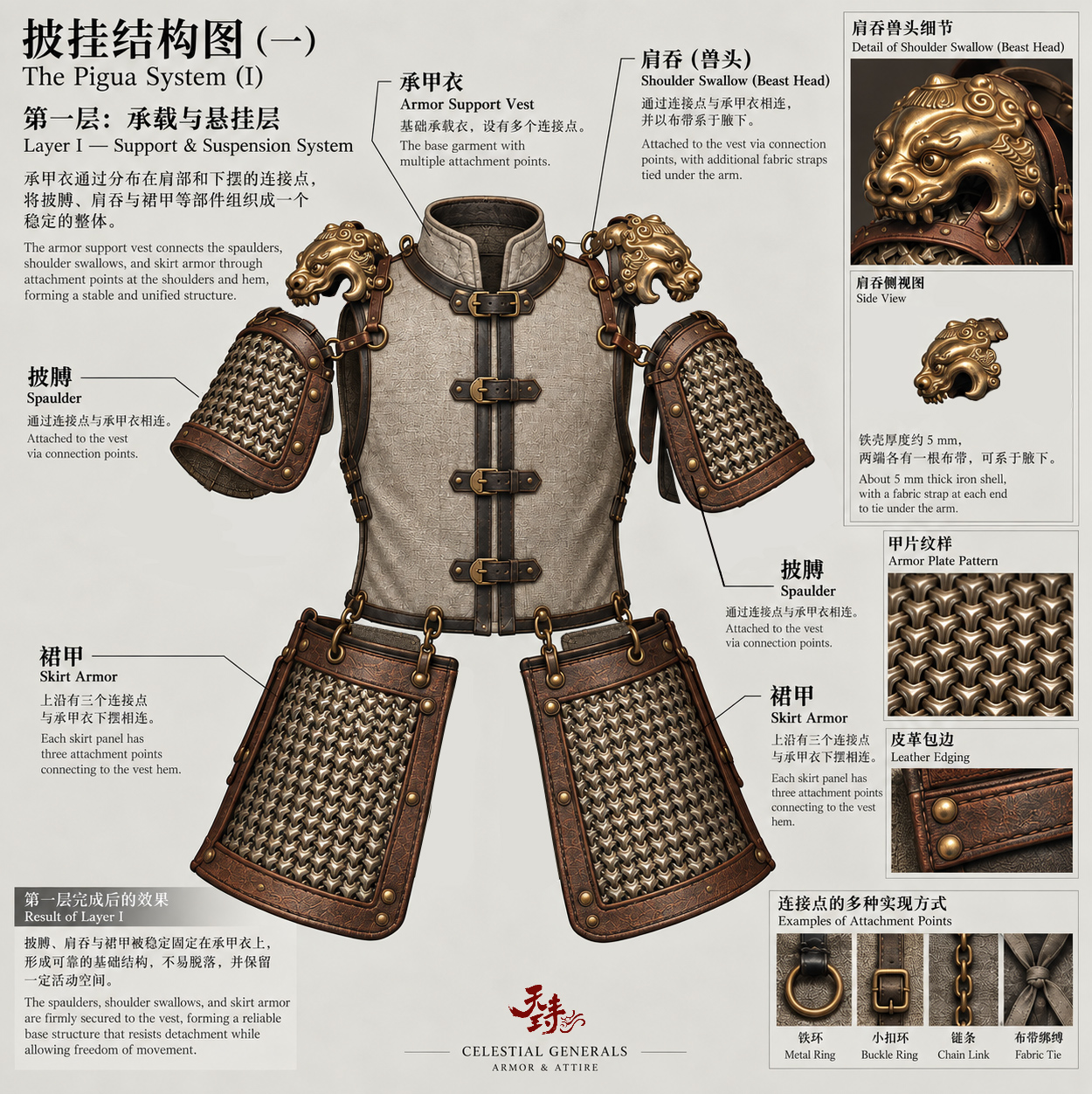
The first layer begins with the Armor Support Vest. This strong sleeveless garment is the hidden base of the reconstruction. Attachment Points at the shoulders and lower hem distribute the load and provide places from which other parts can hang.
Arm Armor and Shoulder Swallows connect around the shoulders. The Shoulder Swallows can also be tied beneath the arms. Skirt Panels hang from the lower edge of the vest. Together these parts create a stable outer frame without turning the wearer into a rigid figure.
The Helmet and its Helmet Tassel form a separate head assembly. They belong to the complete equipment of the figure, but they are not carried by the Armor Support Vest shown in Layer I.
III. Layer II — Body Armor
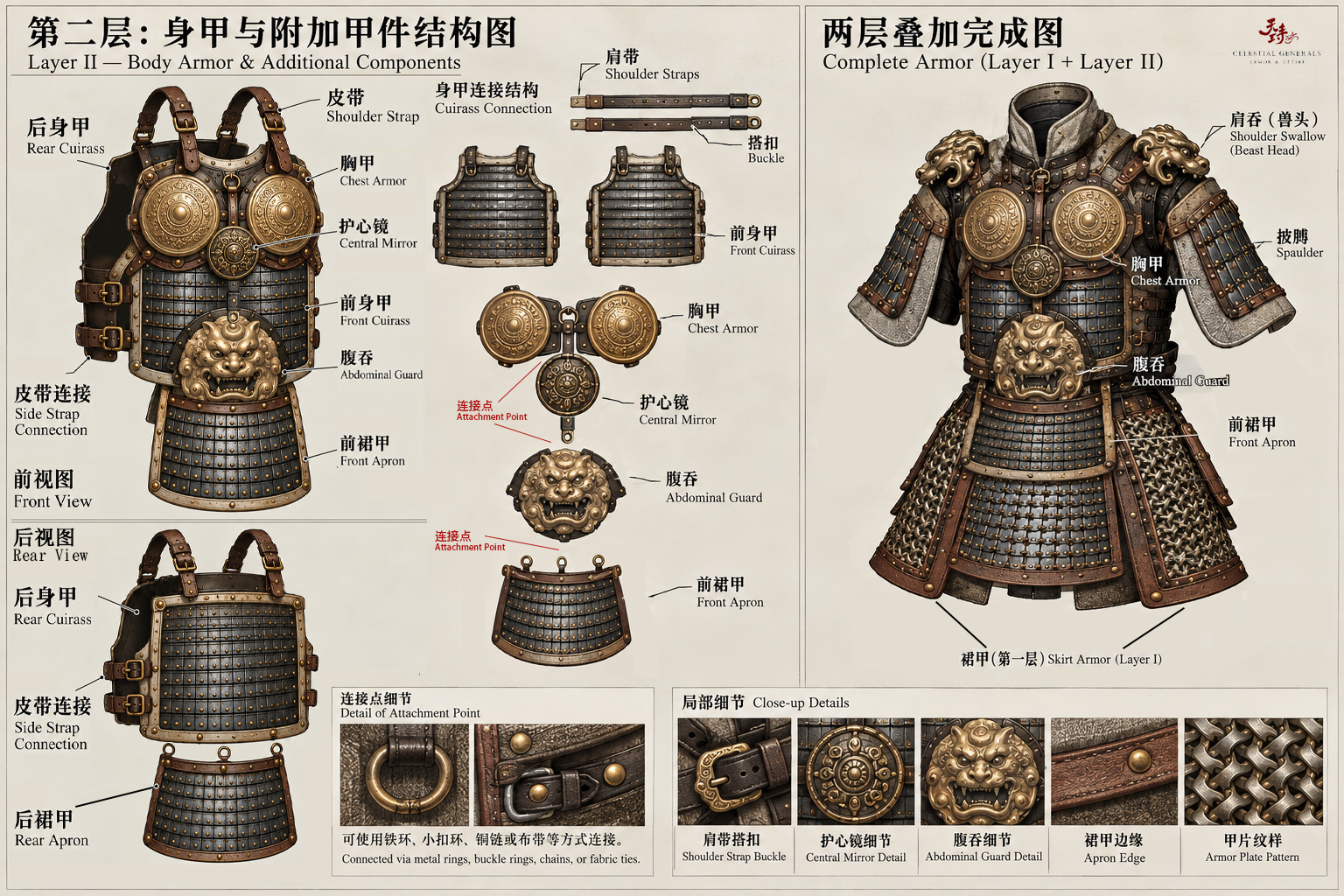
The second layer adds Body Armor around the torso. In the approved reconstruction, front and rear cuirass sections meet through shoulder straps and side straps. These connections stabilize the torso shell while leaving the first suspended layer in place beneath and around it.
Chest Armor is attached to the front structure. The diagram also identifies a central mirror, an abdominal guard, and front and rear aprons. These labels describe parts of the approved reconstruction; missing atomic Subjects will be created only after their own names and definitions are confirmed.
IV. Attached Components
Attached components complete specific areas without becoming a second definition of the underlying Subjects. Chest Armor covers the upper front. Wrist Braces protect and finish the arm assembly. Shank Armor and Ankle Swallows extend the equipment to the lower legs.
Rings, buckles, chains, leather straps, and fabric ties are connection methods rather than decoration alone. Their placement explains how independent components remain organized when the wearer raises an arm, turns, bends, rides, or handles a weapon.
V. Complete Armor
Layer I supplies support and suspension. Layer II encloses and stabilizes the torso. Attached components complete the chest, arms, waist, and legs. The full result reads visually as one suit, while remaining structurally modular.
That is the central meaning of Pigua: armor lives on the body through an ordered network of carrying, hanging, fastening, binding, and attachment. The whole depends on the relationships between its parts.