Forearm Guards are fitted guards worn around the forearm. The Chinese term 臂鞲 can refer to protective or sleeve-controlling gear in this position; 护臂 and 臂甲 are useful modern aliases.
They protect the forearm and restrain wide sleeves during riding, archery, and weapon handling. Their construction may be rigid, segmented, strapped, or textile-based.
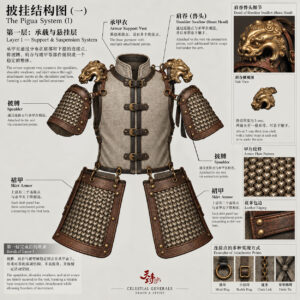
Here Forearm Guards remain separate from 披膊: the former belong to the forearm, while Arm Armor covers the shoulder and upper arm. This positional distinction matters more than ornament.
CG Reconstruction Interpretation
In the Owner’s reconstruction, Forearm Guards and Shank Armor share a mechanical family: a hard inner protective layer of metal lamellae, plates, or hard leather is enclosed by an outer leather wrap. Inner leather may be woven or shaped into horizontal ribs. Circular or oval side windows can reveal leather or the layered protective elements; the visible openings are distinguished from a claim about every hidden layer.
Upper and lower transverse straps work with front and rear longitudinal straps to tighten and organize the guard. Stability comes from tightening, the shape of the forearm, and the blocking geometry at the wrist and hand.
This is an independent local armor system. It does not hang from the main shoulder-and-torso suspension structure, even though it belongs to the same complete wearable ensemble.