If combat efficiency were the only concern, several recurring features of the traditional Chinese warrior image would be hard to explain.
First, even after putting on armor, a warrior may still have two broad robe sleeves flowing outside the arm defenses.
Second, some figures wear a wide-sleeved short robe over a complete suit of armor. It adds no protection and may even obstruct movement.
Third, senior commanders and marshal-like figures can look stranger still: they wear a full-length official robe and formal belt, yet pull one arm out of its sleeve so that the armor underneath remains visible.
Any one of these might be dismissed as an individual painter’s taste. But all three recur across Chinese images of military figures until they become a stable visual tradition.
They are probably more than decoration. They point to another demand placed on the Chinese warrior: he had to say not only “I am a man of war,” but also “I am a man of war within this ritual and bureaucratic order.”
1. The Strangest Sight: Why Does Armor Still Have Two Great Sleeves?
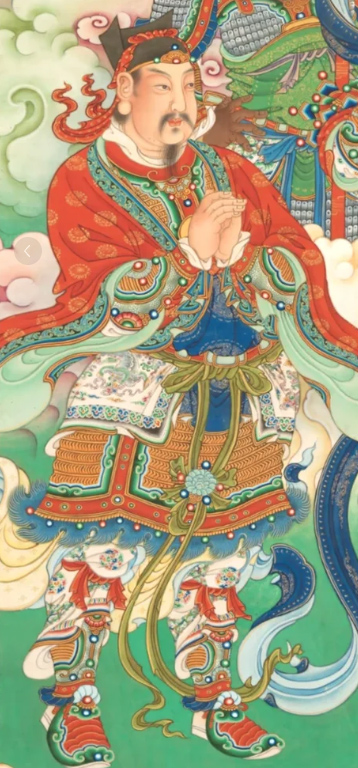
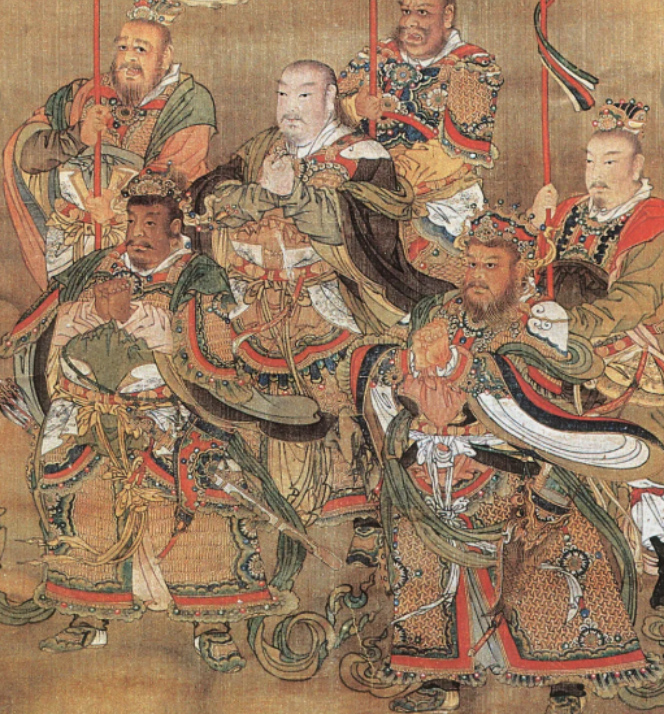
Water-and-land paintings, images of divine generals, and many other representations of warriors repeatedly show the same thing. The chest, shoulders, arms, and legs are fully equipped, yet broad textile sleeves remain visible between and around the armor.
Sometimes the sleeves belong to a garment worn over the armor. Sometimes the body of the garment has disappeared beneath the torso armor, leaving only two large sleeves emerging from below it.
From the narrow perspective of military engineering, this makes little sense. Broad sleeves offer no meaningful protection. They can catch on a weapon or pull against the armor, and they may hinder a raised arm, a turn of the body, or the handling of a long weapon.
Some images even show warriors knotting or binding excess sleeve fabric. The wearers themselves evidently understood that these sleeves were inconvenient.
Yet the sleeves remained. What survived was therefore likely not a military function, but a function of identity.
2. A Sleeve Was No Longer Just a Sleeve
In the traditional Chinese clothing system, broad robes and generous sleeves were never merely matters of cut.
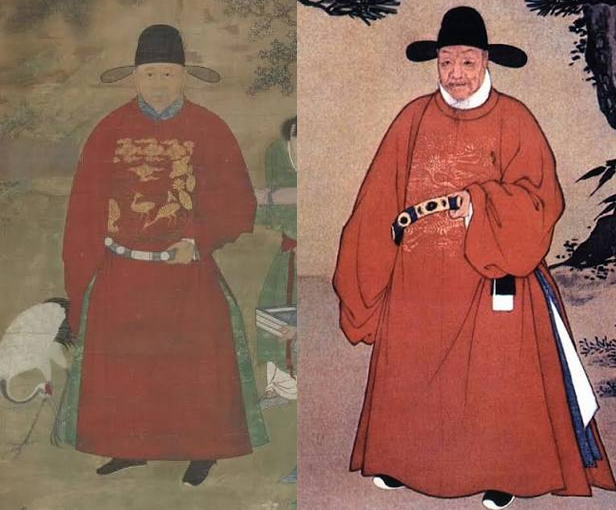
They were bound to ritual, status, rank, decorum, and bureaucratic culture. How a senior official stood and dressed, the breadth of his garments, the belt at his waist, and the headwear above him were not entirely private choices.
By the Song and Ming periods, the visual language of official dress had become especially forceful. Once we stop seeing it simply as beautiful “historical costume,” many of its forms appear deliberately exaggerated:
- immense sleeves
- hat wings extending far beyond the body
- heavy, rigid plaque belts
- complex elements hanging from the waist
- highly regulated colors and patterns
One purpose of these forms was to make identity immediately visible. Clothing continually told the viewer who ranked above whom, who belonged to which level, who was a civil official, and who occupied a higher ritual position.
If that institutional culture entered military life, similar features in a commander’s dress should not surprise us.
3. The Embroidered War Robe: A Garment That “Should Not” Be There
The Embroidered War Robe, or xiushan (绣衫), is a clear example.
It is not an indispensable protective component. In one common arrangement, a warrior puts on his armor and then adds a broad-sleeved short garment over it.
The robe is loose, lacks an elaborate rigid closure, and may use its excess lower corners as ties. From the standpoint of protection, it is almost unnecessary. From the standpoint of movement, it may be a burden.
But as an expression of identity, it suddenly makes sense.
The armor says: “I command force.”
The embroidered robe says: “I am not a warrior outside the social order. I belong to the state’s bureaucratic and ritual system.”
Both visual languages occupy the same body. The figure is no longer simply a person in armor, but a military man whose identity has been shaped by state institutions.
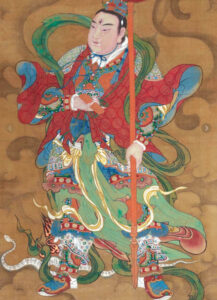
4. Why Is the Embroidered Robe Sometimes Worn Under Armor?
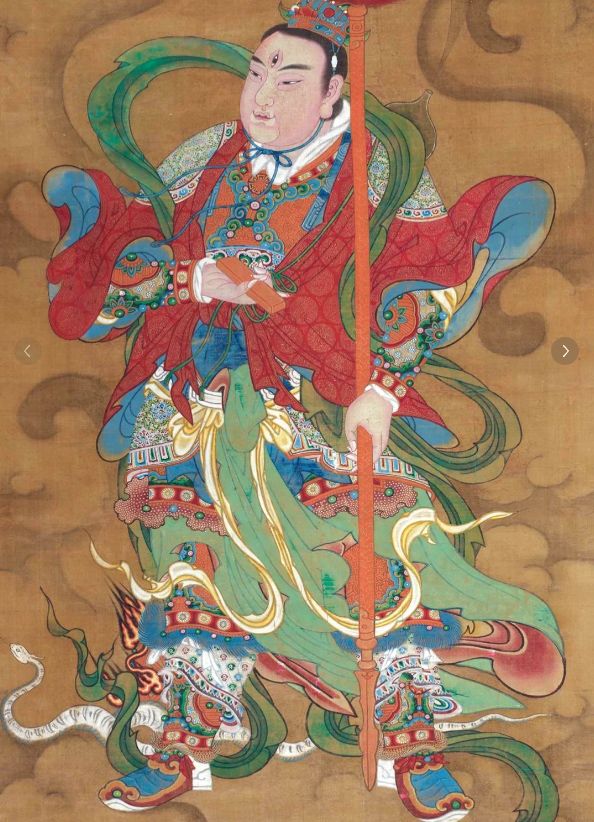
More intriguingly, the robe is not always worn outside the armor. Sometimes it lies beneath the torso defense.
In that arrangement, nearly all of the garment’s body is hidden. Only the two broad sleeves remain visible outside the armor.
As ordinary clothing, this seems even less rational. But if the sleeves themselves had become signs of identity, the problem disappears. The garment could vanish beneath the armor; as long as the sleeves remained, so did the sign.
This may help explain why fully equipped warriors in so many water-and-land paintings still trail two emphatic sleeves. The fabric was not necessarily present only for warmth, nor must it be dismissed as a late painterly convention.
It may preserve an older and more substantial idea about dress: a warrior could put on armor while still making his place within ritual order visible.
5. When Broad Sleeves Became Visually Necessary
Once a sign of dress persists long enough, it can outlive its initial practical circumstances and become part of the image itself.
A warrior was expected to have broad sleeves, just as a helmet was expected to have a tassel, an official robe a belt, or certain divine generals flowing sashes.
If the sleeve got in the way, it could be knotted, tied, or tucked behind the body. Removing it altogether was not necessarily the first solution.
That persistence reveals a value beyond utility. The broad sleeve had become part of what a warrior was supposed to look like.
6. From the Embroidered War Robe to the Wenwu Sleeve
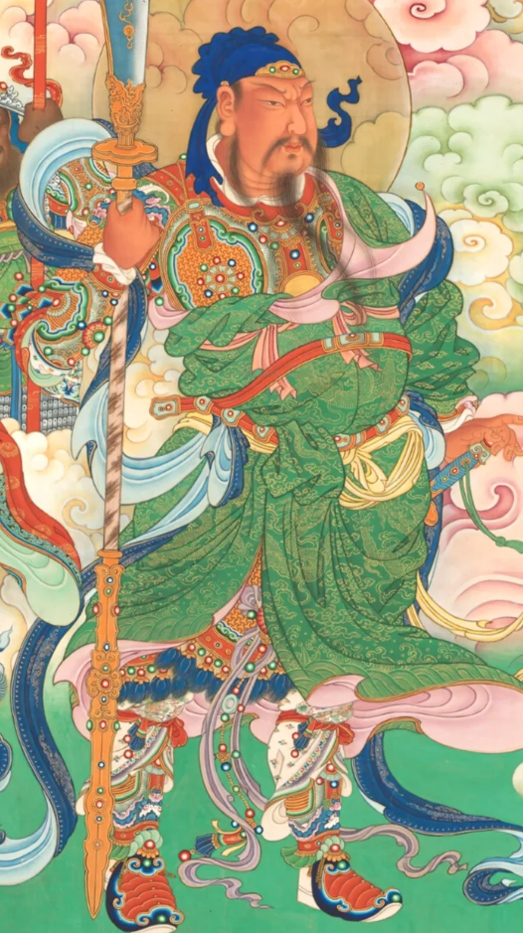
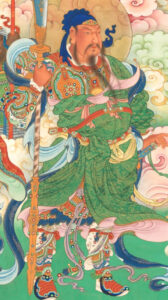
If the embroidered robe preserves the language of civil dress around armor, the Wenwu Sleeve (文武袖) pushes the combination further.
Its silhouette is unmistakable. The wearer has not put on a short over-robe but a full official-style garment:
- broad sleeves
- a hem reaching toward the feet
- a right-front closure or round collar
- a slit along one side
- an official-style belt at the waist
Yet he is no ordinary civil official. Armor lies beneath the robe. More decisively, he pulls his right arm out of its sleeve and exposes the armor directly. The empty sleeve is tucked behind the body or beneath the armpit.
One body now carries two sharply different visual languages. One side presents the complete official robe; the other reveals an armored arm.
The asymmetry is extreme, but that is precisely why it states the coexistence of wen and wu so clearly.
7. Why Expose Just One Arm?
If battle alone were the goal, the robe could simply be removed. If official dress alone were the goal, there would be no reason to pull one arm out of its sleeve.
The Wenwu Sleeve preserves both conflicting demands. It becomes neither a pure combat uniform nor a complete ceremonial robe. It wears the contradiction openly.
Visually, the form seems to say: “I am a military commander.” At the same time it says: “My power does not stand outside the order of the state.”
That assertion matters most for senior commanders. An army is intensely concerned with rank and obedience; a bureaucratic society is equally concerned with graded office. When those two hierarchies overlap, clothing naturally becomes a visible instrument of authority.
The long robe, formal belt, and exposed armored arm present a commander as both warrior and senior official within the state order.
8. “I Am Not an Ordinary Man of Violence”
Traditional Chinese political culture maintained a complicated relationship with the martial sphere. Society needed force. The state needed generals. Frontiers needed people capable of fighting.
At the same time, political order remained wary of authority founded entirely on personal violence, private armies, and military achievement.
The ideal senior commander therefore needed more than fighting ability. He was also expected to understand ritual, observe order, accept established status, submit to bureaucratic and sovereign relationships, and preferably display some degree of cultivation.
The later ideal of the “cultivated general” is one expression of that tendency.
The Wenwu Sleeve turns this idea into a visible figure. The armor remains and military force has not disappeared. But the armor is enveloped by official dress, with only one arm exposed.
In that sense, it is among the most direct visual expressions of the idea that martial power follows civil form—wu sui wen fu (武随文服).
9. Why Did a Commander’s Dress Become Less Like Pure Combat Equipment?
Measured only by military efficiency, much traditional warrior dress does appear irrational. Broad sleeves obstruct movement. An over-robe adds no protection. A long gown may hinder the legs. Elaborate belts, ornaments, and pendants add weight.
But senior commanders did not wear equipment alone. They also wore identity.
A soldier’s equipment first answers a combat problem. A commander’s clothing must answer additional questions:
- Who is in command?
- Who holds the higher rank?
- Who represents the state?
- Who has the authority to issue orders?
- Who occupies the ritual center?
In that setting, an “impractical” garment may still be extremely useful. Its purpose is not to stop a blade. Its purpose is to show who may command.
10. Why the Embroidered Robe May Also Have Carried Rank
There is no need to equate the embroidered robe directly with a modern rank insignia. Yet Song–Ming official dress placed enormous emphasis on visible gradations of status, and the colors, patterns, materials, and forms of military robes were unlikely to be matters of personal taste alone.
Armies also need to recognize hierarchy at a glance. The robe may therefore have performed a social function comparable to rank marking: it made identity visible.
Its appearance told the viewer that this was not an ordinary soldier or an undifferentiated man of war, but someone with a particular degree, office, or institutional identity.
The robe’s splendor was not necessarily mere love of ornament. Splendor itself could be a language of power.
11. Three Strange Features, One Problem
We can now return to the three questions with which we began.
Why are there two large sleeves?
Because a warrior could retain the visual language of civil and ritual dress even after putting on armor.
Why place a small over-robe outside the armor?
Because armor solved the problem of protection, while the embroidered robe solved the problem of identity.
Why expose a single armored arm?
Because the Wenwu Sleeve deliberately displayed official dress and armor together, placing two identities side by side on one body.
Three apparently unrelated oddities therefore point toward the same principle: force had to be placed within order.
12. Perhaps the Painter Was Depicting More Than Clothes
When we look at warriors in water-and-land paintings today, they often seem unlike the ferocious fighters of modern imagination. They are richly dressed. Their sleeves are broad. Their armor is densely layered. Many have controlled expressions and formal postures.
These images should not be treated as photographs of daily camp life. Painters were presenting an ideal figure already shaped by culture.
But that shaping deserves attention. It does not tell us that every historical commander dressed this way every day. It tells us how society wished military authority to appear.
The embroidered robe, the broad sleeve, and the Wenwu Sleeve are among the clearest material traces of that expectation.
Conclusion: Beyond the Armor Was Another Layer of Order
To understand Chinese armor, we cannot study only metal, leather, and plates. A warrior never wore protection alone. He also wore identity, rank, ritual, and political order.
Those apparently superfluous sleeves may not have been superfluous at all. The embroidered robe outside the armor was not merely decorative. The deliberately exposed armored arm was not the result of putting on a sleeve incorrectly.
Together they expressed a particularly Chinese ideal of the warrior: he possessed force, but that force belonged to an order.
That is why the Chinese warrior image could sustain a combination that seems contradictory yet remained stable for centuries:
armor on one side,
robe on the other;
martial on one side,
civil on the other.
The contradiction itself may be the most revealing part of the image.