Armor Belt is the belt structure used to organize armor and carried equipment within a Chinese armor ensemble. It is not simply a modern belt pulled tightly around the abdomen, and it should not be treated as the primary support for the entire suit.
Historical Visual and Structural Evidence
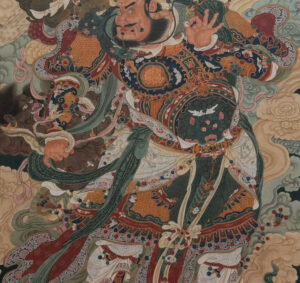
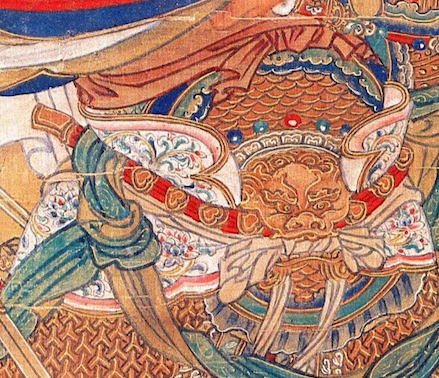
Armor images and surviving belt traditions show that the waist could be organized as a substantial assembly rather than as one narrow cinched strap. Formal Ming belts with distinct front and rear elements joined at the sides provide a useful structural analogy for understanding how a belt can surround the body without relying on one continuous tight band. They do not prove that every armor belt was identical to a Ming formal belt.
Traditional martial belts could carry swords, sabers, bow cases, quivers, and other equipment when their particular construction supported that load. Different armor systems coexist, so the number of pieces, connection method, stiffness, width, and relationship to the body armor may vary.
CG Reconstruction Interpretation
Hands-on reconstruction shows a practical problem with hanging heavy equipment from a narrow belt that is held only by being cinched tightly around the waist: the load drags the belt downward, rotates it around the body, concentrates pressure, and becomes uncomfortable in movement. This observation explains why a broader supported belt assembly is mechanically useful; it is CG reconstruction evidence, not proof of one universal historical design.
In the CG reconstruction model, the belt may be substantially stiff: thick leather, possibly reinforced with plaques, can form a semi-rigid waist frame divided into front and rear sections. Such a frame may not be capable of tight modern-style cinching. It positions and carries equipment while retaining space around the body.
Place in the Armor Suspension System
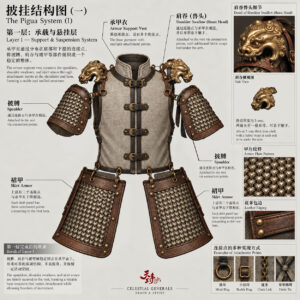
The waist assembly is itself suspended. The rear load path runs from Rear Body Armor through three binding points to the combined rear belt and Waist Support. The front path runs from Front Body Armor through Chest Armor and Belly Swallow to the front belt. Two side buckles join the front and rear sections. The stable body-armor structure above, rather than abdominal compression, provides the primary support.
The belt therefore stabilizes, connects, and carries at the waist, but it does not replace the shoulder and torso structures above it. Its visual role remains important as well: it marks the waist and makes the layered armor read as an organized wearable system.
CG Wearing Sequence and Side Closure
The rear belt and Waist Support are assembled together first. This rear waist module is connected upward to three binding points extending from the body armor. The front belt is then positioned through the front armor chain, including the open mouth of the Belly Swallow, which can receive and hold it.
Left and right side buckles close the front and rear sections, position the belt, provide lateral stability, and allow some adjustment of tightness. Buckle tension is not the primary source of load-bearing support. This sequence is the Owner-locked CG reconstruction interpretation; it is not claimed as the universal historical wearing order.
A projecting abdominal silhouette may reflect a semi-rigid belt, room within the assembly, and the accumulation of body armor, Waist Support, belt sections, Belly Swallow, aprons, and attachments. Heavy hanging equipment can also pull a belt downward and create slack even after initial tightening. Such a figure can look visually bound while retaining mechanical space; this is one structural explanation, not the only explanation of every large-bellied image.
Ming Formal Belt Comparison
The Owner’s comparison uses segmented Ming formal belts to show that a Chinese belt need not be merely a soft cinching strap. The regular front plaque arrangement may group one large square with two smaller squares at the center, peach-shaped plaques to either side, and large terminal squares; a rear section may contain seven or nine larger square plaques. These visible arrangements are comparative examples, not a specification for armor belts or proof that the CG reconstruction duplicates a Ming formal belt. Individual plaque nomenclature is not expanded here.