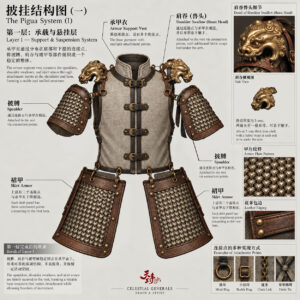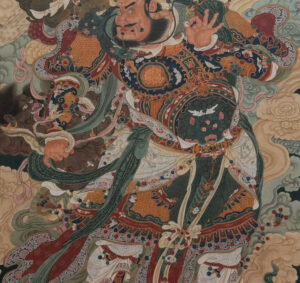
Pigua is an especially apt term in traditional Chinese armor. It does more than describe a general putting on armor. It also expresses how the armor is structured: a complete suit is not a single rigid shell, but an assembly of independent components built up on the body through draping, suspension, fastening, binding, and attachment.
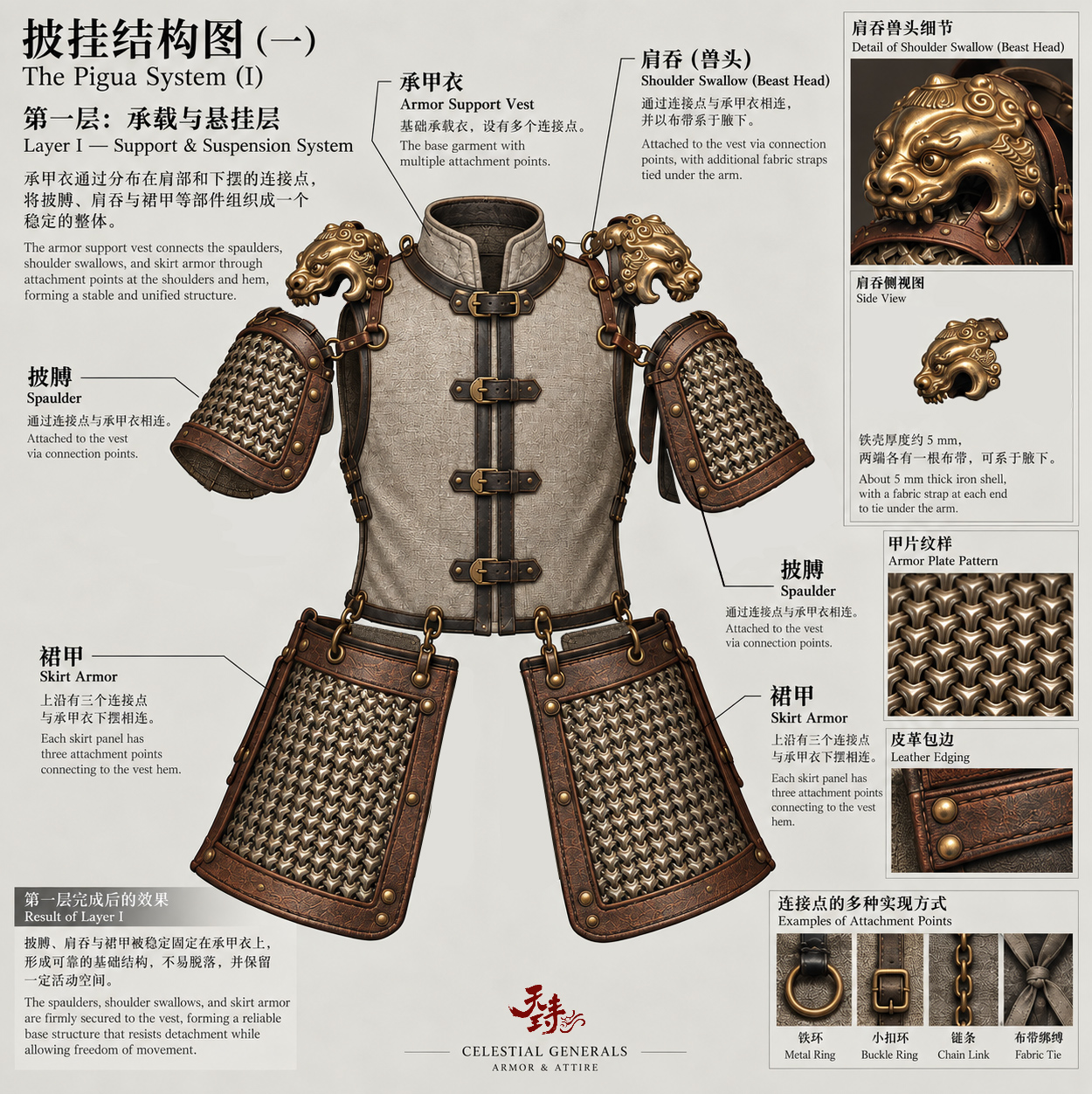
The first idea, pi, is to drape or carry armor parts across the shoulders, back, and torso. The second, gua, is to suspend Arm Armor, Shoulder Swallows, Skirt Armor, and other components from a supporting structure through metal rings, chains, leather straps, buckles, or fabric ties. Other parts are then fastened, secured, and attached until they form a complete and stable system.
The purpose is not to lock every component permanently in place. The structure balances stability with movement.
Once the armor is worn, shoulder straps, leather straps, rings, chains, and ties distribute its weight across the shoulders, torso, waist, and hips. The components remain reliably positioned during riding, running, and weapon handling.
These connections are not completely rigid. Functional Attachment Points retain enough play for plates and components to move within limits as the body moves. The wearer can raise an arm, turn, bend, or ride without being trapped inside a fixed shell.
This articulated method of connection also makes the armor modular.
Arm Armor, Shoulder Swallows, Skirt Armor, Chest Armor, and Abdominal Guards can exist as relatively independent units. A damaged part can be removed, repaired, or replaced without discarding the entire suit. Components can also be exchanged for different figures, occasions, and visual needs while the supporting structure remains consistent.
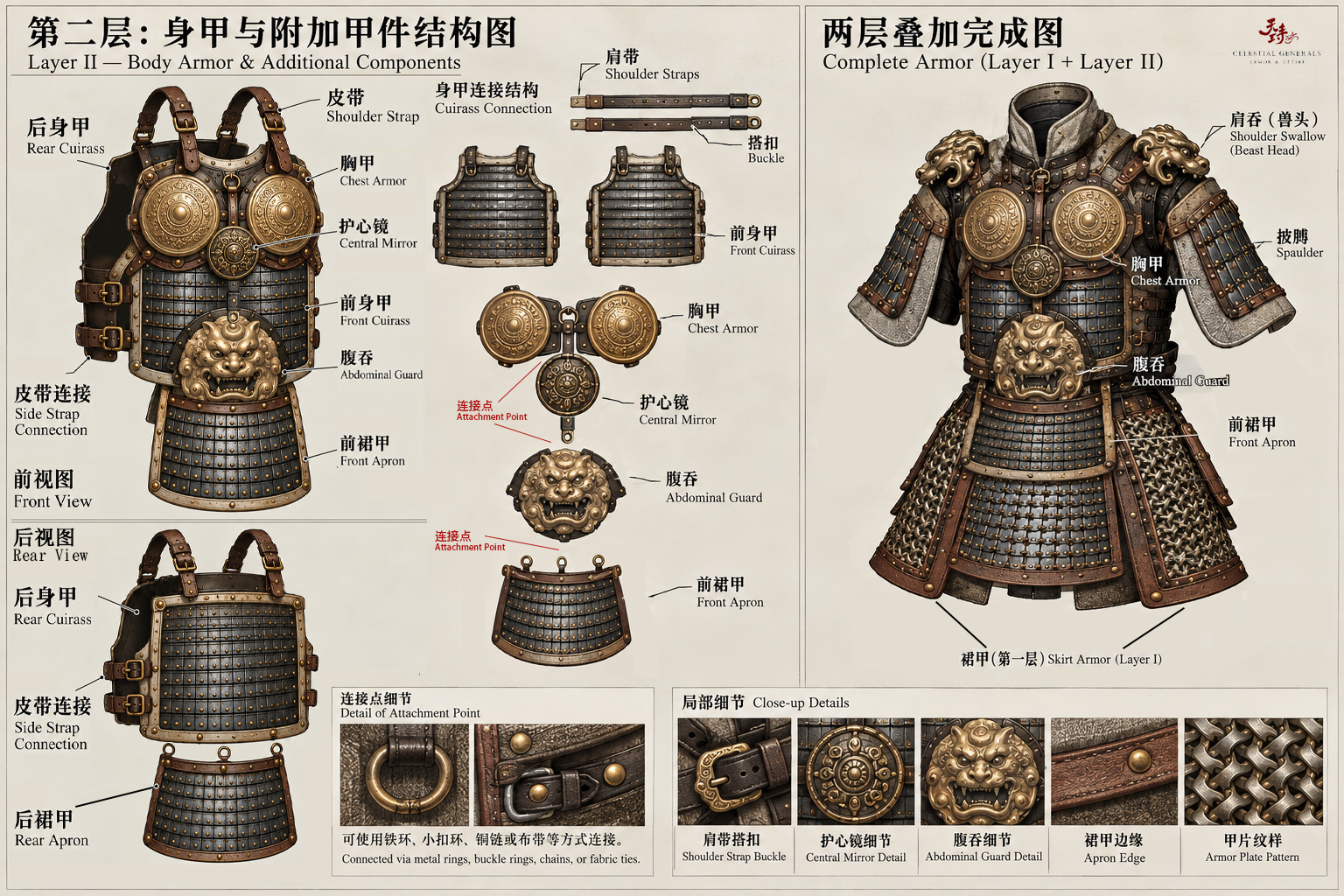
Traditional Chinese armor can therefore be understood as a wearable system of modules:
Draped on the body, suspended from its support, fastened by straps, secured into form, and completed through attached armor.
Independent parts become one stable, flexible, and maintainable whole.
This structural experience also clarifies expressions such as pigua shangzhen, “to take the field fully equipped,” and pigua zhengqi, “to have one’s equipment properly arranged.”
To be fully equipped is more than simply putting on a suit of armor. It means placing, hanging, fastening, and arranging armor, weapons, and necessary equipment piece by piece. When the pigua is in order, every component, buckle, tie, and Attachment Point is ready for movement and combat.
Pigua is therefore more than an ornate expression from the past. It describes a practical structural idea.
Armor is not one thing. It is a system that can be draped, suspended, fastened, removed, exchanged, and allowed to move with the body.
This is fundamental to Celestial Generals armor design. Shoulder Swallows, Arm Armor, Body Armor, Skirt Armor, Chest Armor, and Abdominal Guards may read as one complete silhouette, but each performs a different role. Beneath them, the Armor Support Vest, shoulder straps, leather straps, rings, chains, and ties organize the whole.
To understand Pigua is to begin to understand how Chinese armor lives on the human body.