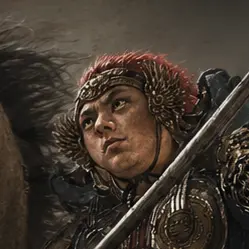
The Rolling War Cart is a legendary weapon of war closely associated with Gao Chong in The Complete Story of Yue Fei. It stands at the center of the famous episode known as “Gao Chong Lifts the War Carts.”
The novel itself calls these machines “iron hua carts” (铁华车). During the battle at Ox-Head Mountain, Gao Chong charges alone into the Jin camp, scatters its soldiers, and prepares to break into the southwestern stockade to burn its stores. Unable to stop him, the defending commander Ha Tielong orders the iron carts released. Gao Chong does not even know what they are at first, but when the first one rushes toward him, he raises it with his spear. He overturns one after another, eleven in succession. At the twelfth cart, Gao Chong himself can still fight, but his horse is utterly spent. It coughs blood and suddenly collapses to its knees, throwing him to the ground, where the oncoming cart crushes him.
The Rolling War Cart therefore becomes much more than an ordinary military vehicle in the Yue Fei story cycle. Its force comes from weight, speed, and terrain rather than from an intricate mechanism. The wonder of the scene lies in Gao Chong meeting that descending force head-on with a single spear.
Power Drawn from the Terrain
The cart is dangerous not simply because it is heavy, but because it rushes from high ground toward lower ground.
A mounted fighter advancing uphill has little room to evade on a narrow mountain road. Once the cart gathers speed, what bears down on Gao Chong is not merely a vehicle, but the combined force of its weight, the slope, and its momentum.
The episode is therefore a collision between forces moving in opposite directions:
Gao Chong and his horse charge upward; the cart drives downward.
That opposing movement is also what makes the story so powerful as an image.
Gao Chong’s Defining Legend
Gao Chong appears only briefly in The Complete Story of Yue Fei, yet the feat of lifting the war carts almost completely defines him.
He does not fall in an ordinary duel. He dies only after overturning eleven iron carts, when his mount can no longer carry him. A later lament quoted in the novel even mourns that the general’s horse was unequal to him.
His death therefore has a distinctive heroic tragedy. He is not defeated by inferior skill or fear. Man and horse are driven beyond their limit, and only then can they bear no more.
CG Visual Language
In CG, the Rolling War Cart should not look like an ordinary transport cart.
- a heavy wooden or mixed iron-and-wood structure
- a low, strongly built profile
- a clear sense of descending weight and impact
- an oppressive relationship with a narrow mountain road
- no need for an overly complex mechanism
- the essential idea of “a heavy object rushing downhill”
In a depiction of Gao Chong lifting the carts, elaborate decoration is less important than making one idea unmistakable:
An immense force is bearing down the slope, and Gao Chong is driving upward against it.