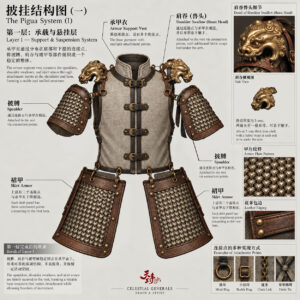
Skirt Panel names the left and right large side armor panels that hang beside the thighs. In the CG Pigua system they belong to the Armor Support Vest layer. They do not form one closed skirt and are distinct from the second-layer Front Apron and Rear Apron.
Support and Attachment
The Armor Support Vest is a front-opening upper-body garment that closes at the front. Along its lower edge, the two side panels may hang from several small iron rings or other attachment points. Multiple connections distribute the load and keep each panel stable; in another suitable construction, a panel may be structurally integrated with the support garment itself. These are approved CG reconstruction solutions, not one universal historical fastening method.
Openings and Controlled Movement
The left and right panels hang independently. They do not meet to close the lower body, so natural openings remain at both the front and rear. Each panel can separate, swing, lift outward, and move with its leg. This controlled freedom allows stepping, riding, and wider leg motion without forcing the wearer to fight against a rigid skirt.
Layering with the Front and Rear Aprons
The side Skirt Panels form the inner, first layer. After the Armor Support Vest and the front-and-rear Body Armor are worn, the Front Apron overlaps the front edges of both panels and the Rear Apron overlaps their rear edges. The protection comes from overlap, not from rigid closure.
Why the Front Apron Hangs from the Belly Swallow
CG hands-on reconstruction found that suspending the Front Apron from widely separated points on Front Body Armor makes the panel curve inward like part of a cylinder. A thigh lifting forward then pushes against the curve and tries to invert it, restricting a natural step and encouraging the leg to lift outward.
The approved CG solution uses two relatively close attachment points beneath the Belly Swallow. The Front Apron then behaves as one freely hanging panel: it can lift and swing forward, move out of the thigh’s path, and fall back under gravity. This is a controlled-mobility interpretation from reconstruction experience, not a universal historical claim.
Visual Identity and Evidence
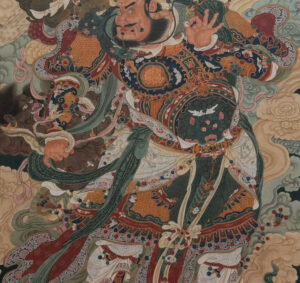
In images, identify the two broad panels at the left and right thighs, the open front and rear spaces, and the overlapping second-layer aprons. Historical images establish visible placement and overlap; hidden attachment details are stated only as CG reconstruction interpretation.