Source Work: Romance of the Three Kingdoms

  • 刘禅

    Liu Shan

    Liu Shan is the son of Liu Bei and the second ruler of Shu-Han in Romance of the Three Kingdoms. His life begins amid flight and collapse: as an infant at Changban, he is carried through Cao Cao’s army by Zhao Yun and returned to Liu Bei. That rescue makes him the child for whom a great warrior risks everything, yet the adult Liu Shan is not a battlefield hero. His power and his weakness both lie in the throne he inherits.

    After Liu Bei dies at Baidicheng, Liu Shan becomes emperor while Zhuge Liang assumes the burden of government and war. He accepts the chancellor’s authority through the southern campaign and repeated northern expeditions, receiving memorials from the front while the court waits on military news. After Zhuge Liang’s death, Jiang Wan, Fei Yi, and later Jiang Wei sustain the state, but eunuch Huang Hao gains influence and the court becomes less able to judge danger clearly.

    When Deng Ai crosses the mountains and reaches Chengdu, Liu Shan chooses surrender rather than a last defense. Shu ends, and he is taken to Luoyang as Duke of Anle. At Sima Zhao’s banquet he gives the famous answer that he is content there and does not miss Shu, a scene that leaves readers debating whether he is foolish, adaptable, or deliberately harmless. His importance is therefore political and tragic: he is the rescued heir who lives to yield the kingdom built for him.
  • Zhang He

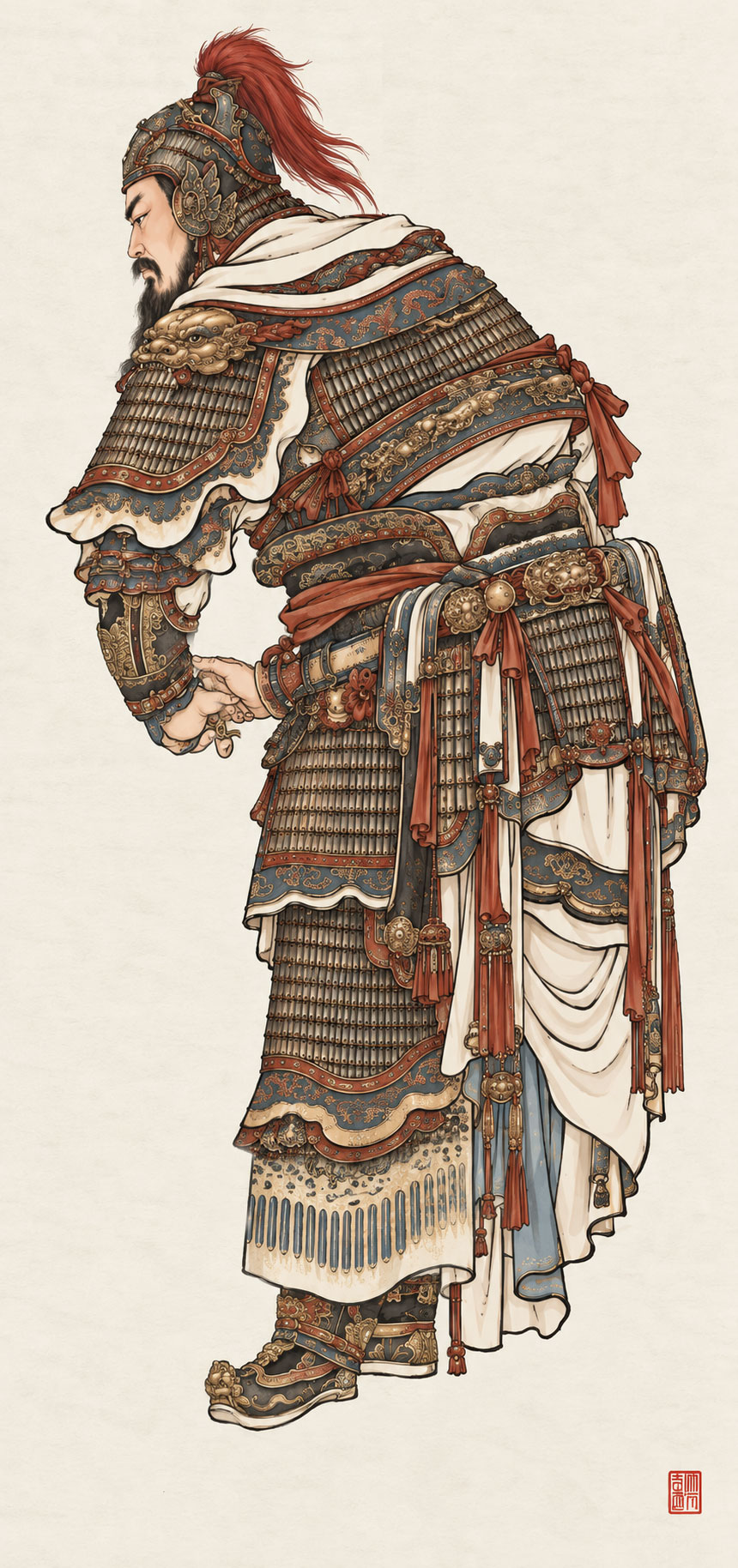
    Zhang He

    Zhang He is a prominent Cao Wei commander in Romance of the Three Kingdoms. He first serves under Yuan Shao before eventually entering Cao Cao’s camp and developing into one of the long-serving generals of the Wei military establishment.

    During the Battle of Guandu, Zhang He becomes caught in conflict within Yuan Shao’s command structure. As the situation deteriorates, he defects to Cao Cao and thereafter participates in numerous campaigns, gradually earning recognition for experience and battlefield command.

    Zhang He remains an important Wei commander well into the later Three Kingdoms period. He repeatedly fights the forces of Shu Han and becomes one of the principal Wei generals confronting Zhuge Liang’s northern expeditions.

    In the story surrounding Mumen Path, Zhang He pursues the retreating Shu forces into an ambush and is killed by a storm of arrows. His career stretches from Yuan Shao’s northern armies to the mature military system of Cao Wei, making him one of the most enduring warrior figures on the Wei side.

  • 严颜

    Yan Yan

    Yan Yan is an elderly commander of the Shu region in Romance of the Three Kingdoms who originally serves Liu Zhang as a defender of Ba Commandery. He is remembered for age, courage, and an uncompromising sense of martial honor.

    After Liu Bei enters Shu, Zhang Fei advances against Ba Commandery. Yan Yan holds the city and resists, but is eventually defeated and captured as the military situation turns against him.

    When Zhang Fei demands to know why he refused to surrender, Yan Yan answers without fear, declaring that there are generals who lose their heads, but no generals who surrender. His defiance impresses Zhang Fei rather than provoking his execution.

    Zhang Fei personally releases Yan Yan from his bonds, treats him with respect, and persuades him to join Liu Bei’s side. The episode makes Yan Yan one of the novel’s most memorable veteran warriors and also reveals Zhang Fei’s ability to honor courage and loyalty in an enemy.

  • 凌统

    Ling Tong

    Ling Tong, courtesy name Gongji, is a young Eastern Wu commander in Romance of the Three Kingdoms. His father Ling Cao dies from an arrow shot by Gan Ning while Gan Ning still fights for another lord. Ling Tong inherits the Sun family’s military service and carries the blood feud with him even after the killer submits to Sun Quan. Duty puts the two men in one army before emotion makes them comrades.

    At Xiaoyao Ford, Ling Tong has only a few hundred riders when Zhang Liao’s force crashes toward Sun Quan. He orders his lord across the broken bridge and turns back to fight, buying the time needed for escape. His immediate followers die, but Ling Tong cuts his way back. Later, at the banquet after Wancheng, praise of Gan Ning revives the old hatred. Ling Tong draws a sword under the pretense of dancing; Gan Ning takes up paired halberds, and Lü Meng physically places himself between them.

    The feud ends on another battlefield. Ling Tong fights Zhang Liao for fifty bouts, then meets Yue Jin for another fifty. A hidden arrow strikes his horse and throws him down as Yue Jin charges to kill him. Gan Ning fires first, hits Yue Jin in the face, and saves Ling Tong. When Sun Quan reveals who released the arrow, Ling Tong bows to his father’s former killer and the two bind themselves as brothers in life and death. His story makes courage only half the test; the harder victory is accepting a deed that loyalty has transformed.

  • 黄盖

    Huang Gai

    Huang Gai, courtesy name Gongfu, is a veteran commander of Eastern Wu in Romance of the Three Kingdoms. He serves the Sun family across the generations of Sun Jian, Sun Ce, and Sun Quan and belongs to the older military core of Jiangdong.

    His most famous role comes before the Battle of Red Cliffs. As part of the plan to destroy Cao Cao’s fleet by fire, Huang Gai and Zhou Yu stage a “self-injury scheme.” Zhou Yu publicly has Huang Gai beaten so that Cao Cao’s side will believe the veteran commander has been humiliated and is ready to defect.

    Huang Gai then secretly sends a false surrender message to Cao Cao and approaches the Wei fleet with ships loaded with flammable material. Once close enough, the vessels are set ablaze, allowing the fire attack to spread through Cao Cao’s naval camp.

    Huang Gai is therefore remembered not only as a veteran warrior but as one of the essential executors of the Red Cliffs strategy. The famous story of “Zhou Yu beating Huang Gai” makes him one of the most recognizable loyal old commanders in the Three Kingdoms tradition.

  • 程普

    Cheng Pu

    Cheng Pu, courtesy name Demou, is one of the most senior commanders of Eastern Wu in Romance of the Three Kingdoms. He serves three generations of the Sun family—Sun Jian, Sun Ce, and Sun Quan—and belongs to the veteran military core that helps establish Jiangdong power.

    Cheng Pu is already campaigning under Sun Jian during the family’s early rise. After Sun Jian’s death, he continues under Sun Ce and participates in the fighting that secures the Jiangdong territories and builds the foundations of the future Wu state.

    When Sun Ce dies and Sun Quan succeeds him, Cheng Pu remains one of the regime’s experienced commanders. As Cao Cao advances south before the Battle of Red Cliffs, Cheng Pu joins Zhou Yu and others in preparing resistance. His seniority initially creates some tension with the younger Zhou Yu, but both ultimately serve the same war effort.

    Cheng Pu continues in Eastern Wu service after Red Cliffs. His importance lies less in a single spectacular episode than in the continuity of his service across three generations, making him one of the clearest representatives of the old military guard behind the rise of the Sun family.

  • 于禁

    Yu Jin

    Yu Jin, courtesy name Wenze, is an important commander under Cao Cao in Romance of the Three Kingdoms. He serves through many years of warfare and becomes known for strict discipline and uncompromising enforcement of military orders. He joins Cao Cao’s camp relatively early and takes part in major campaigns during the consolidation of northern China.

    Over the course of these wars, Yu Jin develops into a commander capable of leading substantial forces independently. Alongside figures such as Zhang Liao and Xu Huang, he becomes part of the durable military establishment supporting Cao Cao’s expanding power.

    During Guan Yu’s northern campaign against Xiangyang and Fancheng, Yu Jin is ordered to lead reinforcements to Cao Ren, with Pang De also taking part in the defense. Heavy autumn rains cause catastrophic flooding, and Guan Yu uses the disaster to overwhelm the Wei armies in the celebrated episode known as the “Flooding of the Seven Armies.” Pang De refuses to surrender and is killed, while Yu Jin submits to Guan Yu.

    The surrender casts a long shadow over Yu Jin’s earlier reputation. Although he eventually returns to Wei, the defeat at Fancheng permanently alters how his career is remembered. His story is therefore marked by a sharp contrast between decades of disciplined service and a single disastrous campaign that comes to dominate his final image.

  • 张苞

    Zhang Bao

    Zhang Bao is the son of Zhang Fei in Romance of the Three Kingdoms and one of the important second-generation warriors of Shu Han. He inherits much of his father’s martial image and begins to take a larger role in the wars that follow the generation of Liu Bei, Guan Yu, and Zhang Fei.

    When Liu Bei launches his campaign against Eastern Wu to avenge Guan Yu, Zhang Bao serves alongside Guan Xing, the son of Guan Yu. The two young warriors initially quarrel over the position of vanguard, but Liu Bei eventually arranges for them to become sworn brothers and fight together.

    Zhang Bao and Guan Xing thereafter appear repeatedly as a pair, representing a new generation of Shu commanders. Their partnership deliberately echoes the bond between their fathers and gives the Shu military tradition a sense of inheritance across generations.

    During later northern campaigns, Zhang Bao continues to serve in the field. While pursuing enemy forces, however, he suffers a serious accident after falling into a ravine and later dies from his injuries. His early death removes one of Shu’s promising younger warriors and brings the partnership between the sons of Zhang Fei and Guan Yu to a premature end.

  • 曹洪

    Cao Hong

    Cao Hong is a clan cousin and early officer of Cao Cao in Romance of the Three Kingdoms. His defining act comes after Cao Cao’s rash pursuit from Luoyang ends in defeat by Xu Rong. Cao Cao’s horse is killed and his position seems hopeless. Cao Hong dismounts and offers his own mount, answering the refusal with the judgment that the world can do without Cao Hong but cannot do without Cao Cao. He then finds a boat and helps carry his wounded lord across the Bian River.

    That devotion does not make him an infallible commander. At Tong Pass, Cao Hong and Xu Huang are ordered to hold for ten days without offering battle. For eight days Cao Hong endures abuse from Ma Chao’s side; on the ninth he can bear no more, rides out, and is lured into losing the pass. Cao Cao prepares to execute him, and the other officers plead for mercy. The episode fixes both sides of his character: personal bravery and clan loyalty are unquestioned, but anger can break the discipline required of an independent commander.

    Cao Hong later recovers standing in the western wars. In the Hanzhong fighting he takes the field, kills Ren Kui in a brief mounted encounter, and helps drive back Wu Lan’s force while directing subordinate commanders. His martial weight lies below the novel’s supreme duelists but above that of a ceremonial kinsman; he rescues the future ruler with his own horse, receives real operational responsibility, fails publicly, and returns to useful command. The novel does not build a dramatic death for him, so his completed arc is one of durable service rather than a final heroic sacrifice.