Source Work: Romance of the Three Kingdoms

  • 苦肉计

    Self-Torture Stratagem

    The Self-Torture Stratagem is one of the most famous deceptions surrounding the Battle of Red Cliffs in Romance of the Three Kingdoms. It is a dangerous performance carried out by Zhou Yu and the veteran general Huang Gai.

    The allied forces hope to destroy Cao Cao’s fleet with fire, but there is a problem. Fire ships cannot simply sail into the enemy camp without arousing suspicion.

    Someone must appear to defect.

    Huang Gai volunteers.

    Cao Cao, however, is notoriously suspicious. A letter promising surrender will not be enough. Zhou Yu and Huang Gai therefore decide that the deception must look painfully real.

    During a military council, Huang Gai deliberately challenges Zhou Yu. Zhou Yu responds with fury and orders the old general severely beaten.

    Other officers plead for mercy, but Huang Gai is left badly wounded.

    To everyone watching, the humiliation appears genuine. Huang Gai now seems to have every reason to hate Zhou Yu.

    A secret message is then sent to Cao Cao. Huang Gai claims that after years of service he has been cruelly punished and now wishes to defect with his men.

    Cao Cao remains cautious at first, but the story of Huang Gai’s punishment makes the surrender increasingly believable.

    When the decisive day arrives, Huang Gai’s ships approach Cao Cao’s position. The enemy sees what appears to be the promised defection and allows the vessels to come near.

    Only then is the trap revealed.

    The ships are set ablaze and driven directly into Cao Cao’s fleet.

    The brilliance of the Self-Torture Stratagem lies not simply in Huang Gai enduring a beating. Zhou Yu and Huang Gai must deceive almost everyone around them in order to deceive Cao Cao. Huang Gai pays for one moment of enemy trust with his own blood, and that moment is enough to bring the fire ships within reach.
  • 连环计

    Chain Stratagem

    The Chain Stratagem is one of the key deceptions that prepares the way for the fire attack at Red Cliffs in Romance of the Three Kingdoms. Its most famous element is Pang Tong’s advice that Cao Cao bind his warships together.

    Many of Cao Cao’s soldiers come from the north and are unused to fighting on the river. The movement of the ships leaves men seasick and weak, creating a serious problem for the enormous army.

    At this moment Pang Tong, the celebrated Young Phoenix, enters Cao Cao’s camp.

    He offers an apparently clever solution.

    If the ships are fastened together with iron rings and connected by planks, he explains, the fleet will become as steady as solid ground. Northern soldiers will be able to walk, drill, and fight without suffering from the constant movement of separate vessels.

    Cao Cao is delighted by the proposal.

    Soon the ships are linked together in great groups. The soldiers find the decks more stable, and Cao Cao becomes even more convinced that the plan has strengthened his fleet.

    What he does not realize is that the arrangement creates exactly the condition the fire attack requires.

    A single burning ship might normally be isolated or moved away. A mass of vessels locked together cannot separate quickly once flames begin to spread.

    When Huang Gai’s fire ships finally rush into Cao Cao’s naval camp, the connected fleet becomes a vast field of fire.

    The Chain Stratagem is memorable because the trap first appears to solve a real problem. Pang Tong gives Cao Cao relief from seasickness and instability, but the solution quietly binds the entire fleet together in preparation for the final blaze.

  • 华容道

    Huarong Pass

    Huarong Pass is one of the most famous locations associated with the aftermath of Red Cliffs in Romance of the Three Kingdoms. Its fame comes not from geography itself, but from the legendary meeting between the defeated Cao Cao and Guan Yu.

    After fire consumes Cao Cao’s fleet at Red Cliffs, his great southern campaign collapses. The commander who had marched south with enormous confidence is reduced to fleeing north with exhausted remnants of his army.

    Zhuge Liang, however, has already anticipated the route of retreat.

    Zhao Yun, Zhang Fei, and other forces appear in ambush along the way, adding fresh attacks to Cao Cao’s misery. By the time he reaches Huarong Pass, his battered column has already endured repeated shocks.

    Then another force appears ahead.

    Its commander is Guan Yu.

    Cao Cao understands the danger, but he also remembers the past. When Guan Yu had temporarily remained under Cao Cao’s authority, Cao Cao treated him generously, offering gifts, robes, and the famous Red Hare horse. Guan Yu eventually left to seek Liu Bei, but he never forgot the kindness he had received.

    At Huarong Pass, Cao Cao appeals to that old debt.

    Guan Yu has military orders and should stop him. Yet faced with a man who once treated him with honor, he cannot entirely silence his sense of obligation.

    In the end, Guan Yu allows Cao Cao to escape.

    He must later return and answer to Zhuge Liang for disobeying the military order.

    Huarong Pass therefore becomes one of the great stories of yi — personal loyalty, obligation, and honor — in the Romance. The fire at Red Cliffs decides the battle, but the moment at Huarong Pass reveals the men themselves: Cao Cao searching for survival even in disaster, Zhuge Liang anticipating the path ahead, and Guan Yu unable to forget an old kindness even when duty demands otherwise.

  • 汉献帝

    Emperor Xian

    Emperor Xian, Liu Xie, is the last emperor of the Eastern Han in Romance of the Three Kingdoms. He ascends the throne while still young, yet from the beginning he has little control over his own fate.

    After Dong Zhuo seizes power in Luoyang, he removes the young emperor and places Liu Xie on the throne. Dong Zhuo’s death does not restore imperial authority. Emperor Xian instead falls into the hands of competing military strongmen, including Li Jue and Guo Si, while the court sinks deeper into disorder.

    The situation changes when Cao Cao receives the emperor and establishes the court at Xu. Emperor Xian escapes the immediate chaos of the earlier warlords, but he now lives under Cao Cao’s power. Cao Cao can issue commands in the emperor’s name, giving him an enormous advantage over his rivals.

    The emperor is not entirely passive. Court conspiracies such as the famous Girdle Edict attempt to rally loyalists against Cao Cao, but these efforts fail. As Cao Cao’s power grows, the emperor’s room for independent action becomes increasingly narrow.

    After Cao Cao’s death, Cao Pi inherits his father’s position and soon forces Emperor Xian to abdicate. The Han dynasty finally comes to an end.

    In the Romance narrative, Emperor Xian is not a battlefield hero, but he stands at the center of the struggle for legitimacy. His imperial title becomes a prize and a political weapon for Dong Zhuo, Cao Cao, Liu Bei, and the competing lords of the age.

  • Battle of Guandu

    Battle of Guandu

    The Battle of Guandu is the decisive confrontation between Cao Cao and Yuan Shao for control of northern China in Romance of the Three Kingdoms.

    Yuan Shao commands the larger army and possesses enormous resources in the north. When his forces advance south, Cao Cao appears to be at a severe disadvantage. His army is smaller, supplies are increasingly strained, and the long confrontation threatens to exhaust him.

    The dramatic turning point comes with Xu You. Once a member of Yuan Shao’s camp, Xu You quarrels with his former side and secretly defects to Cao Cao. According to the famous story, Cao Cao is so delighted by his arrival that he rushes out barefoot to welcome him.

    Xu You reveals that Yuan Shao’s great supply depot is located at Wuchao and is poorly protected. Cao Cao immediately decides on a dangerous surprise attack. Leading picked troops through the night, he strikes Wuchao and burns the enemy supplies.

    Once the granaries are in flames, Yuan Shao’s army falls into confusion. Internal suspicion and poor command deepen the disaster, and commanders such as Zhang He eventually turn to Cao Cao. Yuan Shao’s great army collapses.

    The enduring drama of Guandu lies in its sudden reversal of strength. Cao Cao, outnumbered and under pressure, identifies one vulnerable point and destroys the foundation of Yuan Shao’s campaign. The victory becomes one of the most famous tales of winning against overwhelming odds in Cao Cao’s legend.

  • 曹魏

    Cao Wei

    Cao Wei is the state that grows from the power built by Cao Cao and becomes one of the three great camps of Romance of the Three Kingdoms.

    Its story begins above all with Cao Cao. Acting in the emperor’s name, he defeats powerful rivals such as Lü Bu and Yuan Shao while gathering talented commanders and advisers around him. His power expands from the central plains across much of northern China.

    Cao Cao’s camp includes famous warriors such as Zhang Liao, Xu Huang, Xiahou Yuan, and Cao Ren. Each has his own celebrated battles, but together they form one of the strongest groups of military heroes in the Romance.

    Cao Cao himself never formally becomes emperor. After his death, Cao Pi inherits his position, forces Emperor Xian to abdicate, and establishes the state of Wei. The power Cao Cao spent years building now becomes Cao Wei.

    Within the Romance, Cao Wei is more than the name of a political state. It is one of the great heroic camps of the story, standing against Liu Bei’s Shu and Sun Quan’s Wu. Battles such as Guandu, Red Cliffs, Hefei, and Hanzhong repeatedly bring these rival networks into conflict.

    Within Celestial Generals, Cao Wei is most useful not as a subject of institutional history, but as a network hub connecting Cao Cao, Zhang Liao, Xu Huang, Xiahou Yuan, Cao Ren, and the great wars of the Three Kingdoms.

  • 赤壁之战

    Battle of Red Cliffs

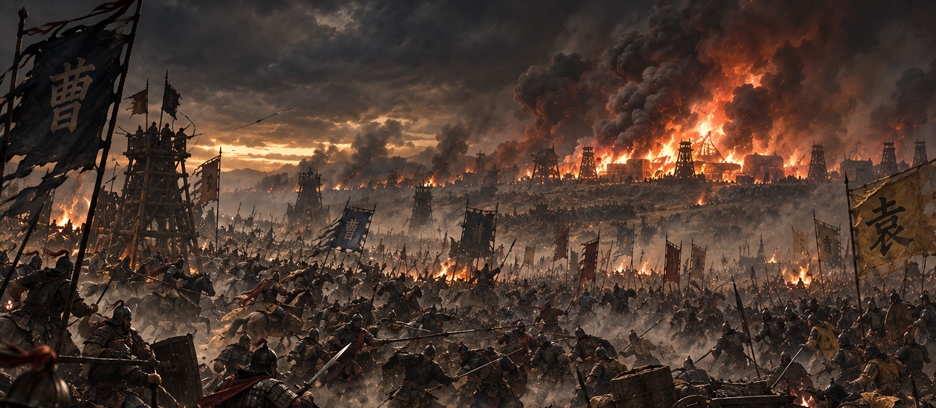
    The Battle of Red Cliffs is one of the most famous great battles in Romance of the Three Kingdoms and a turning point in the fortunes of Cao Cao, Liu Bei, and Sun Quan.

    After unifying the north, Cao Cao leads his great army south. Jing Province quickly falls, Liu Bei retreats under pressure, and Sun Quan faces a momentous choice: submit to Cao Cao or risk everything in battle.

    Zhuge Liang travels to Eastern Wu and argues forcefully for an alliance against Cao Cao. Zhou Yu ultimately chooses resistance, setting the stage for a great confrontation along the Yangtze.

    To break Cao Cao’s fleet, Zhou Yu and Huang Gai prepare the famous ruse of self-inflicted punishment. Huang Gai allows himself to be publicly beaten and then sends word that he wishes to surrender to Cao Cao. At the same time, Pang Tong’s linked-ships stratagem causes the northern warships to be chained together.

    On the night of the decisive attack, Huang Gai leads vessels toward Cao Cao’s fleet as though coming over in surrender. The boats are packed with flammable materials. Once they draw near, they are suddenly set ablaze.

    Driven by the wind, the fire ships crash into Cao Cao’s chained fleet. Flames race from vessel to vessel until the river seems covered by a sea of fire.

    Cao Cao suffers a disastrous defeat and flees north with the remnants of his army. Along the road he encounters further attacks from commanders including Zhao Yun and Zhang Fei. At Huarong Pass he finally meets Guan Yu. Remembering their former bond, Guan Yu allows Cao Cao to escape with his life.

    The enduring appeal of Red Cliffs lies not simply in victory and defeat, but in the succession of stratagems and unforgettable personalities: Zhuge Liang, Zhou Yu, Huang Gai, Pang Tong, Cao Cao, and Guan Yu all take their turns on the stage. It becomes one of the grandest legendary dramas in the entire Romance.

  • Pang Tong

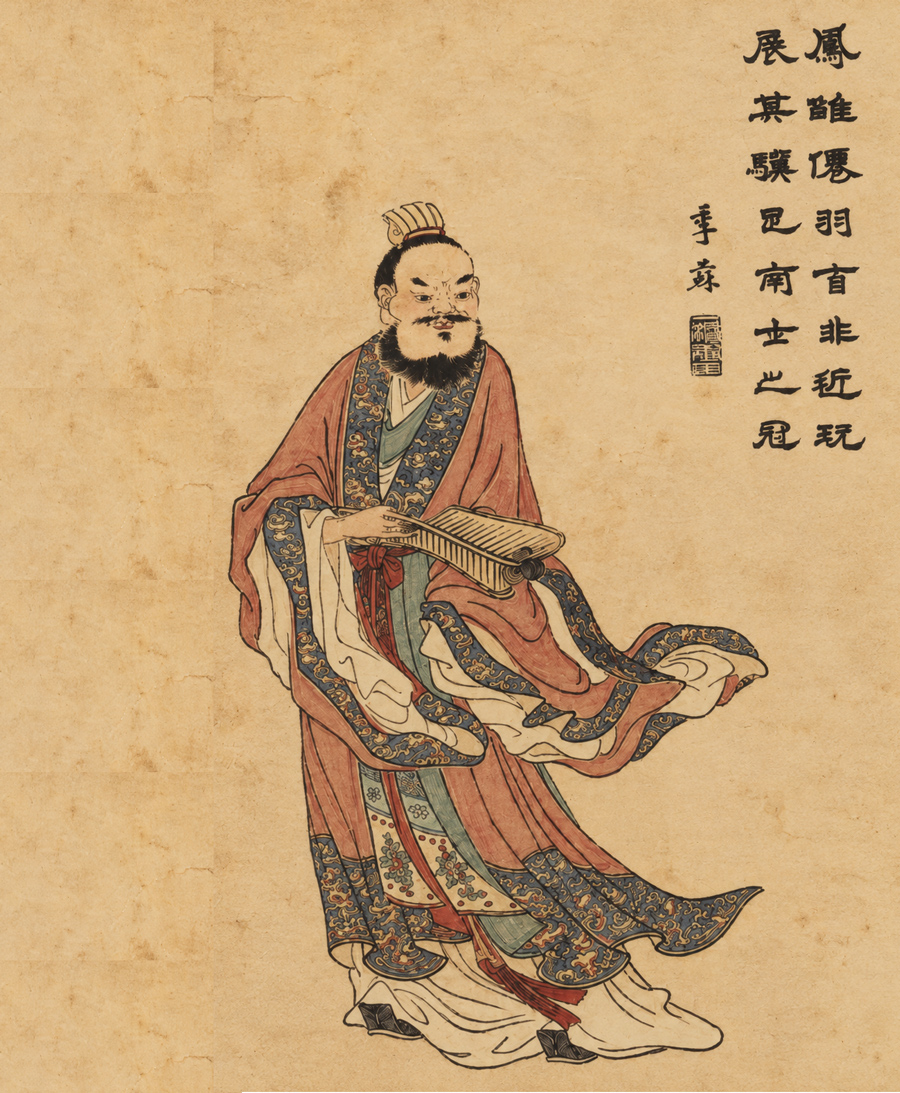
    Pang Tong

    Pang Tong is the strategist called the Young Phoenix in Romance of the Three Kingdoms. Sima Hui places his reputation beside Zhuge Liang’s Sleeping Dragon, yet Pang Tong enters Liu Bei’s service without an impressive appearance or immediate honor. At Red Cliffs he helps make Cao Cao accept the chained-fleet arrangement, turning the northern navy’s need for stability into the condition that allows the fire attack to spread.

    His first appointment under Liu Bei is only the magistracy of Leiyang. Pang Tong neglects the office, then clears a hundred days of accumulated cases in a brief sitting when Zhang Fei comes to investigate. Liu Bei realizes that he has misjudged the man, while recommendations from Lu Su and Zhuge Liang confirm his ability. Pang Tong is elevated and becomes one of the chief minds behind the move into Yi Province.

    When Liu Bei hesitates over taking Liu Zhang’s territory, Pang Tong presents upper, middle, and lower plans, each balancing speed, risk, and political cost. He accompanies the army and presses the campaign forward, but his urgency leads into tragedy. Riding beneath an unlucky association at Luofeng Slope, he is caught in Zhang Ren’s ambush and killed by arrows. His short career gives the Young Phoenix unusual weight: a thinker rated beside Zhuge Liang whose death removes the adviser most willing to force Liu Bei toward a kingdom in the west.

  • 鲁肃

    Lu Su

    Lu Su is the Eastern Wu adviser who gives Sun Quan a long view of the realm in Romance of the Three Kingdoms. Born to wealth, he spends freely on guests and soldiers before entering Sun Quan’s service. Rather than think only about surviving between Cao Cao and Liu Bei, he urges his lord to hold the southeast, build independent strength, and wait for a chance to contend for the empire.

    His decisive work comes before Red Cliffs. When Cao Cao advances south, Lu Su argues against surrender, travels to meet Liu Bei’s party, and brings Zhuge Liang to Wu. He works between Sun Quan, Zhou Yu, and the allied camp while suspicion threatens to break cooperation. After Zhou Yu’s death, Lu Su succeeds to major command and continues to favor a workable Sun–Liu alliance, even as possession of Jingzhou turns the partners into rivals.

    The dispute culminates in the banquet meeting with Guan Yu. Lu Su intends to press Wu’s claim and surrounds the gathering with armed men, but Guan Yu arrives with his great blade and leaves safely after a tense exchange. The episode often makes Lu Su appear mild beside more theatrical warriors, yet it also shows the burden placed on him: he must demand territory from the most feared general of Shu without starting a ruinous war. His standing comes from judgment, patience, and the authority to speak for Sun Quan at the alliance’s breaking point.