I. The Third Day
The last snow around Liangshan Marsh had begun to thaw. Lin Chong still had no head to take back to the mountain.
Wang Lun had given him three days. Kill a traveler, bring in the severed head, and he would be admitted as a brother. Fail, and even Chai Jin’s letter of introduction would buy him no place at the table.
On the first day no lone traveler came. On the second, a company of more than three hundred passed along the road, its rear close behind its front. Lin Chong watched from the trees and let them go. By the third day he and a young mountain follower were waiting beside the eastern road. The sun rose higher. Snow glare filled the track, but no one appeared.
The follower kept looking down the slope. Lin Chong had stopped speaking.
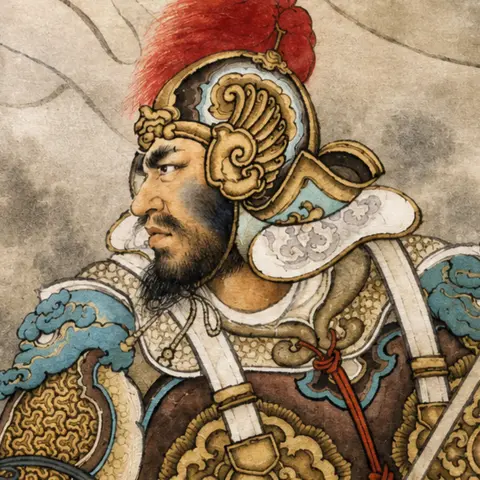
Not long before, he had trained the spearmen and staff fighters of the imperial guards in Tokyo. Gao Qiu’s son had coveted his wife; Gao Qiu had lured him into the White Tiger Hall, then sent him away as a branded exile. Lin Chong had nearly been murdered in Wild Boar Forest. The fodder depot where he was stationed had been set on fire. At the mountain shrine, he had finally killed Lu Qian and the others sent against him. There was no home to return to after that night. Chai Jin had helped him escape and recommended him to Liangshan. Lin Chong thought he had reached a refuge. Instead, Wang Lun, afraid of his skill, wanted a stranger’s life as the price of entry.
Lin Chong had killed before. Choosing an innocent passerby because a bandit chief required it was another matter.
He glanced at the sky. “Enough. I’ll collect my things and find somewhere else.”
“Brother—someone’s coming!” the follower said.
A porter was climbing the slope with a heavy carrying pole. Lin Chong waited until the man came level with the trees, then sprang into the road. The porter cried out, dropped his load and ran. Lin Chong chased him over the rise but could not catch him. When he returned, the follower had already hauled the baggage clear of the trees.
“There may be money in it,” the young man said. “That might serve.”
Lin Chong did not answer. Wang Lun had asked for a head, not a bundle. He was turning back toward the road when a shout came from below, loud enough to shake loose snow from the branches.
“Thieves! Where have you taken my baggage?”
II. The Blue-Faced Man
The man came up the slope at a run.
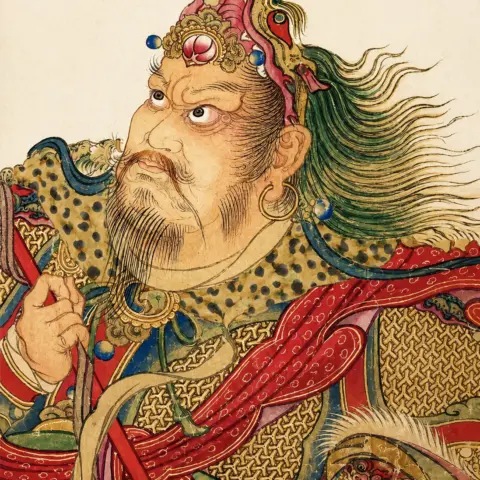
His Fan-yang felt hat had fallen back, its red tassel whipping in the wind. A sash bound his white satin traveling coat; cloth gaiters wrapped his legs. A saber hung at his waist, and a long-handled saber—a pu dao—was already in his hands. He was tall, with the beginnings of a reddish beard. Across his face lay a large blue birthmark, unmistakable even against the dirty snow.
Lin Chong did not know him. He did not know Lin Chong.
His name was Yang Zhi. He came from a military family, had passed the martial examination, and had served as an officer of the Palace Command. When the court ordered ten officers to transport ornamental stones for the imperial garden, Yang Zhi’s vessel sank in a storm on the Yellow River. Afraid to answer for the loss, he fled west. An amnesty had now given him a chance to return to Tokyo and seek a commission. The money and belongings in that load were all he had brought to make the journey possible.
He had hired the porter and followed behind him. At the man’s cry he hurried forward to find his possessions gone and an armed stranger in the road. The fear he had carried all the way from the west gave way to anger. He did not ask again for his baggage. He leveled the pu dao and charged.
Lin Chong had endured three days of Wang Lun’s suspicion. The attacker was fast and his weapon was ready. Lin Chong had neither time nor temper for introductions. He stepped into the rush.
The two long blades met.
III. Two Blades in the Thaw
Steel rang over the stream. Neither man gave ground.
The pu dao could cut with its broad blade or drive forward on its long shaft. The track left little room to turn: trees heavy with melting snow stood to one side, and shallow water skinned with ice lay to the other. A bad step would give the opposing blade a clear path. Yang Zhi pressed toward the center at once, desperate to recover his load. Lin Chong caught the stroke crosswise, bore down on the shafts and sent his edge toward Yang Zhi’s shoulder. Yang Zhi lowered his wrists to break the pressure. They passed, turned, and faced each other with a different kind of attention.
One exchange had told each man that the other was trained.
Yang Zhi’s blade had been taught in military yards. He did not spend strength on flourishes. His feet claimed the ground before him; when the cut fell, his waist and legs drove it, and when the blade returned, the shaft guarded his body. Lin Chong had taught spear and staff in the capital. He knew how to yield a line without opening a gate. Catch, guide, turn, press: his weapon kept moving between Yang Zhi and the road behind him.
They fought along the stream. A blade shaved cloth from a sleeve. Shaft struck shaft hard enough to numb their palms. The thin ice broke underfoot, and hard earth became a slick mash of mud and snow. The young follower set down the stolen load and retreated among the trees. From there he saw the two edges close and separate and dared come no nearer.
Yang Zhi dropped his blade as though to sweep a leg, then turned his wrists and sent the edge upward. Lin Chong stepped away; steel passed before his chest. On the retreat he wheeled his own weapon, its point reaching for Yang Zhi’s ribs. Yang Zhi struck the shaft aside, let his shoulder move with the force, and drove straight back at him. Lin Chong twisted clear. They met again at less than half a pace.
No judge watched from a training platform. No ranks of soldiers stood ready to call the bout. There was only the hiss of a long blade through cold air, water moving beneath the ice, and the sound of two men breathing harder.
After some thirty exchanges, neither had won an advantage.
Lin Chong knew this blue-faced man would not be driven off by a few fierce strokes. He was strong, his technique sound, and the longer they fought, the more firmly he kept his form. Yang Zhi saw that the dust on his opponent’s clothes concealed a soldier’s hands. Several times Yang Zhi had pressed close; each time the other blade returned to the one place it needed to be.
Neither asked for a name.
If Lin Chong withdrew, his three days would end with no token for Wang Lun. If Yang Zhi withdrew, his baggage would go up the mountain. A space opened between the blades, and both men stepped into it again.
They fought for a further dozen or so exchanges. What had begun with testing had become a contest for the smallest opening. Lin Chong offered half the road, tempting Yang Zhi into a long advance. Yang Zhi entered, checked his own momentum, and thrust the shaft outward across Lin Chong’s return cut. Their weapons locked. Both edges hung within a few feet of their faces. Both men strained, released, and stepped back.
Their boots had scraped the snow away to dark soil. Yang Zhi’s hat hung behind him; sweat ran beside the blue mark on his face. Lin Chong’s bristling beard framed a face set in concentration, his hands still steady on the shaft. Neither looked beaten. One mistaken step could still end the fight.
Yang Zhi was coming forward when a voice rang down from the height.
“Good men! Stop fighting!”
Lin Chong knew the voice came from the stronghold. He sprang clear. Yang Zhi saw him lower his blade and did not pursue, though he kept his own weapon across his body and his eyes on the men descending the hill.
Wang Lun came down with Du Qian, Song Wan and a crowd of followers. They crossed the water by boat. Wang Lun looked from the fighters to the tracks churned through the snow.
“Two fine long-handled sabers,” he said. “Wonderful work with both.” He turned to Yang Zhi. “This is our new brother, Lin Chong, once an instructor of the imperial guards in Tokyo. And you, blue-faced friend—who are you?”
Only then did Yang Zhi learn the name of the man he had been fighting.
He lowered the point a little. “Yang Zhi. People call me the Blue-Faced Beast. That load is mine. Give it back, and this ends here.”
Lin Chong, in turn, learned that the man who had held him through both stretches of the fight was Yang Zhi, the former Palace Command officer.
IV. One Feast, Two Roads
Wang Lun knew Yang Zhi’s reputation. He invited him up to the stronghold for wine and promised to return the baggage afterward. Yang Zhi had no wish to enter, but with his possessions in mountain hands he could hardly refuse.
In the hall, Wang Lun, Du Qian, Song Wan and Zhu Gui sat on one side; Yang Zhi and Lin Chong on the other. Yang Zhi told them of the sunken transport, his years of avoiding punishment in the west, and the amnesty that had opened the road back to Tokyo. Wang Lun listened with a second purpose. Lin Chong’s skill made him uneasy. If Yang Zhi could be persuaded to stay, neither fighter would stand alone in the stronghold.
Wang Lun filled Yang Zhi’s cup. “You may have been pardoned, Officer Yang, but that does not mean your old post will be returned. Gao Qiu commands the army now. Why would he welcome you? Stay here instead. Eat and drink with brothers who know what you can do.”
Lin Chong glanced at Yang Zhi. The warning about Gao Qiu rang true to a man whose home and office had been taken from him. Yang Zhi left the wine untouched.
“I have family in Tokyo,” he said. “They suffered because of my case. I have yet to make it right with them. Whatever happens, I must go.”
“And if the court refuses you?”
“That is a question for Tokyo.” Yang Zhi pushed the cup back toward the center of the table. “For today, I ask for my baggage. If I cannot have it, I shall leave without it.”
The hall fell quiet. Wang Lun saw that he would not turn him.
“We would never force a guest to stay,” he said at last. “Rest the night. We’ll send you off in the morning.”
Yang Zhi thanked him. Lin Chong made no attempt to persuade him. Both had served in the capital’s armed ranks; both had been driven onto this road. Lin Chong had no door left to knock on. Yang Zhi still believed his skill might open one.
Wang Lun gave a farewell feast the next day and returned the load intact. The leaders accompanied Yang Zhi to the road below. A follower ferried him across the water; on the far bank he hired another porter and set out for Tokyo.
Lin Chong stayed on the shore.
The fight had brought Wang Lun no severed head. It had shown the stronghold what Lin Chong could do—and shown Lin Chong what Wang Lun feared. With Yang Zhi gone, Wang Lun had no further pretext for keeping him outside. He gave Lin Chong the fourth seat in the hall.
Years later, Yang Zhi would come to Liangshan after all. Wang Lun would no longer be there, and the two fighters would no longer be strangers quarreling over a load on a mountain road. On this afternoon, with the snow only just melting, neither knew any of that. One remained beside the marsh. The other took the road to Tokyo.
V. On Their Fighting Skill
The terms of this encounter make it unusually revealing. The two men had never met. Both fought on foot with pu dao, without horses or supporting troops. The source first records some thirty exchanges without a victor, then another dozen or so before Wang Lun and his men called a halt. Both figures are approximate. They cannot be added up into a precise total, and the interruption cannot be rewritten as a victory for either man.
Lin Chong, an imperial guard instructor, held his guard through a long contest. Yang Zhi, trained for the martial examination and formerly an officer of the Palace Command, arrived in haste after his baggage was taken yet kept his blade, footing and stamina. His later display with spear, bow and horse at Daming further shows the breadth of that military training.
On this ground, with these weapons, neither gained a decisive advantage. The novel does not say who would have prevailed had no one intervened. This fight can show the quality of both men’s soldierly skill; it cannot establish their absolute standing against every fighter in Water Margin.