I. No Way Back from Yellow Mud Ridge
The men on Yellow Mud Ridge still lay scattered where the drugged wine had brought them down. Yang Zhi had already understood that the birthday gifts were gone.
He had left Daming in charge of chests of jewels intended for the Grand Tutor Cai. He had also been put in charge of men who resented his every order. He had forced them along harder roads and through the heat, knowing thieves would be watching for a rich caravan. On the ridge they had bought the wine he forbade. By the time Yang could stand again, there was nothing left on the carts.
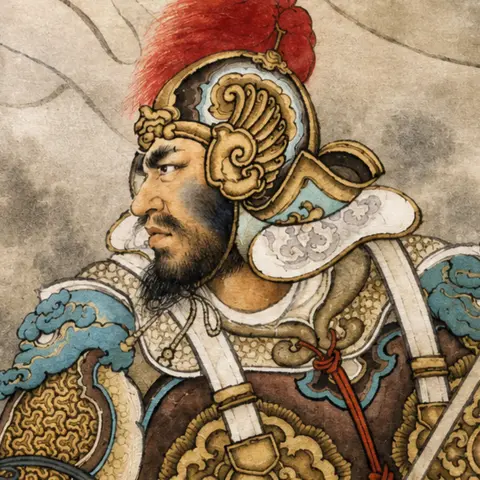
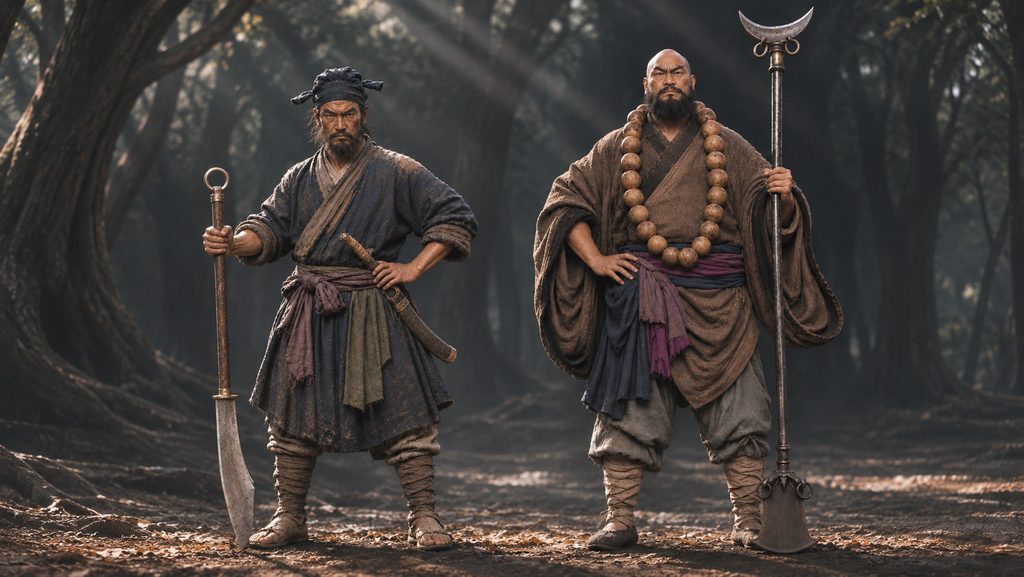
For a moment he approached the edge of the slope. Governor Liang’s trust, his lost post in Tokyo, and the penal mark on his face came back to him together. Then someone groaned behind him. Yang turned, picked up his long-handled saber—a Po Dao—from beneath a tree, and secured the shorter blade at his waist. If his life was to end, it would not be decided by one burst of shame.
He walked south until his money was gone. At a roadside inn he ate and asked to pay later. An attendant pursued him; then the innkeeper himself came after him with a staff. Yang met him with the Po Dao. After twenty or thirty exchanges the man jumped clear and demanded his name.
The innkeeper was Cao Zheng, a former pupil of Lin Chong. Yang had once fought Lin with a Po Dao below Liangshan. Cao Zheng said Yang’s skill reminded him of his teacher’s, and invited him back inside.
Over wine Cao listened to the story of the stolen convoy. “Where will you go now, Officer Yang?”
“I thought of finding your teacher at Liangshan.” Yang looked toward the blade resting beside the table. “Wang Lun asked me to stay once. I refused. How am I to return now, with a convict’s mark on my face?”
Cao spoke of another place. Nearby stood Erlong Mountain, where Deng Long had taken over Baozhu Temple and held the single road to it. If Yang needed a refuge, perhaps he could take that one for himself. Yang borrowed enough money to travel, spent the night at Cao’s inn, and went toward the mountain the next day. Whether anyone would open its gate was another question.
II. The Monk Among the Pines
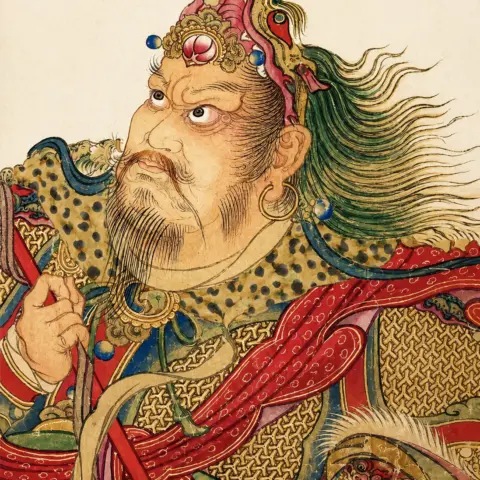
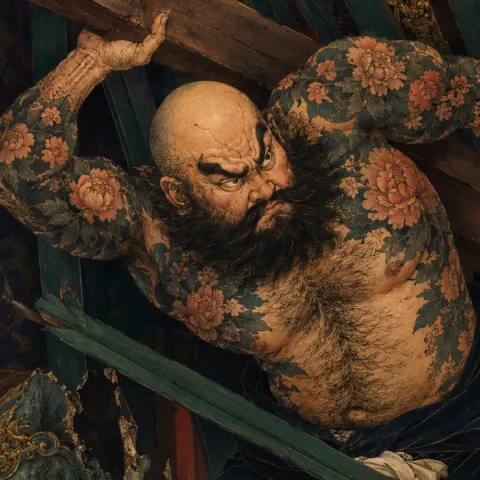
The gate lay half-hidden beyond the trees. Yang stopped on the path. A large monk sat by a pine, his robe loose from the heat, an iron monastic staff beside him. He looked like a man who had waited long enough to be offended by another hour.
Yang would have gone past. The monk looked up.
“What are you watching up there?”
“The road,” Yang said. “It is the only one.”
The monk rose, bringing the staff with him. “I’ve waited for Deng Long to come out. He will not. If you want the mountain too, let me see what you can do.”
Yang took the Po Dao from his shoulder. “I do not know you.”
“Fight me, and you will.”
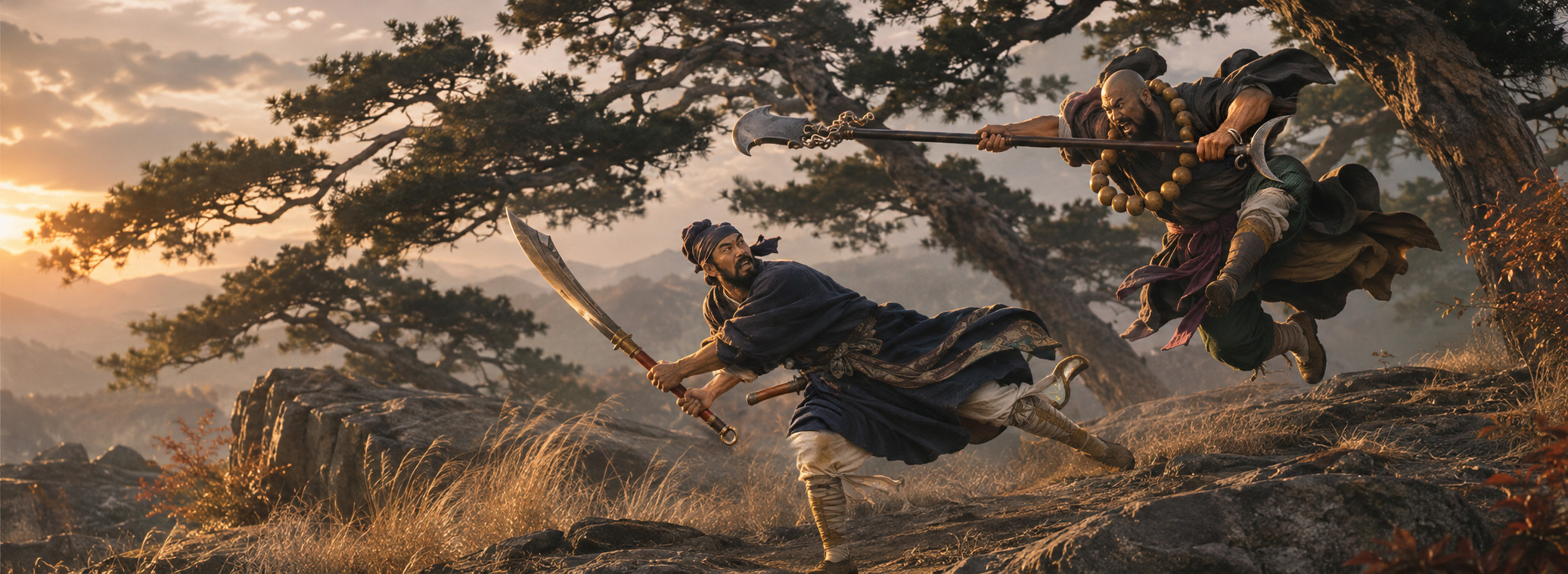
The staff descended at his head. Yang caught it obliquely with his blade, but the weight drove through his wrists and forced him half a step aside. He knew at once he could not stand in place and receive another stroke like it. He shifted his footing, let the staff’s weight pass, and sent the edge toward the monk’s forward shoulder.
The monk recovered quickly. Yang pressed with his blade; the staff haft turned it away. Yang stepped across to open another line; the monk crossed the iron staff before him. Pine needles lifted under their feet, exposing damp earth.
At first Yang still meant to ask who this man was. He soon had no breath to spare. Each time the monk stepped in, Yang moved diagonally, keeping room for the long blade to work. When a tree checked his retreat, he used the shaft to make space and passed around the trunk. The staff was heavy enough to drive him back, yet its owner could recover it before Yang took full advantage of the opening.
They fought for forty or fifty exchanges without a clear winner. Yang’s hand had begun to tingle from the repeated shocks. He stopped trying to meet the iron head with force and watched the brief interval between the monk’s lift and downward stroke. The monk, in turn, saw that this blue-faced swordsman did not waste a cut.
Then the monk appeared to leave a gap. Yang moved to enter it. The monk sprang out of reach and struck the butt of his staff on the ground.
“Hold!”
Yang kept his blade between them. “You began this.”
“I did. Now tell me the name of the man who held me off.”
“Yang Zhi. The Blue-Faced Beast. And you?”
The monk laughed. “Lu Zhishen. The Flower Monk.”
Yang knew the name. Lu had once saved Lin Chong from murder in Wild Boar Forest. The two fighters were still breathing hard, but the mention of Lin gave them something other than the mountain gate to speak of. Lu told Yang that Deng Long had barred the way after failing to defeat him.
“You want to go up there too?” Lu asked.
“You have been outside for days,” Yang said. “And you are still outside.”
“That is why I am asking.”
III. Another Way Through the Gate
They returned to Cao Zheng’s inn. Cao recognized his teacher’s old friend in Lu. The monk set his staff within reach and barely sat still.
“If Deng Long came down,” Lu said, “one stroke would settle it. But he hides behind his gate.”
“Then we pass through the gate,” said Yang.
Cao looked from one man to the other. “Have you made friends, or are you still deciding who struck harder?”
“Tell us how to get inside,” Yang said.
Cao proposed bringing Deng Long a prize: a drunken monk bound with rope. The knots would slip loose; the weapons would be close at hand. Lu held out his arms while Cao measured the rope and grinned at the thought of Deng Long believing it.
The gate opened the next day. Deng Long’s men hurried their captives into the temple. Before Deng could finish questioning them, the rope slipped from Lu’s arms. Cao passed him the iron staff. Lu sprang forward; Yang raised the Po Dao against the men rushing to their chief.
Lu struck Deng Long down with the staff. Yang thrust down four or five of the lesser fighters who came at him. Cao shouted for the others to surrender. Men with weapons in their hands looked at one another, then lowered them. The mountain’s followers accepted new leaders.
At dusk Lu found Yang counting the men near the gate.
“I told you,” he said. “Fight me, and you’ll know me.”
Yang looked up. “If we had only fought, we would still be outside. Cao found the way in.”
Lu shouldered his staff without arguing. The gate stood open behind them. Erlong Mountain had become a place they could hold together.
IV. On Their Fighting Skill
In the novel Yang fights on foot with a Po Dao against Lu’s iron monastic staff. They exchange roughly forty to fifty blows without a decided winner. Lu offers an opening, springs clear, and calls a halt. Yang privately acknowledges that he could only just hold his own. That admission matters: enduring the contest did not mean the heavy staff had placed him under no pressure.
Lu’s strength did not make his fighting crude. He recovered the staff quickly and made Yang adjust his distance. Yang survived the weight of those attacks by moving, guarding his own reach, and choosing when to enter. The exact movements in this telling are literary reconstruction; the source does not enumerate each stroke. Neither man’s conduct supports a victory invented for Yang, or a conclusion about which would win under every condition. What the meeting did give them was a reason to recognize one another—and, with Cao Zheng, a way onto Erlong Mountain.