Source Work: Romance of the Three Kingdoms

  • 王双

    Wang Shuang

    Wang Shuang is a Wei warrior in Romance of the Three Kingdoms, introduced during Zhuge Liang’s northern campaigns as a large mounted fighter with several powerful weapons.

    A Heavy Cavalry Warrior

    The novel describes Wang Shuang as tall and broad-bodied, wearing gold armor and riding with a sixty-jin saber. He also carries a powerful bow and three meteor hammers for sudden attacks.

    Saber, Bow, and Meteor Hammers

    Wang Shuang carries a sixty-jin saber, draws a heavy bow, and conceals three meteor hammers. The combination gives him three ranges of attack: cavalry cutting, archery, and a sudden thrown strike.

    Against the Shu Army

    He defeats and wounds several Shu officers before Wei Yan kills him through an ambush. The episode places force and weapon variety against Zhuge Liang’s planning and Wei Yan’s battlefield action.
  • Zhang Ren

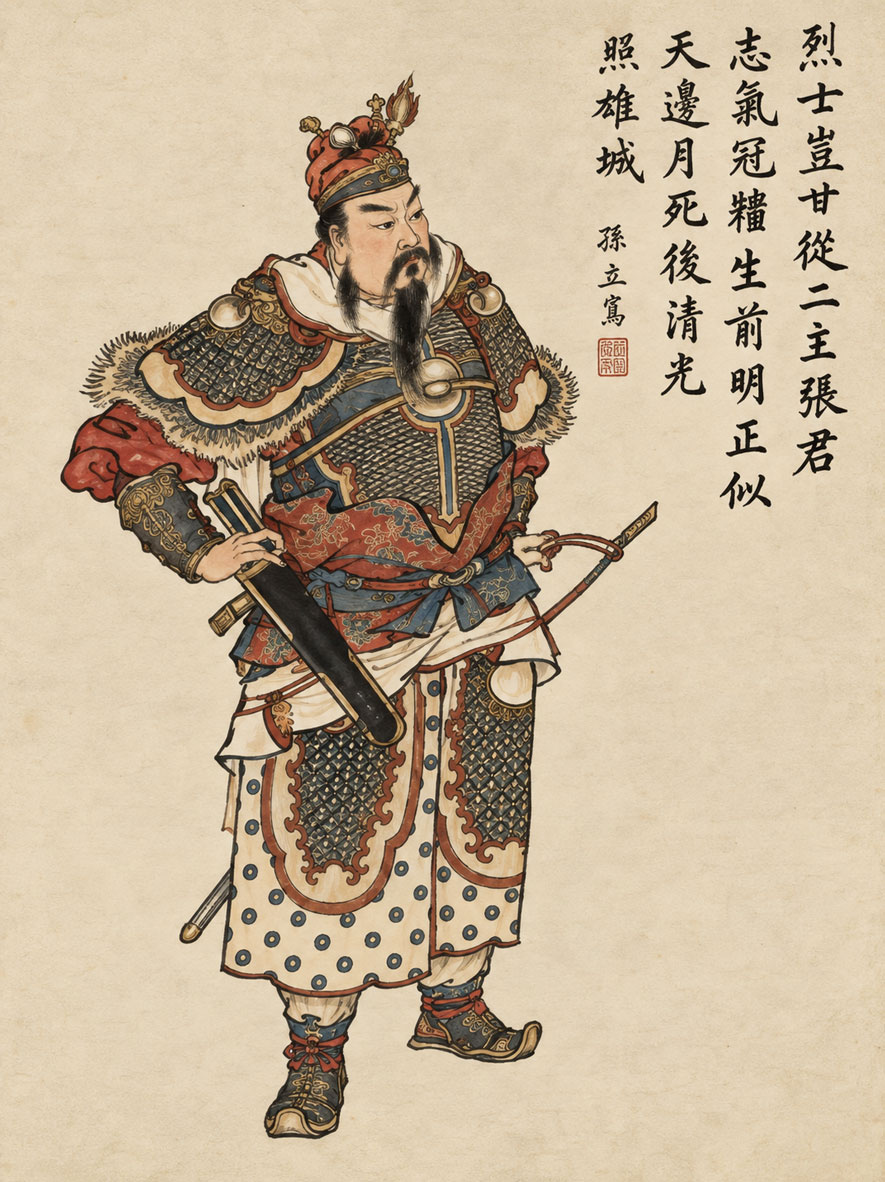
    Zhang Ren

    Zhang Ren is a military commander serving Liu Zhang in Romance of the Three Kingdoms. He is defined by the defense of Yi Province, disciplined ambush tactics, and his refusal to abandon his lord after capture.

    A Defender of Yi Province

    Zhang Ren fights on the defending side of Liu Bei’s entry into Shu, using cavalry, city approaches, and narrow mountain roads to protect Liu Zhang’s territory.

    The Ambush at Falling Phoenix Slope

    He leads the ambush that kills Pang Tong at Falling Phoenix Slope. The episode emphasizes hidden troops, bows and crossbows, restricted terrain, and mistaken identity around the white horse.

    Capture and Refusal

    After later defeat and capture, Zhang Ren refuses to serve a new lord. This ending reinforces discipline and loyalty without turning the figure into a supernatural hero.

  • 文鸯

    Wen Yang

    Wen Yang, the younger son of Wen Qin, enters Romance of the Three Kingdoms at eighteen with the childhood name A-Yang. At Lejia he proposes a two-pronged night attack on Sima Shi’s camp. His father fails to arrive at the agreed time, but Wen Yang rides into the enemy lines again and again, shouting challenges and throwing the camp into panic. The shock is so severe that Sima Shi’s recently treated eye bursts from its socket.

    At dawn Wen Yang meets Deng Ai and fights him for fifty bouts without a decision. Forced to withdraw, he is pursued by hundreds of cavalry. He repeatedly turns back alone, wielding spear and steel whip, strikes down several men, and scatters the rest before returning to his father. The sequence gives him one of the novel’s clearest displays of young martial daring: an assault begun with flawed support becomes a withdrawal controlled by his own nerve and strength.

    Later Wen Qin joins Zhuge Dan at Shouchun, but quarrels within the besieged city end with Zhuge Dan killing him. Wen Yang and his brother Wen Hu fight their way to the wall, leap the moat, and surrender to Sima Zhao. Although Wen Qin had helped bring about Sima Shi’s death, Zhong Hui advises mercy. Sima Zhao pardons the brothers, grants them rank, and sends them around Shouchun to announce clemency. Their survival weakens the defenders’ will, and Wen Yang ends the novel’s account not as a condemned rebel, but as a former enemy absorbed into Wei service.

  • 沙摩柯

    Shamoke

    Shamoke is a frontier king who joins Liu Bei’s punitive campaign against Eastern Wu in Romance of the Three Kingdoms. He arrives from the Wuling region at the head of his own warriors, carrying an iron spiked mace and two bows. The novel gives him only a short campaign, but places him at the violent center of Yiling rather than among distant auxiliaries.

    His greatest result comes when Gan Ning, already sick, rides out to meet the Shu advance. Seeing the size of Shamoke’s contingent, Gan Ning turns away instead of forcing a close fight. Shamoke draws one of his bows and sends an arrow into the veteran’s head. Gan Ning escapes as far as Fuchi, dies beneath a tree, and receives mourning and honors from Sun Quan. The shot makes Shamoke the direct cause of a major Wu hero’s death.

    The balance reverses when Lu Xun’s fire attack destroys Liu Bei’s extended camps. Shamoke flees alone through the collapse and encounters Zhou Tai. He does not die without resistance: the two fight for more than twenty bouts before Zhou Tai kills him. These linked encounters define his level without speculation. He is dangerous enough to bring down Gan Ning at range and to sustain a substantial duel with Zhou Tai, yet he cannot survive once Shu’s formations, supplies, and escape routes burn around him.

  • 周泰

    Zhou Tai

    Zhou Tai is one of the veteran Jiangdong warriors in Romance of the Three Kingdoms. He and Jiang Qin join Sun Ce during the early conquests, and Zhou later serves Sun Quan with a loyalty proved at the closest possible distance. When rebels strike at Xuancheng, he shields the young lord and cuts a way out, receiving wound after wound while keeping Sun Quan alive. The rescue turns him from a regional fighter into one of the ruler’s trusted personal defenders.

    He saves Sun Quan again during the struggle at Ruxu. Some officers still look down on his origins, so Sun Quan holds a banquet and orders Zhou Tai to uncover the scars across his body. As Zhou identifies the battles in which each wound was received, the ruler pours wine and publicly honors him. The scene is not a catalogue of appearance but a record of command earned through sacrifice: every mark answers doubt with a remembered act of protection.

    Zhou Tai remains formidable in later war. During Liu Bei’s disastrous retreat from Yiling, he catches Shamoke, the frontier king whose arrow had killed the ailing Gan Ning. They fight for more than twenty bouts before Zhou Tai cuts him down, giving Eastern Wu both pursuit and revenge. The novel leaves Zhou Tai as a survivor rather than ending him in a final spectacle. His weight rests on continuity—from Sun Ce’s expansion, through repeated rescues of Sun Quan, to Yiling—making him a living link between Jiangdong’s founding generation and its mature state.

  • Taishi Ci’s Short Ji

    Taishi Ci’s Short Ji

    Taishi Ci’s Short Ji is the compact weapon carried on Taishi Ci’s back in Romance of the Three Kingdoms. CG uses a bearer-specific canonical name so it cannot be confused with Dian Wei’s Twin Iron Ji.

    The Romance Account

    During Taishi Ci’s encounter with Sun Ce, the novel refers to a short ji carried on his back. The episode makes the weapon part of his close-combat silhouette without establishing that it must always be represented as a pair.

    The Historical Text Layer

    The Records of the Three Kingdoms uses the term hand ji in its account of the encounter. CG keeps this as a related historical text layer while using “Taishi Ci’s Short Ji” for the literary Subject.

    A Multi-Weapon Warrior

    The short ji adds a compact secondary weapon to Taishi Ci’s broader martial image, which also includes long weapons and archery. It should remain visually distinct from a full-length halberd and from Dian Wei’s paired iron ji.

    CG Visual Language

    • short ji carried on the back
    • Taishi Ci as primary bearer
    • secondary close-combat weapon
    • part of a multi-weapon identity
    • quantity left open unless the selected source is explicit
    • no connection to Dian Wei’s Twin Iron Ji
  • 藤甲军

    Rattan-Armored Army

    The Rattan-Armored Army is the military force led by Wutugu during the southern campaign in Romance of the Three Kingdoms. It is a collective military concept, separate from Rattan Armor as an equipment subject.

    The Army of Wuguo

    The troops belong to Wutugu’s kingdom and enter the campaign as a force defined by shared armor, terrain, and coordinated fighting methods. Their identity is collective rather than attached to one warrior.

    Rattan Armor

    Rattan armor gives the army a unified surface and silhouette. The equipment Subject explains the material and protective construction; this Subject explains the troops who wear it and fight as a group.

    The Southern Campaign

    The army becomes part of the wider campaign involving Zhuge Liang, Wei Yan, Meng Huo, and the southern forces. Its resistance to ordinary weapons and vulnerability to fire shape the final tactical episode.

    CG Visual Language

    • collective military formation
    • Wutugu as commander
    • shared rattan equipment
    • southern terrain and campaign context
    • fire-attack episode
    • distinct from the Rattan Armor equipment Subject
  • 藤甲

    Rattan Armor

    Rattan Armor is the protective equipment associated with Wutugu and the Rattan-Armored Army in Romance of the Three Kingdoms. In CG it is treated as a literary armor subject with a strong material identity.

    Literary Depiction

    The novel describes armor made through the preparation and weaving of rattan. Within the story, it resists blades and arrows but is vulnerable to fire, a contrast that drives the final battle involving the rattan-armored troops.

    Visual Characteristics

    The key visual idea is fibrous material organized into protective coverage. Braided, woven, or layered surfaces can distinguish it from metal plate, lamellar, and scale constructions, while the exact pattern should remain tied to the selected visual evidence.

    Historical Caution

    The novel’s rattan armor should not be presented as a standard armor system used generally across ancient China. Literary description, later visual adaptation, and securely documented historical armor must remain separate evidence layers.

    CG Interpretation

    CG uses Rattan Armor as a special-material armor node. It is useful for studying how texture, color, flexibility, fire vulnerability, and group identity can shape an armored figure without turning the literary account into a universal historical claim.

    CG Visual Language

    • woven or layered plant-fiber surface
    • strong material contrast with metal armor
    • Wutugu and the Rattan-Armored Army
    • specialized group identity
    • literary depiction kept separate from historical fact
  • 五口飞刀

    Five Flying Knives

    The Five Flying Knives are the set of throwing knives carried by Lady Zhurong in Romance of the Three Kingdoms. The Chinese canonical name follows the novel’s wording: 五口飞刀.

    Lady Zhurong’s Ranged Weapon

    Lady Zhurong carries the five knives on her person and uses them from a distance in battle. They give her a ranged attack that contrasts with the long weapons and close combat surrounding her.

    A Set of Five

    The number is part of the weapon image. The knives should read as a coordinated carried set rather than as a generic article about every kind of throwing knife.

    Within the Southern Campaign

    The weapon belongs to Lady Zhurong’s role in the southern campaign and connects directly with the episodes commonly grouped under the Seven Captures of Meng Huo.

    CG Visual Language

    • five carried throwing knives
    • Lady Zhurong as primary bearer
    • clear ranged-weapon action
    • southern campaign context
    • no unsupported magical properties