Source Work: Romance of the Three Kingdoms

  • 兀突骨

    Wutugu

    Wutugu is the ruler of Wuguo in the southern campaign of Romance of the Three Kingdoms. The novel presents him as a figure of exceptional size who commands troops equipped with rattan armor.

    A Giant Southern Ruler

    Wutugu’s exceptional height and strength distinguish him from ordinary commanders, while the massed rattan-armored troops mark him as the ruler of a formidable southern army.

    The Rattan-Armored Army

    His army wears armor made from treated rattan. Within the novel, this armor resists blades and arrows but becomes vulnerable to fire. That contrast drives the strategy used against the army.

    The Fire Attack

    Zhuge Liang draws the rattan-armored troops into confined terrain and destroys them with fire. The same treated rattan that resists blades and arrows makes escape almost impossible once the valley burns.
  • 祝融夫人

    Lady Zhurong

    Lady Zhurong is a female warrior in the southern campaign of Romance of the Three Kingdoms. She fights from horseback with a long spear and flying knives and personally enters combat against Shu officers.

    A Southern Female General

    Lady Zhurong appears as a battlefield commander, not as a court figure standing behind Meng Huo. Her role is active: she rides out, challenges enemy officers, captures opponents, and changes the pressure of the campaign.

    Spear and Flying Knives

    Lady Zhurong fights with a long spear and carries five flying knives. She uses the spear from horseback, then throws the knives to strike opponents who believe they are beyond her reach.

    The Southern Campaign

    Her story connects directly with Meng Huo, Zhuge Liang, Zhao Yun, Wei Yan, and Ma Dai during the campaign usually organized around the Seven Captures of Meng Huo.

    The novel also gives her a red, curly-maned horse, a mount belonging to this southern campaign rather than the Red Hare ridden by Lü Bu and Guan Yu.

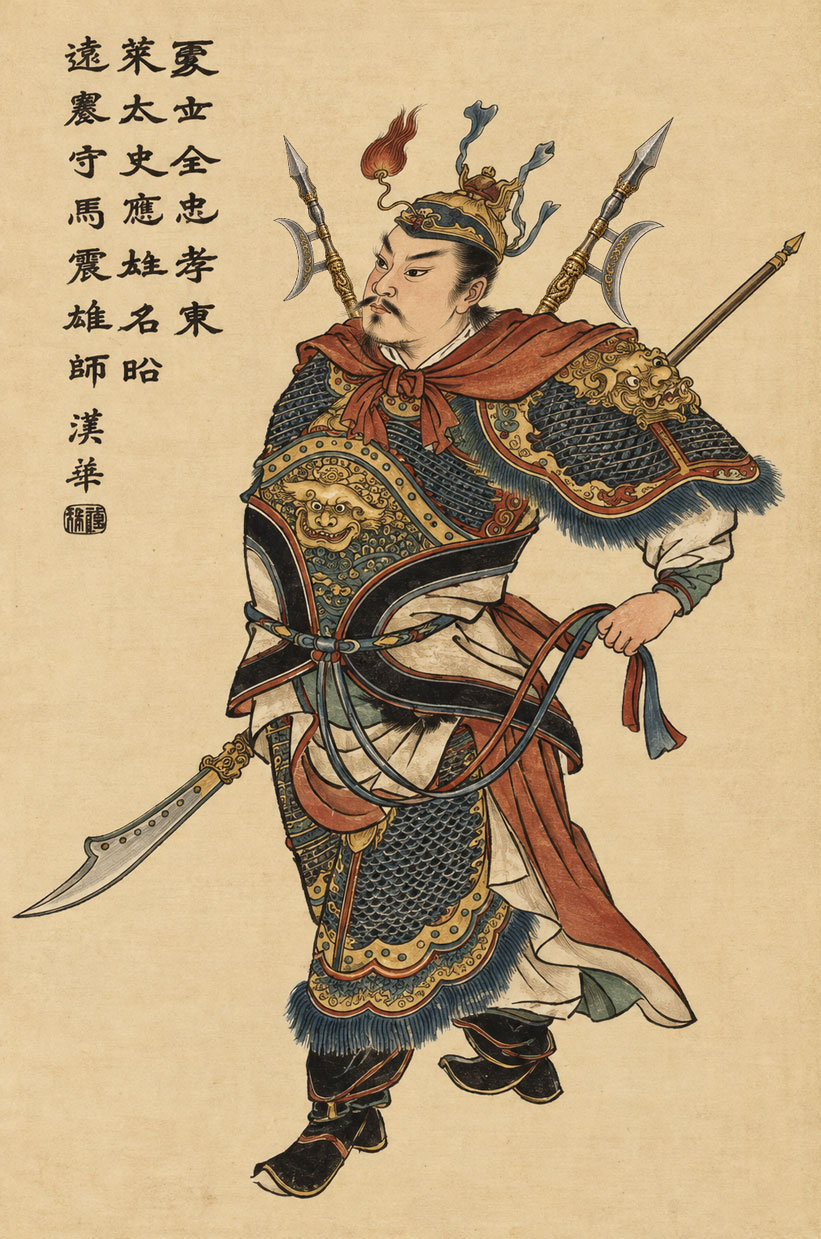
  • Taishi Ci

    Taishi Ci

    Taishi Ci is one of the boldest mounted warriors of early Eastern Wu in Romance of the Three Kingdoms. His loyalty first appears through his mother: because Kong Rong has aided her, Taishi Ci rides to repay the debt when Beihai is besieged. He shoots his way through the encirclement, reaches Liu Bei for reinforcements, and returns to help lift the danger. The feat establishes both his archery and his willingness to cross an army for an obligation.

    Serving Liu Yao, he later meets Sun Ce in a famous duel. Spear work gives way to a close struggle in which Sun Ce seizes a short halberd from Taishi Ci while Taishi Ci takes Sun Ce’s helmet; neither can claim a clean victory. After capture, Taishi Ci accepts Sun Ce’s trust and is allowed to return for his remaining soldiers. He keeps his appointed time and brings them back, turning a former enemy into one of Sun Ce’s most dependable generals.

    Taishi Ci can fight with bow, spear, and paired hand halberds, but the novel measures him most clearly through his opponents: he breaks a siege line, matches Sun Ce at close quarters, and later faces Zhang Liao’s hard defense around Hefei. In the romance he returns wounded from that campaign and dies lamenting that a man should carry a great sword and rise to the highest honor before death. The lament suits a warrior whose ability was repeatedly proven, yet whose ambitions outlived his campaigns.

  • 八门金锁阵

    Eight Gates Golden Locks Formation

    The Eight Gates Golden Locks Formation is the battlefield array Cao Ren deploys against Liu Bei’s forces in Romance of the Three Kingdoms. Its ordered gates promise control, yet the same structure gives a knowledgeable opponent a way to diagnose and break it.

    Chapter 36 has Cao Ren arrange the formation outside Xinye. Xu Shu identifies the eight gates—Rest, Life, Injury, Obstruction, Prospect, Death, Alarm, and Open—and explains that entry through the favorable gates can succeed. Zhao Yun attacks according to that reading and throws the array into disorder.

    The formation makes military knowledge spatial. Lines of troops, named entrances, a guarded center, and shifting routes define the image; interpretation defines the meaning. It is neither an unbreakable magical prison nor a decorative diagram, but a command system whose strength depends on denying the enemy its logic.

  • 八阵图

    Eight Formations

    The Eight Formations are Zhuge Liang’s ordered system of gates and transformations, made visible in Romance of the Three Kingdoms as a stone array beside the river. Tactics become landscape: entering the wrong route can defeat an army without a conventional battle.

    Chapter 84 has Lu Xun inspect the stones after his victory over Liu Bei. Wind, sand, and shifting perception leave him unable to find a way out until Huang Chengyan leads him through the Gate of Life. The eight gates are named and the array is said to change without end.

    The Eight Formations bind strategic intelligence to spatial design and later cultural memory. The novel’s marvelous stone array is a literary realization of military order; it should not be reduced to eight static troop icons or treated as a single magic attack.

  • 七星宝刀

    Seven-Star Precious Saber

    The Seven-Star Precious Saber is the blade Cao Cao borrows from Wang Yun to assassinate Dong Zhuo in Romance of the Three Kingdoms. The weapon becomes crucial because a failed strike must instantly be disguised as a gift.

    Chapter 4 names it before the attempt. When Dong Zhuo sees Cao Cao drawing the blade in a mirror, Cao Cao kneels and presents it instead. The text describes a saber a little over a foot long, decorated with seven treasures and exceptionally sharp; Lü Bu recognizes the attempted attack after Cao Cao escapes.

    The saber marks the gap between intention and outward performance. Its rich decoration is explicit, but “seven-star” should not be expanded into celestial magic. The object is memorable because Cao Cao converts evidence of treason into a plausible offering in a single moment.

  • 木牛流马

    Wooden Ox and Flowing Horse

    The Wooden Ox and Flowing Horse are transport devices associated with Zhuge Liang’s northern campaigns in Romance of the Three Kingdoms. They turn the problem of moving grain through difficult country into a story about planning, craft, and control of information.

    Chapter 102 describes the wooden ox before introducing the flowing horse, gives dimensions and operating features, and has the Shu army use them to carry provisions. Sima Yi captures some devices and orders copies, but Zhuge Liang’s men exploit a concealed method to stop and recover the loads.

    The pair belongs to military logistics rather than to a modern robot category. Their cultural force comes from making ingenuity visible: wooden forms, hidden handling knowledge, and a supply line that becomes part of strategy. Reconstructions may vary because the literary measurements do not settle every mechanical detail.

  • 的卢

    Dilu

    Dilu is Liu Bei’s celebrated horse in Romance of the Three Kingdoms. Its story turns a supposedly unlucky mount into the means of its rider’s escape.

    Chapter 34 identifies the horse through marks around the eyes and forehead and repeats the warning that it will harm its master. When Liu Bei flees an ambush and is trapped at Tan Stream, Dilu leaps from the water to the far bank and carries him beyond pursuit.

    The horse’s significance lies in this reversal between prediction and rescue. A rider and mount clearing the stream can tell the story at a glance; the episode does not require a permanent power of flight or a claim that the rescue is established historical fact.

  • 美髯

    Magnificent Beard

    The Magnificent Beard is a bodily mark of dignity and martial recognition shared by Guan Yu and Zhu Tong in their literary portrayals. It belongs to the person rather than to a detachable piece of equipment.

    Romance of the Three Kingdoms chapter 25 shows Guan Yu protecting his long beard in a silk bag, then displaying it before the emperor, who praises him as the Lord of the Beautiful Beard. Water Margin chapter 13 gives Zhu Tong the same epithet and explicitly compares his appearance with Guan Yu’s.

    The shared feature creates a visual echo between two distinct heroes. It conveys imposing presence and a literary association with honour, while leaving each man’s biography and identity separate.