Source Work: Romance of the Three Kingdoms

  • Green Dragon Crescent Blade

    Green Dragon Crescent Blade

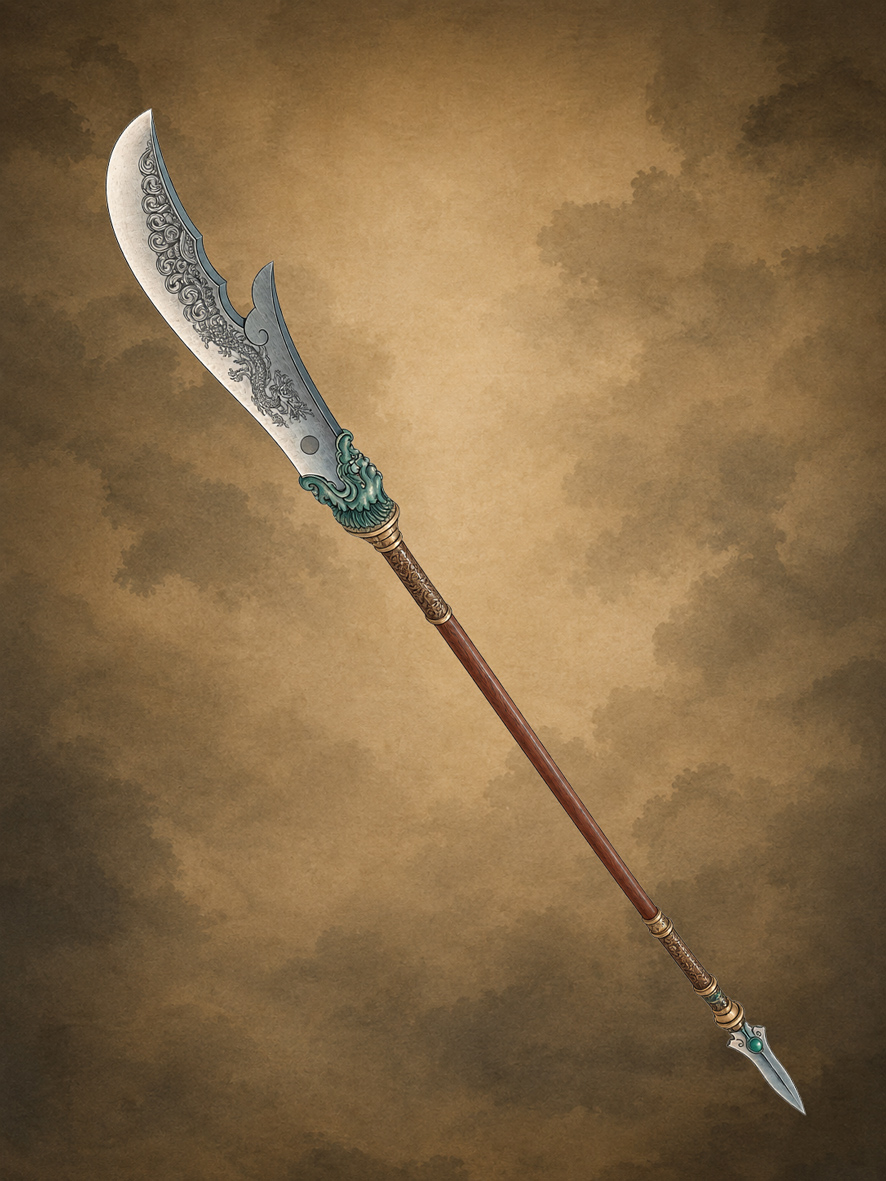
    The Green Dragon Crescent Blade is Guan Yu’s legendary signature weapon. At the opening of Romance of the Three Kingdoms, Guan Yu has the blade made as the three sworn brothers prepare their weapons. Guan Yu’s fame made the blade legendary, while the blade became one of the clearest visual signs by which viewers recognize him.

    It is first and foremost a great blade on a long shaft, not a magical treasure that depends on supernatural power. Its legendary force comes mainly from Guan Yu’s martial prowess and commanding presence, and from the status given to it over centuries of story and art.

    How to Recognize It

    Look for its overall silhouette: a long, straight shaft; a broad, single-edged blade; and a pronounced crescent curve sweeping upward. The blade head appears heavy and powerful. Refer to the image for its specific structure and decoration.

    Guan Yu and the Blade

    Guan Yu made the Green Dragon Crescent Blade famous, and the blade makes Guan Yu recognizable at a glance. In painting and sculpture, it acts almost like his “visual nameplate”: whether he is seated, standing, or on horseback, the long blade immediately signals his identity.

    In Art

    Guan Yu is the blade’s principal legendary bearer. Traditional images of Guandi sometimes show Zhou Cang standing nearby and carrying it; Zhou Cang is the weapon-bearing attendant, while the blade still points to Guan Yu. Guan Sheng, a later hero of Water Margin, echoes Guan Yu’s visual language through the great blade, long beard, and commanding martial presence.

    History and Legend

    There is no reliable evidence that the historical Guan Yu used a weapon of this exact form. In later legend and art, however, the Green Dragon Crescent Blade became his fixed visual emblem.

  • 五丈原

    Battle of Wuzhang Plains

    The Battle of Wuzhang Plains is the final act of Zhuge Liang’s legend and one of the most melancholy episodes in Romance of the Three Kingdoms.

    After years of northern campaigning, Zhuge Liang once again leads the Shu army against Wei and enters a long confrontation with Sima Yi.

    Sima Yi knows how dangerous Zhuge Liang can be and refuses to accept battle carelessly.

    Zhuge Liang repeatedly tries to provoke him.

    He even sends women’s clothing as an insult, mocking Sima Yi for refusing to fight.

    Sima Yi endures the humiliation and remains behind his defenses.

    The armies settle into a prolonged standoff.

    Meanwhile Zhuge Liang continues managing military affairs in exhausting detail.

    He works constantly.

    His health begins to fail.

    From a Shu envoy, Sima Yi learns that Zhuge Liang eats very little while personally handling an enormous burden of work.

    He concludes that his rival cannot survive much longer.

    Zhuge Liang also realizes that his life is approaching its end.

    In the legendary account, he performs a ritual intended to extend his lifespan. A life-lamp is lit inside the command tent, and if it can remain burning for seven days, there may still be hope.

    At the crucial moment, Wei Yan suddenly enters with urgent military news.

    The movement extinguishes the lamp.

    Zhuge Liang understands that Heaven will not grant him more time.

    Soon afterward, he dies at Wuzhang Plains.

    The Shu army conceals his death and begins withdrawing according to plans prepared in advance.

    When Sima Yi sees the retreat, he suspects that Zhuge Liang may finally be dead and gives chase.

    Then the Shu forces suddenly turn back, displaying Zhuge Liang’s wooden image.

    From a distance, Sima Yi believes his great opponent may still be alive and hurriedly withdraws.

    The episode gives rise to the famous saying that a dead Zhuge Liang frightened away a living Sima Yi.

    Wuzhang Plains is a fittingly heavy end to Zhuge Liang’s story because even death does not immediately end his influence.

    Until the final moment he is planning against his enemy, arranging the retreat, and thinking beyond his own life.

    The man dies, but his reputation continues protecting the army.

  • 六出祁山

    Zhuge Liang’s Northern Expeditions

    Zhuge Liang’s Northern Expeditions, remembered in the Romance tradition as the Six Campaigns from Qishan, form the great military storyline of the strategist’s later life.

    After Liu Bei’s death, Zhuge Liang continues serving Liu Shan and carrying the burden of the Shu-Han cause.

    Shu is weaker than the great northern state of Wei in territory, population, and military resources.

    Zhuge Liang nevertheless refuses to abandon the struggle.

    In Romance of the Three Kingdoms, he leads the army north again and again, seeking a path toward the central plains.

    Each campaign brings new opponents, new stratagems, and new crises.

    During the first great expedition, the loss of Jieting under Ma Su suddenly destroys a promising situation.

    Zhuge Liang later executes Ma Su with tears and must use the famous Empty Fort Strategy when Sima Yi’s forces threaten him at a moment of extreme weakness.

    The northern campaigns continue.

    Shu and Wei struggle over supply lines, passes, camps, and opportunities for ambush.

    Zhuge Liang devises the Wooden Ox and Flowing Horse to transport supplies and repeatedly matches wits with Sima Yi and other Wei commanders.

    At times Zhuge Liang tries to lure the enemy into a trap.

    At other times Sima Yi refuses to leave his defenses.

    Sometimes the Shu army gains an advantage only to withdraw because supplies fail or conditions elsewhere change.

    Jiang Wei gradually becomes one of the most important younger commanders around Zhuge Liang.

    The expeditions begin again and again, yet the final objective remains out of reach.

    Still Zhuge Liang does not stop.

    On his last campaign, he reaches Wuzhang Plains and enters a prolonged confrontation with Sima Yi.

    By then his health is failing badly, but he continues personally handling military affairs day and night.

    He finally dies at Wuzhang Plains.

    The Six Campaigns from Qishan are therefore not a single battle. They form the repeating legendary rhythm of Zhuge Liang’s later life:

    march north, match wits with the enemy, suffer reversal, withdraw, and march north again.

    The story is ultimately about persistence.

    Zhuge Liang knows that Shu is limited in strength and that every campaign is difficult, yet he continues taking the same road north until the end of his life.

  • 三顾茅庐

    Three Visits to the Thatched Cottage

    Three Visits to the Thatched Cottage is the famous story of Liu Bei seeking out Zhuge Liang and the moment when the hidden strategist finally enters the great struggle of the Three Kingdoms.

    Liu Bei already has formidable warriors such as Guan Yu and Zhang Fei, but he still lacks a strategist capable of seeing the larger shape of the realm.

    Before leaving Liu Bei, Xu Shu recommends Zhuge Liang, a brilliant young man living in seclusion at Longzhong.

    Liu Bei decides to visit him personally.

    On the first journey, Zhuge Liang is away.

    Liu Bei returns without meeting him.

    After some time, he goes again with Guan Yu and Zhang Fei. The second visit also fails.

    Zhang Fei grows impatient. Why should a lord like Liu Bei repeatedly humble himself before an obscure scholar living in the countryside?

    Liu Bei refuses to give up.

    On the third visit, Zhuge Liang is at home but asleep inside the thatched cottage.

    Rather than wake him, Liu Bei waits quietly outside.

    When Zhuge Liang finally rises, the two men meet.

    Liu Bei asks him about the future of the realm.

    Zhuge Liang lays out a grand strategy. Cao Cao dominates the north. Sun Quan holds the southeast. Liu Bei must establish himself in Jingzhou and Yizhou, build his own power, and create a three-sided balance before seeking greater ambitions.

    This becomes the famous Longzhong Plan.

    Liu Bei is deeply impressed and repeatedly asks Zhuge Liang to leave seclusion and assist him.

    Moved by Liu Bei’s sincerity, Zhuge Liang finally agrees.

    He walks away from the thatched cottage and enters the world in which his legend will unfold.

    The power of Three Visits to the Thatched Cottage lies not simply in the discovery of a clever adviser. Liu Bei, already a lord surrounded by warriors, is willing to humble himself again and again before a young man who has not yet entered public life.

    And when Zhuge Liang finally steps beyond the cottage door, the great stories associated with his name truly begin.

  • 草船借箭

    Borrowing Arrows with Straw Boats

    Borrowing Arrows with Straw Boats is one of the most famous stories displaying Zhuge Liang’s ability to turn an impossible problem into an advantage.

    Before the Battle of Red Cliffs, Sun Quan and Liu Bei have joined forces against Cao Cao, but Zhou Yu remains deeply wary of Zhuge Liang.

    Looking for a way to place him in danger, Zhou Yu asks what weapon is most urgently needed for naval warfare.

    Zhuge Liang answers that arrows are essential.

    Zhou Yu then orders him to produce one hundred thousand arrows within ten days.

    The task seems impossible.

    Zhuge Liang calmly replies that ten days is too long.

    He needs only three.

    He even accepts a military pledge guaranteeing the result.

    Lu Su becomes worried and privately asks how Zhuge Liang could possibly manufacture so many arrows in such a short time.

    Zhuge Liang does not attempt to manufacture them.

    Instead, he asks Lu Su to secretly prepare twenty boats. Soldiers are placed aboard, and straw figures are arranged along both sides of each vessel.

    Before dawn on the third day, a heavy fog settles over the river exactly as Zhuge Liang expected.

    He takes Lu Su aboard and orders the straw boats toward Cao Cao’s naval camp.

    Visibility is extremely poor.

    Zhuge Liang has the soldiers beat drums and shout loudly, creating the sound of an approaching attack.

    Cao Cao, suspicious by nature, fears an ambush hidden in the fog. Rather than send his forces out blindly, he orders his archers to fire into the mist.

    Arrows rain down upon the boats and bury themselves in the straw figures.

    Zhuge Liang then has the boats turned so that the other sides can receive another shower of arrows.

    By the time the fog begins to lift, the vessels are covered with them.

    Zhuge Liang orders the boats home while his men loudly thank Cao Cao for the arrows.

    Back at camp, the arrows are counted.

    There are more than one hundred thousand.

    Zhou Yu tried to trap Zhuge Liang with an impossible demand. Zhuge Liang never made the arrows at all. He simply borrowed them from Cao Cao.

    The brilliance of the episode lies in the way Zhuge Liang turns everything around him into part of the plan: the fog, Cao Cao’s suspicious temperament, and even Zhou Yu’s attempt to destroy him.

  • 借东风

    Borrowing the East Wind

    Borrowing the East Wind is one of Zhuge Liang’s most legendary episodes in the story of Red Cliffs.

    Zhou Yu has already decided that fire is the key to defeating Cao Cao.

    Huang Gai’s false surrender and Pang Tong’s linked-ship stratagem are falling into place.

    Then Zhou Yu realizes a fatal problem.

    The wind is blowing from the northwest.

    Cao Cao’s fleet lies to the north, while the allied forces are positioned to the south. If the fire attack is launched against the wind, the flames may turn back upon the attackers themselves.

    The realization leaves Zhou Yu sick with anxiety.

    Zhuge Liang visits him and immediately understands the problem.

    He tells Zhou Yu that he can borrow several days of southeastern wind.

    Zhou Yu has little choice but to let him try.

    Zhuge Liang orders the construction of the Seven Stars Altar on Nanping Mountain and ascends it to perform his mysterious rites.

    Banners move around the altar. Zhuge Liang, sword in hand, appears to be calling upon Heaven and Earth for the wind itself.

    Zhou Yu waits.

    At the appointed time, the weather changes.

    The southeastern wind begins to blow.

    Zhou Yu is overjoyed.

    The fire attack can begin.

    Huang Gai’s burning ships race with the wind toward Cao Cao’s fleet, and the great blaze at Red Cliffs erupts.

    But Zhuge Liang has calculated more than the weather.

    He knows that Zhou Yu may decide to kill him once his usefulness is over. Zhao Yun has therefore already been arranged as his escape.

    The legend of Borrowing the East Wind is memorable because Zhuge Liang seems to calculate both nature and human intention. Zhou Yu waits for the wind. Zhuge Liang waits for the wind while also preparing for the danger that will follow it.

  • 舌战群儒

    Debate with the Scholars

    Debate with the Scholars is one of Zhuge Liang’s most famous battles of words and a classic episode leading toward the alliance between Liu Bei and Sun Quan.

    After Cao Cao’s great army advances south, Liu Bei is badly weakened.

    Zhuge Liang travels to Jiangdong hoping to persuade Sun Quan that resistance is still possible and that an alliance with Liu Bei offers a path against Cao Cao.

    But many officials at the eastern court do not want war.

    They believe Cao Cao is too powerful.

    Submission, in their view, is safer than risking destruction.

    As soon as Zhuge Liang enters their world, the scholars challenge him one after another.

    Some mock Liu Bei for possessing too few soldiers and too little territory to oppose Cao Cao.

    Others argue that Cao Cao controls the central plains and acts in the name of the Han court, making resistance hopeless.

    Still others attack Zhuge Liang personally, accusing him of speaking grandly without having accomplished anything worthy of his reputation.

    Zhuge Liang refuses to retreat.

    One challenger speaks, and he answers.

    Another attacks, and he answers again.

    When they speak only of military strength, he argues that numbers alone do not decide everything.

    When they appeal to Cao Cao’s political position, Zhuge Liang denounces Cao Cao as a traitor who uses the name of the Han while seizing its power.

    When Liu Bei’s defeats are mocked, Zhuge Liang turns the argument around, presenting Liu Bei as a man who continues pursuing his cause despite repeated adversity.

    Personal attacks fare no better.

    Zhuge Liang answers with such sharpness that the attempt to embarrass him becomes a display of his own confidence and verbal skill.

    The purpose of the debate is larger than winning an argument.

    Zhuge Liang is trying to break the atmosphere of fear surrounding Cao Cao and demonstrate that surrender is not the only possible choice.

    After the debate, he continues working with figures such as Lu Su and Zhou Yu as the movement toward alliance and the Battle of Red Cliffs gathers force.

    Debate with the Scholars became a classic scene because there are no swords on the field, yet it still feels like a battle.

    Standing alone among the officials of Jiangdong, Zhuge Liang uses words as weapons and fights open a path toward resistance.

  • 空城计

    Empty Fort Strategy

    The Empty Fort Strategy is one of the most famous stories of Zhuge Liang’s cunning in Romance of the Three Kingdoms. With Sima Yi’s army suddenly approaching and almost no troops available for defense, Zhuge Liang turns an empty city into a psychological trap.

    The situation is desperate.

    Most of the Shu forces have already been sent elsewhere, leaving Zhuge Liang with only a small number of men.

    Then Sima Yi approaches with a powerful army.

    There is no realistic chance of winning a direct battle.

    There is not enough time to abandon the city safely.

    Panic spreads among those around Zhuge Liang.

    He responds with an astonishing order.

    Open the gates.

    A few soldiers are dressed like ordinary townspeople and told to sweep the roads calmly near the entrances.

    No great defensive force appears on the walls.

    No frantic preparations for battle can be seen.

    Zhuge Liang himself puts on his robe and headdress, takes two young attendants, and climbs the city tower.

    Then he sits down, burns incense, and plays the qin.

    Sima Yi arrives expecting resistance.

    Instead, he sees an open city.

    Zhuge Liang sits above the gate with complete composure, and the music continues.

    That calmness becomes more frightening than an army.

    Sima Yi knows Zhuge Liang’s reputation for caution and careful planning. He cannot believe that such a man would expose himself so openly without a hidden purpose.

    The emptier the city appears, the more dangerous it seems.

    Suspecting an ambush, Sima Yi orders his army to withdraw.

    Only after the enemy has gone do the defenders finally relax.

    The brilliance of the Empty Fort Strategy lies in the fact that Zhuge Liang’s only real weapon is Sima Yi’s knowledge of Zhuge Liang himself.

    There are no hidden troops.

    But Zhuge Liang’s reputation is powerful enough to make his enemy imagine them.

  • 七擒孟获

    Seven Captures of Meng Huo

    Seven Captures of Meng Huo is the famous story of Zhuge Liang’s southern campaign in Romance of the Three Kingdoms. Its defining idea is not simply that Zhuge Liang defeats Meng Huo seven times, but that he repeatedly captures and releases him until submission becomes genuine.

    When rebellion breaks out in the south, Zhuge Liang personally leads the Shu forces into the region.

    Meng Huo emerges as a major leader of the resistance.

    Zhuge Liang understands that winning one battle will not be enough.

    If Meng Huo submits only because he has been physically defeated, rebellion may begin again as soon as the Shu army leaves.

    Zhuge Liang therefore decides to conquer the heart.

    Meng Huo is captured.

    He refuses to admit that Zhuge Liang has truly beaten him and insists that he merely fell into a trick.

    Zhuge Liang does not execute him.

    He releases him.

    Meng Huo gathers his strength and tries again.

    He is captured again.

    Still he refuses to accept defeat.

    Again Zhuge Liang releases him.

    The story develops through this extraordinary repetition. Meng Huo returns with new plans, new confidence, and new attempts to overcome the Shu army. Zhuge Liang defeats him, captures him, and gives him another chance.

    Each time Meng Huo believes the next contest will prove that the previous defeat was accidental.

    Each time he ends up in Zhuge Liang’s hands.

    Only after the seventh capture does Meng Huo finally abandon his resistance.

    He acknowledges Zhuge Liang’s superiority and submits sincerely.

    The southern campaign can then end.

    Seven Captures of Meng Huo became legendary because it separates military victory from genuine submission.

    Zhuge Liang does not want a prisoner who bows because he is bound.

    He wants an opponent who has been released again and again and finally admits, of his own will, that he has been defeated.