Nezha
The Third Lotus Prince
Chinese – 哪吒
Titles – Third Lotus Prince | Great Divine Marshal of the Three Altars
Tradition – Taoism · Buddhism
Attributes – Universe Ring · Fire Wheels
Overview
Nezha (哪吒), also known as Nezha the Crown Prince (哪吒太子), is one of the most influential warrior deities in Chinese religion and folklore. Revered in Taoism, Buddhism, and popular belief, he is widely known by the title Marshal of the Central Altar (中坛元帅) and honored as the Third Lotus Prince (莲花三太子).
For more than a thousand years, Nezha’s image has been continuously reshaped by religion, literature, theater, visual art, and popular culture. The result is a remarkably rich and enduring figure whose many forms reflect the evolving imagination of Chinese civilization.
Story
Birth. Rebellion. Sacrifice. Rebirth. Apotheosis.
For more than a thousand years, Nezha’s story has been continuously reimagined through religion, literature, theater, and popular culture. → Read more
THE MYTH OF NEZHA
Birth • Rebellion • Sacrifice • Rebirth • Apotheosis
For more than a thousand years,
the story of Nezha has been continuously retold through
religion, literature, theater, and popular imagination.
BIRTH
The Child Born from a Ball of Flesh
Keywords: Prophecy · Incarnation · Supernatural Birth
Nezha was born at Chentang Pass during the Shang dynasty as the earthly incarnation of Lingzhu Zi, destined to assist the Zhou conquest of Shang. After Lady Yin carried him for three years and six months, she gave birth not to a child, but to a ball of flesh. When Li Jing struck it with his sword, a fully formed boy emerged. Nezha could walk and speak immediately after birth and was later accepted as the disciple of Taiyi Zhenren.
Themes: miraculous birth, destiny, divine incarnation.
REBELLION
The Battle of the Eastern Sea
Keywords: Defiance · Dragons · Violence
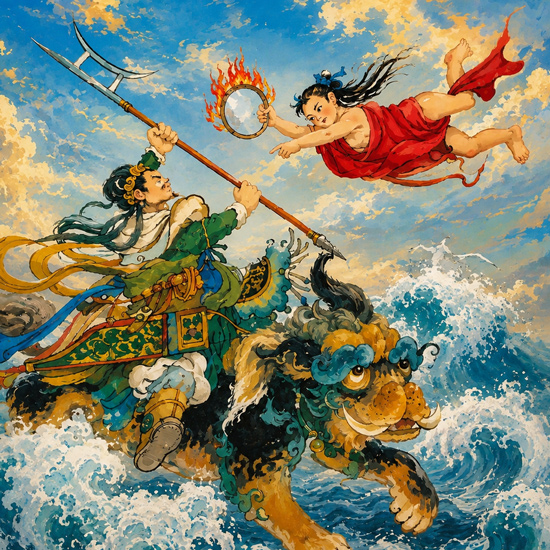
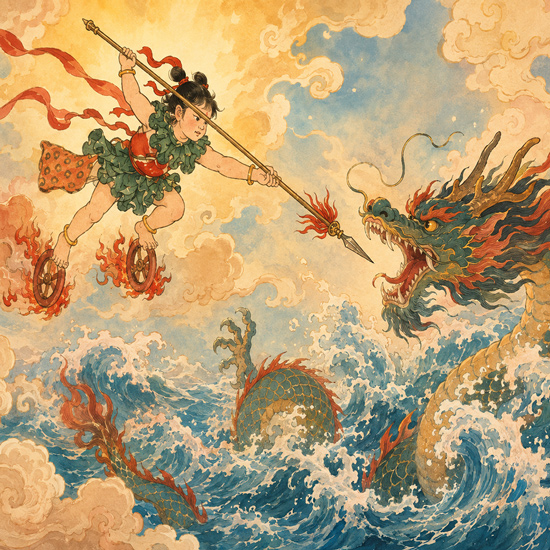
At the age of seven, Nezha disturbed the Dragon King’s underwater palace while bathing in the Jiuwan River. He killed the Yaksha Li Gen and later slew Ao Bing, the third son of the Dragon King of the East Sea, using the Qiankun Ring. This event triggered a conflict between Nezha, the Dragon Kings of the Four Seas, and the heavenly bureaucracy itself.
Themes: youthful rebellion, conflict with authority, divine violence.
SACRIFICE
Returning Flesh to the Mother, Bones to the Father
Keywords: Filial Piety · Self-Sacrifice · Redemption
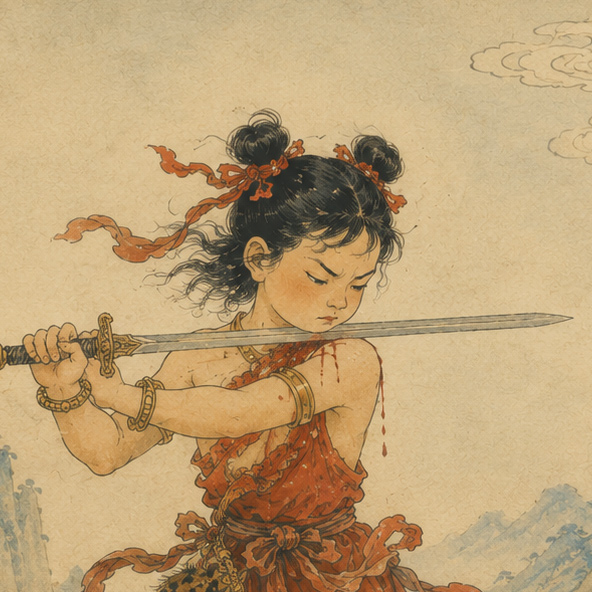
When the Dragon Kings demanded punishment and threatened the Li family, Nezha chose to sacrifice himself. In one of the most famous scenes in Chinese mythology, he cut off his own flesh and returned it to his mother, and broke his bones to return them to his father, repaying the debt of birth and saving his family from destruction.
Themes: filial piety, self-sacrifice, tragic heroism.
REBIRTH
The Lotus Body
Keywords: Resurrection · Transformation · New Identity
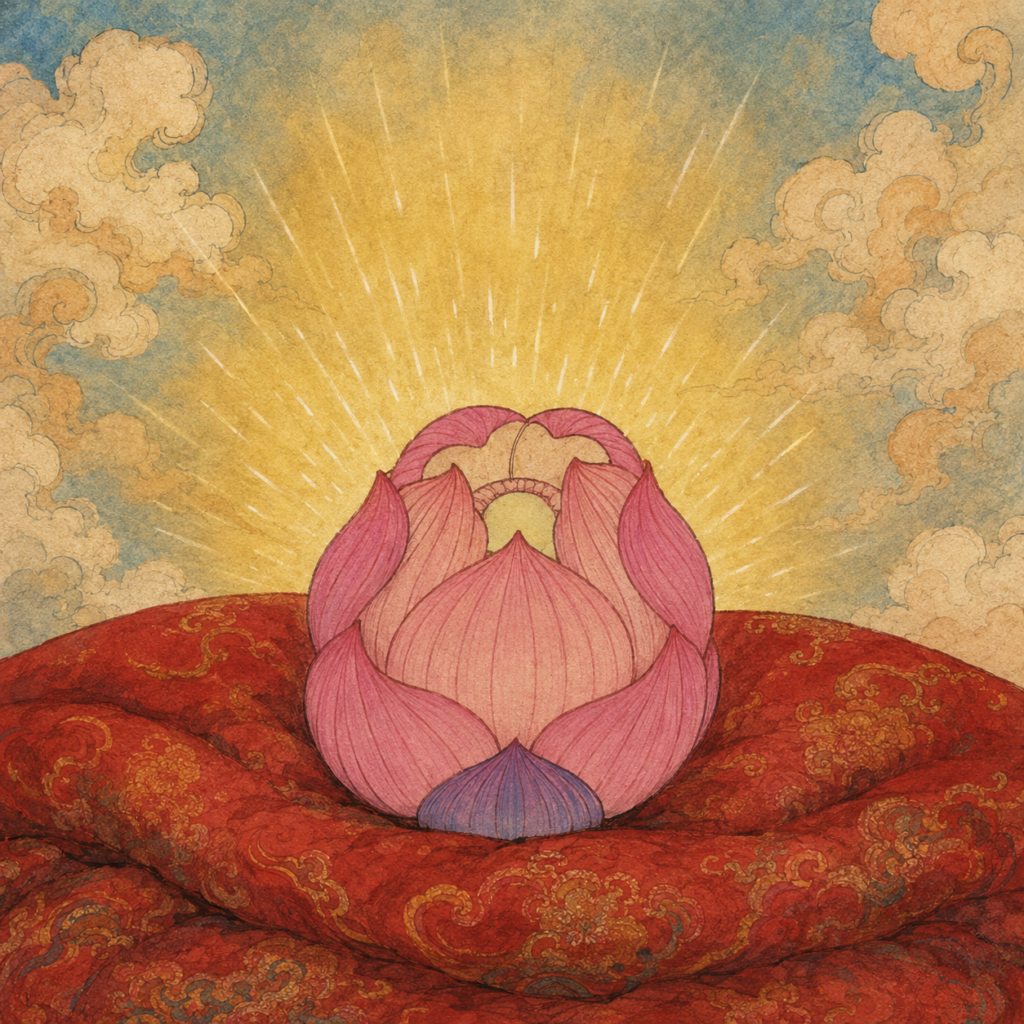
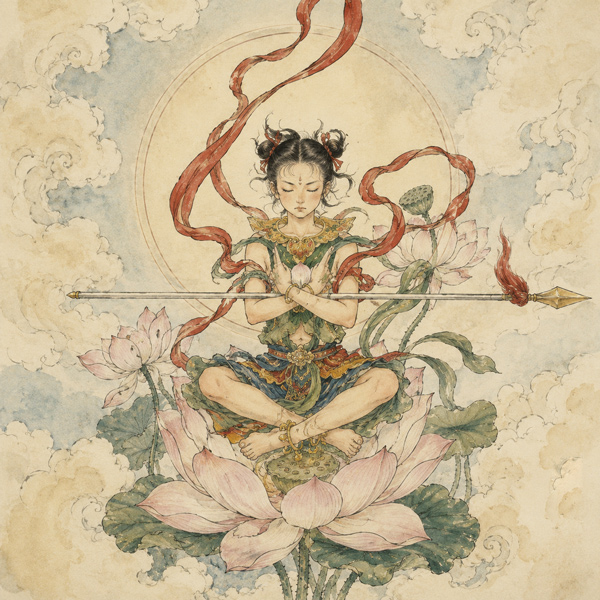
After his death, Nezha’s spirit sought refuge through a temple secretly built by his mother. Following its destruction by Li Jing, the conflict between father and son deepened. Taiyi Zhenren eventually restored Nezha to life by constructing a new body from lotus roots and bestowed upon him the Wind Fire Wheels and Fire-Tipped Spear.
Themes: death and rebirth, spiritual transformation, divine empowerment.
FATHER AND SON
The Conflict with Li Jing
Keywords: Authority · Family · Reconciliation
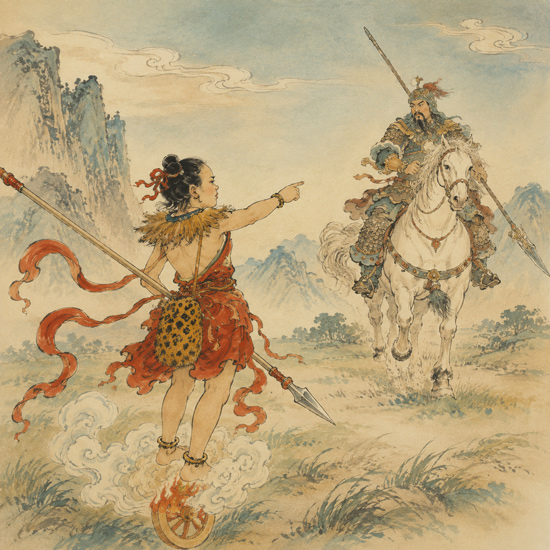
After his resurrection, Nezha repeatedly confronted his father, Li Jing. Their conflict escalated into open combat and could only be resolved through the intervention of powerful immortals and Buddhas. Different traditions explain this reconciliation differently, but most conclude with Li Jing becoming the Pagoda-Bearing Heavenly King and Nezha accepting the cosmic order.
Themes: father-son conflict, authority, reconciliation.
APOTHEOSIS
From Rebellious Child to Celestial Marshal
Keywords: Apotheosis · Command · Divine Order
Following his trials, Nezha emerged as one of the most important warrior deities in Chinese religion. In Daoist tradition he became the Marshal of the Central Altar (中坛元帅), while later traditions honored him as the Great God of the Three Altars and Seas (三坛海会大神), commander of heavenly armies and protector of cosmic order.
Themes: transcendence, military authority, divine kingship.
ATTRIBUTES & ICONOGRAPHY
The Symbols That Define the Third Lotus Prince
Over more than a thousand years of artistic evolution, Nezha acquired a rich visual language of weapons, magical objects, and bodily transformations. These attributes became essential to his identity and remain recognizable across paintings, sculptures, theater, and popular culture.
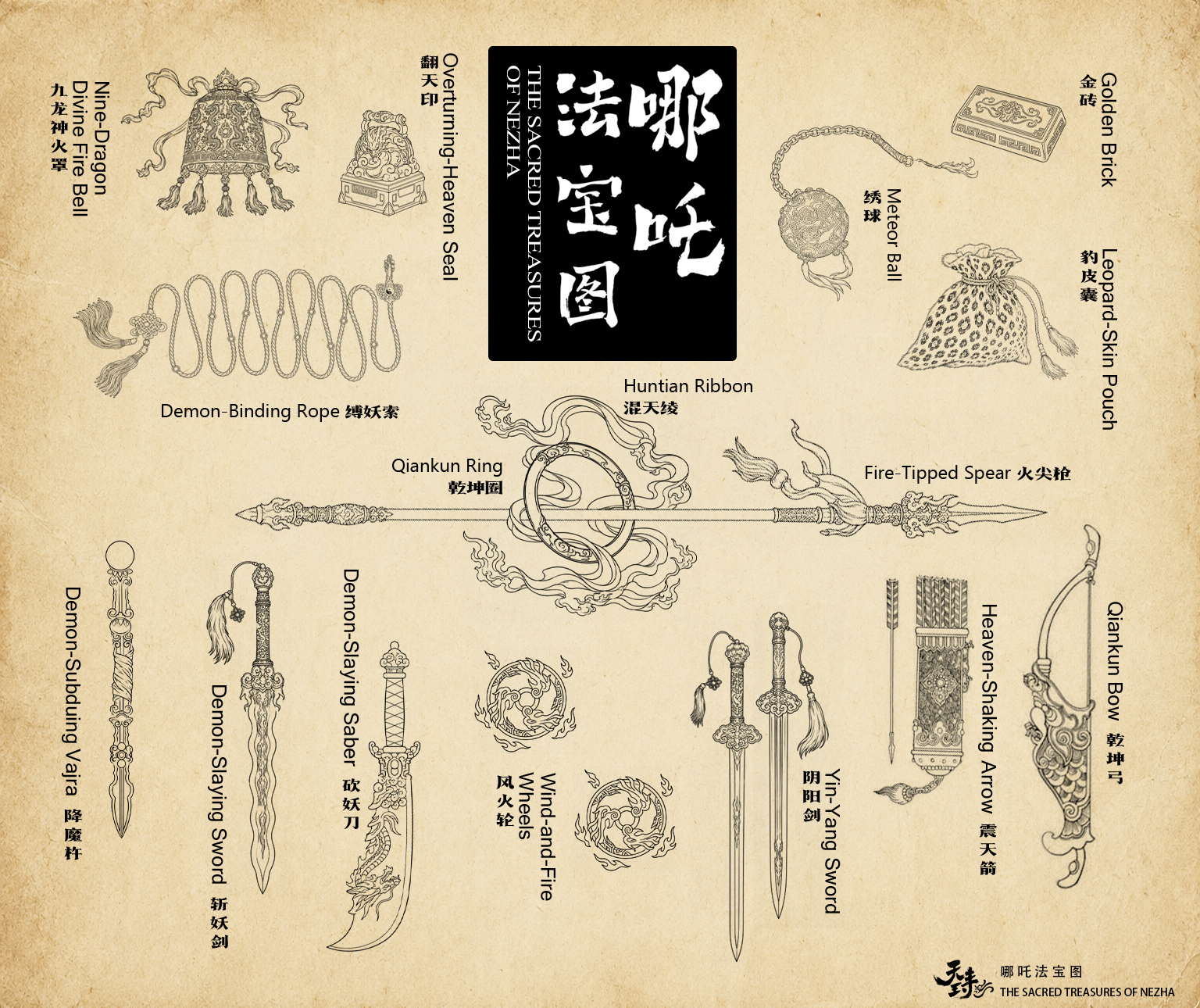
PLATE I
THE SACRED TREASURES OF NEZHA
A visual synthesis of Nezha’s sacred treasures across Chinese religious art, literature, theater, and popular imagination.
This reconstruction combines objects associated with Nezha in
different historical periods and traditions. Not all treasures
depicted here appear together in any single textual or artistic source.
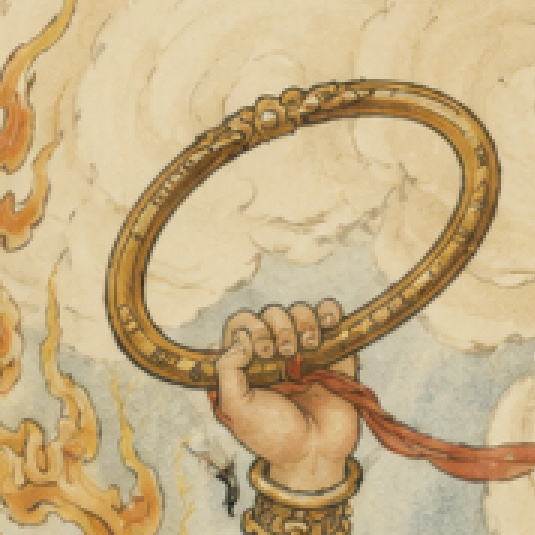
Universe Ring
乾坤圈 (Qiankun Quan)
Type: Divine weapon
Meaning: Cosmic authority · Heavenly order
The Qiankun Quan (乾坤圈) is Nezha’s most recognizable magical artifact and one of the defining symbols of his identity. Traditionally associated with the balance of heaven and earth, it represents the cyclical forces of the cosmos and the harmony of yin and yang.
According to Fengshen Yanyi (Investiture of the Gods), the Qiankun Quan was a sacred treasure of Jinguang Cave on Mount Qianyuan and was bestowed upon Nezha by his master, Taiyi Zhenren. In the original novel, it is described as a golden bracelet, while later literary, theatrical, cinematic, and animated interpretations transformed it into a powerful golden ring capable of suppressing demonic forces and shaking heaven and earth.
The Qiankun Quan serves both offensive and defensive purposes. It can be wielded as a close-combat weapon, used as a protective talisman, or thrown as a projectile with devastating accuracy and force.
In religious art and popular imagery, Nezha is often depicted wearing the Qiankun Quan around his arm or slung across his shoulder. Alongside the Wind Fire Wheels and the Fire-Tipped Spear, it has become one of the most enduring visual symbols associated with the deity.
In visual art, the Universe Ring often functions as Nezha’s primary identifying attribute.
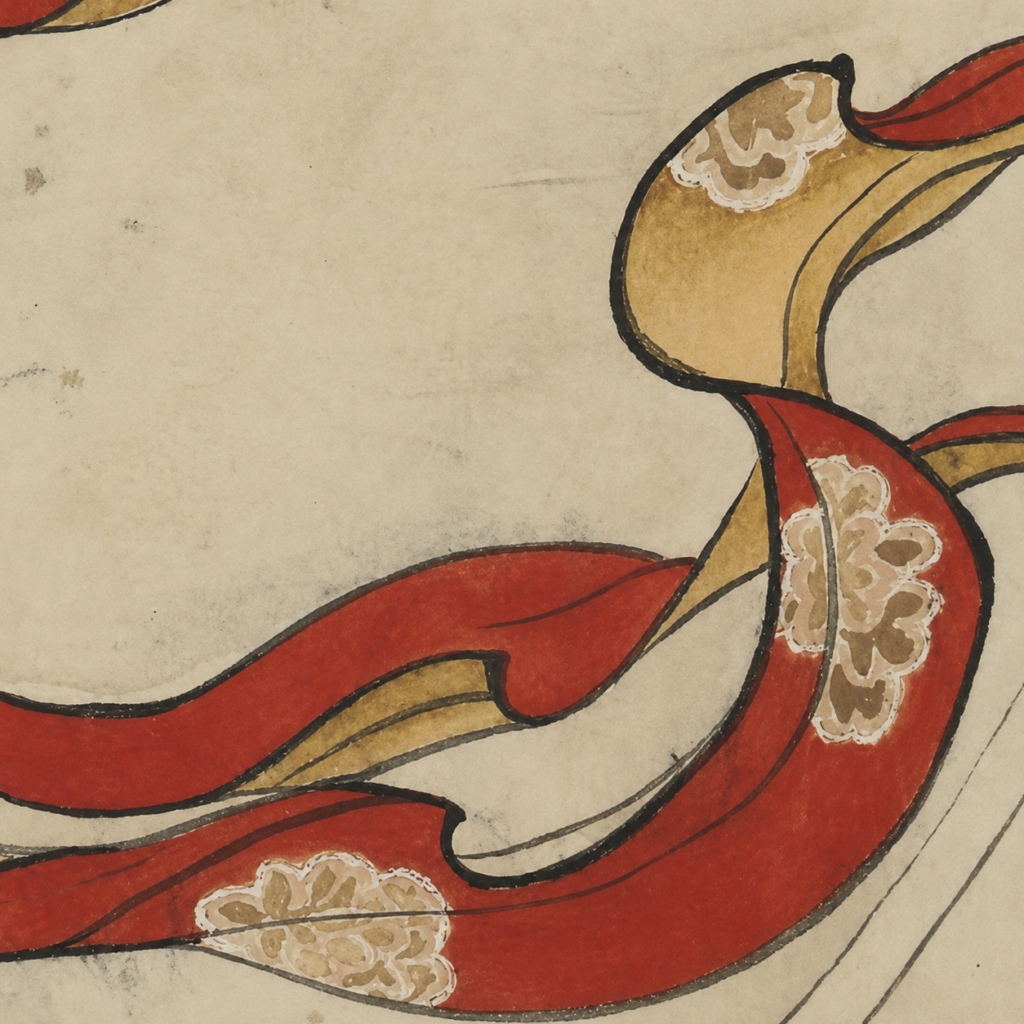
Red Armillary Sash
混天绫 (Huntian Ling)
Type: Divine textile
Meaning: Chaos · Cosmic energy
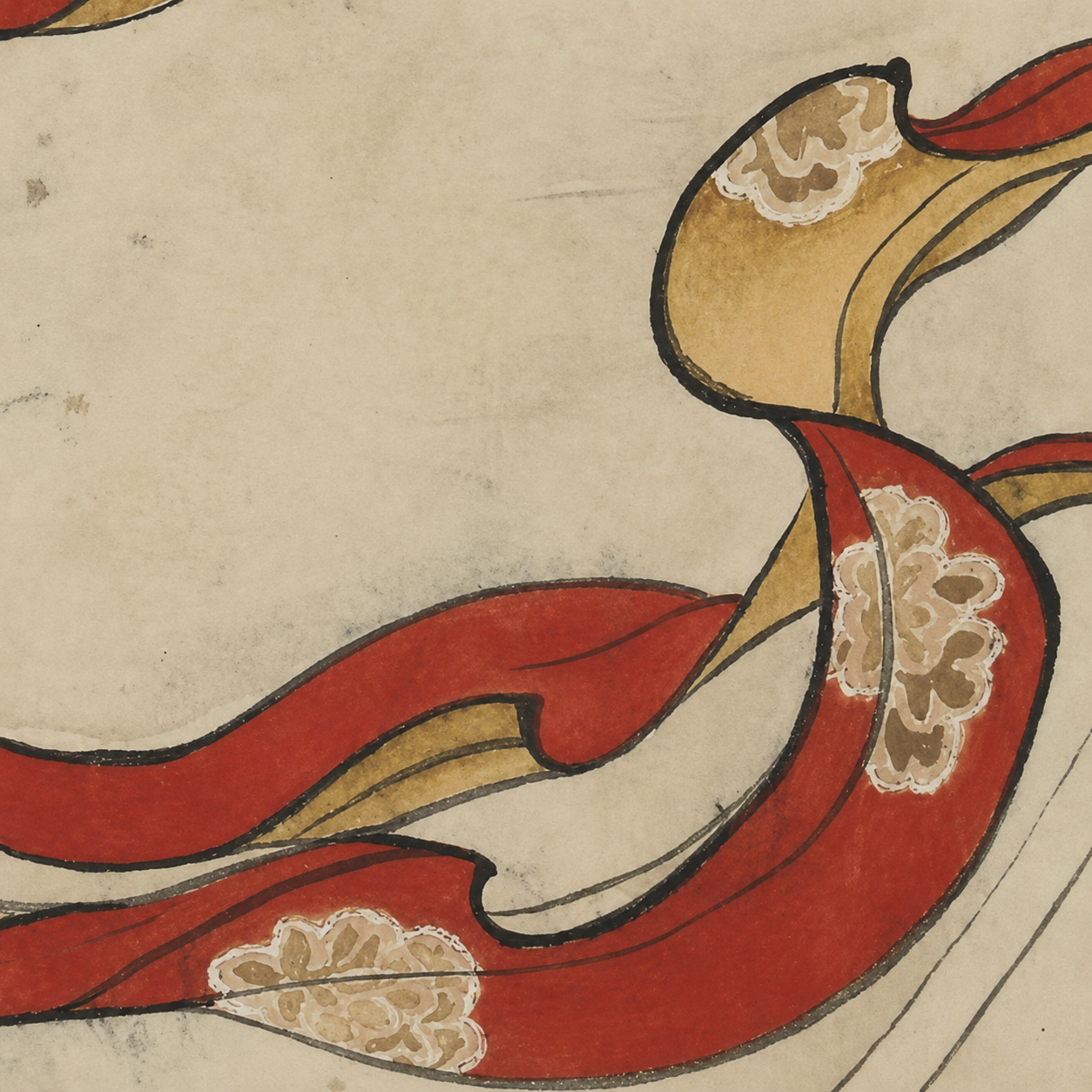
The Huntian Ling (混天绫) is one of Nezha’s most iconic magical treasures. Described as a crimson silk ribbon approximately one chi wide and seven chi long, it was bestowed upon Nezha by his master, Taiyi Zhenren, shortly after his birth. In its resting state, the ribbon appears soft and elegant, often draped around Nezha’s body as both an ornament and a symbol of divine status.
Despite its delicate appearance, the Huntian Ling possesses immense supernatural power. It can extend indefinitely, bind opponents automatically, and withstand tremendous force without breaking. In battle, it functions as both a restraining weapon and a manifestation of Nezha’s divine authority.
Its name literally means “Ribbon that Mixes the Heavens,” reflecting its legendary ability to disturb the natural order of the cosmos. According to Fengshen Yanyi (Investiture of the Gods), Nezha once used the Huntian Ling while bathing in the Jiuwan Stream, causing violent disturbances that shook the underwater palace of the Dragon King of the East Sea. The resulting turmoil set in motion the famous conflict between Nezha and Ao Bing (敖丙), the Dragon King’s third son.
In art, literature, and popular culture, the flowing red Huntian Ling is often depicted swirling around Nezha’s body. Together with the Qiankun Quan (乾坤圈), Wind Fire Wheels (风火轮), and Fire-Tipped Spear (火尖枪), it has become one of the most recognizable visual symbols associated with the deity.
Wind Fire Wheels
风火轮 (Fenghuolun)
Type: Divine vehicle
Meaning: Speed · Fire · Transcendence
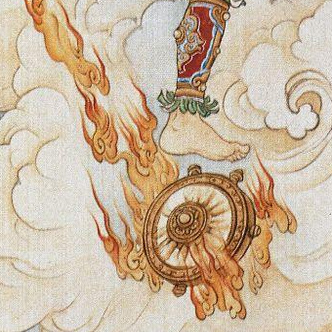
The Wind Fire Wheels (风火轮) are among Nezha’s most iconic magical treasures and one of the defining elements of his visual identity. Described in Fengshen Yanyi (Investiture of the Gods) as a pair of wheels that generate wind and fire when set in motion, they enable Nezha to travel across the heavens at extraordinary speed.
Bestowed upon him by his master, Taiyi Zhenren, the Wind Fire Wheels serve primarily as a means of transportation and aerial maneuverability. By standing upon them and reciting the appropriate incantations, Nezha can fly freely through the sky, rapidly change direction, and move across great distances. In battle, they function much like a celestial mount, providing the mobility that complements his Fire-Tipped Spear (火尖枪) and other weapons.
In religious art, popular illustrations, theater, animation, and film, the Wind Fire Wheels are almost always depicted beneath Nezha’s feet. Together with the Qiankun Quan (乾坤圈), Huntian Ling (混天绫), and Fire-Tipped Spear (火尖枪), they form one of the most recognizable visual symbols associated with the deity.
Modern adaptations have reinterpreted the Wind Fire Wheels in various ways. In Nezha Conquers the Dragon King (1979), they are used in Nezha’s battle against Sun Wukong, while in The Legend of Nezha they become a symbol of his regained power. In the animated film Nezha: Birth of the Demon Child (2019), the Wind Fire Wheels are reimagined as a magical mount transformed into one of Nezha’s signature treasures.
Fire-Tipped Spear
火尖枪 (Huojianqiang)
Type: Polearm
Meaning: Martial authority
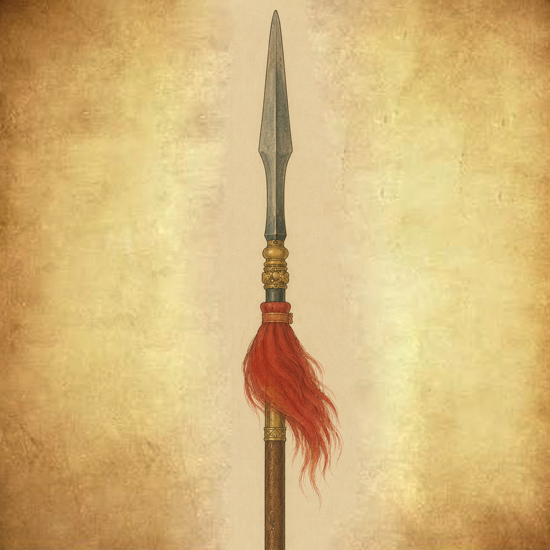
The Fire-Tipped Spear (火尖枪) is Nezha’s primary weapon in Fengshen Yanyi (Investiture of the Gods). Bestowed upon him by his master, Taiyi Zhenren, it is most often depicted alongside the Wind Fire Wheels (风火轮), forming the core of Nezha’s martial iconography and serving as his principal weapon in battle.
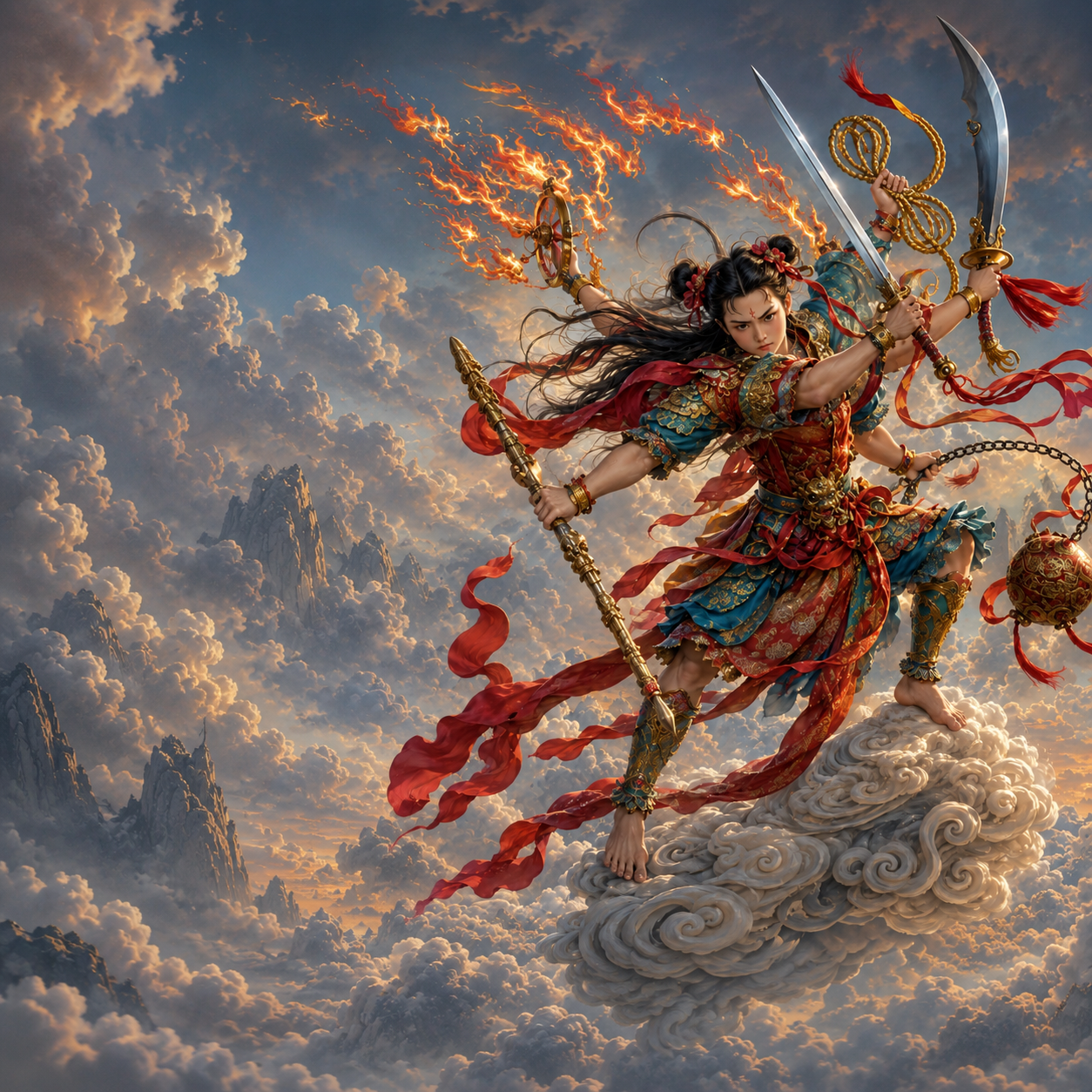
The spear is described as being one zhang and eight chi (approximately six meters) in length, with a blade capable of emitting flames. During the campaign against the Shang dynasty, Nezha wielded the Fire-Tipped Spear in countless battles, defeating numerous enemy generals. In some depictions, he assumes his supernatural form of Three Heads and Six Arms (三头六臂), wielding multiple weapons simultaneously, including twin Fire-Tipped Spears.
The Fire-Tipped Spear also appears in Journey to the West, where it is associated with Red Boy (红孩儿). Although the weapon retains its characteristic length, it is generally not described as possessing the same flame-emitting properties found in Fengshen Yanyi.
In religious art, opera, illustration, and modern popular culture, the Fire-Tipped Spear is almost invariably portrayed in Nezha’s hand, making it one of the most enduring and recognizable symbols of the deity.
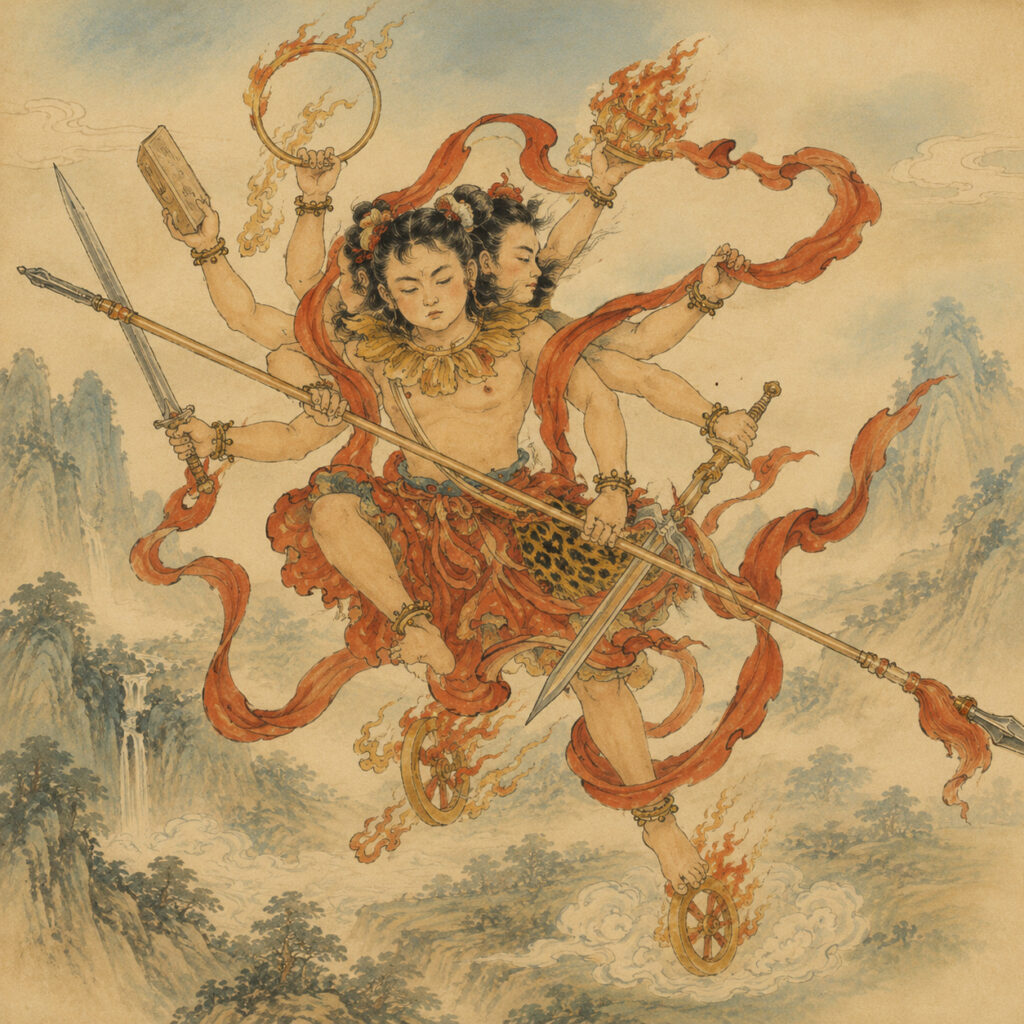
Three Heads and Six Arms
三头六臂 (Santou Liubi)
Type: Divine transformation
Meaning: Supernatural power · Multiplicity
Three Heads and Six Arms (三头六臂) is a supernatural form found in both Buddhist and Chinese religious traditions. Originally associated with divine manifestations in Buddhist iconography, it later became a symbol of extraordinary power, representing the ability to perform multiple actions simultaneously and to overcome seemingly impossible challenges.
Among all figures in Chinese mythology, Nezha is perhaps the character most closely associated with this form. In Fengshen Yanyi (Investiture of the Gods), he assumes the appearance of Three Heads and Six Arms when confronting particularly powerful enemies. In this state, his combat abilities increase dramatically, allowing him to wield multiple magical weapons at the same time and fight on a scale far beyond that of an ordinary warrior.
Different literary traditions describe slightly different combinations of weapons. The form is most commonly associated with Nezha simultaneously wielding treasures such as the Qiankun Quan (乾坤圈), Huntian Ling (混天绫), Fire-Tipped Spear (火尖枪), Wind Fire Wheels (风火轮), Jiulong Shenhuo Zhao (九龙神火罩), Golden Brick (金砖), and the Yin-Yang Swords (阴阳剑).
In Journey to the West, Nezha famously transforms into his Three Heads and Six Arms form during his battle against Sun Wukong. Each of his six hands carries a different weapon, including the Demon-Slaying Sword (斩妖剑), Demon-Cleaving Saber (砍妖刀), Demon-Binding Rope (缚妖索), Demon-Subduing Pestle (降魔杵), Embroidered Ball (绣球儿), and Fire Wheel (火轮儿). Sun Wukong responds by assuming the same form and multiplying his Golden-Hooped Staff into countless copies. Their clash in midair became one of the most celebrated magical duels in Chinese literature.
In religious art, opera, temple sculpture, and modern popular culture, the Three Heads and Six Arms form remains one of the most recognizable visual representations of Nezha, symbolizing his divine power, martial prowess, and supernatural status.
Lotus Body
莲花化身 (Lianhua Huashen)
Type: Divine body
Meaning: Death · Rebirth · Transcendence
The Lotus Body (莲花化身) is one of the most celebrated episodes in Nezha’s mythology. After sacrificing himself to save his family from the wrath of the Dragon Kings, Nezha’s spirit sought refuge with his master, Taiyi Zhenren, who resolved to restore him to life through divine means.
According to Fengshen Yanyi, Taiyi ordered the gathering of sacred lotus flowers and lotus leaves, which he transformed through immortal arts into an entirely new body for Nezha. Reborn from the lotus rather than from human flesh, Nezha emerged with a supernatural body and entered a new stage of his existence.
Unlike ordinary mortals, the lotus body was believed to be immune to many spiritual attacks, diseases, and supernatural afflictions. This transformation also marked Nezha’s complete separation from his former mortal identity and the beginning of his life as a divine warrior.
In Chinese culture, the lotus symbolizes purity and transcendence. Nezha’s lotus body therefore represents not merely resurrection, but the complete transformation from mortal child to divine being.
Evolution of the Image
How a Buddhist Guardian Became China’s Most Famous Divine Child
Few figures in Chinese mythology have undergone as many transformations as Nezha. Over more than a thousand years, he evolved from a Buddhist protector deity into a celestial marshal, a rebellious child hero, and eventually one of the most recognizable icons of Chinese popular culture.
INDIAN ORIGINS
Nalakūvara
The Buddhist Guardian
Period: India – Early Buddhism
Period: India • Early Buddhism
Transformation:
Buddhist guardian deity and son of Vaiśravaṇa.
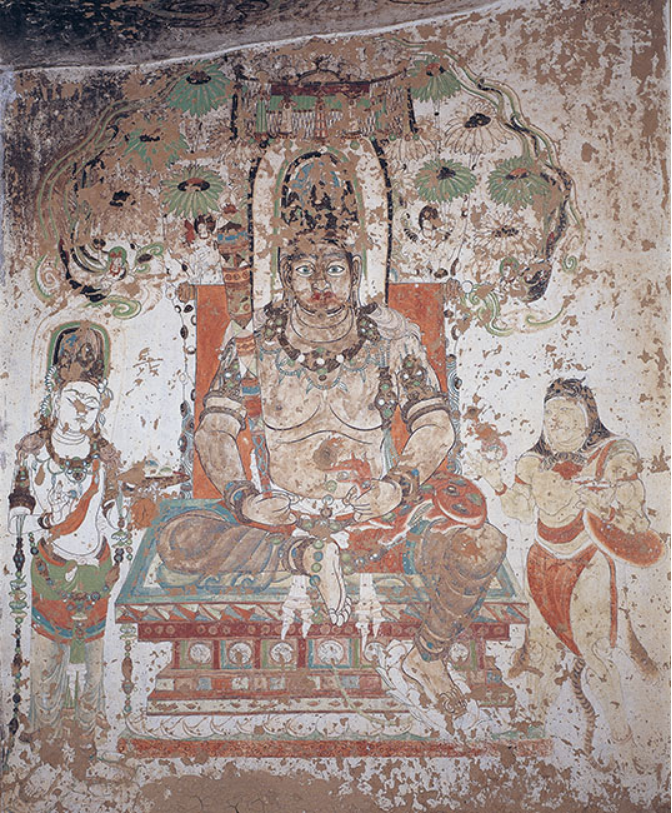
FIG. 13
Vessavaṇa
Vessavaṇa is one of the Four Heavenly Kings in Buddhism and Ne Zha’s grandfather (or father). The grotto mural of Vessavaṇa was found in Dunhuang, dated to late Tang Dynasty (618-907)/Dunhuang Academy.
TANG DYNASTY
The Armored Prince
Period:618–907
Transformation:
Nezha entered Chinese Buddhism as an armored celestial warrior.
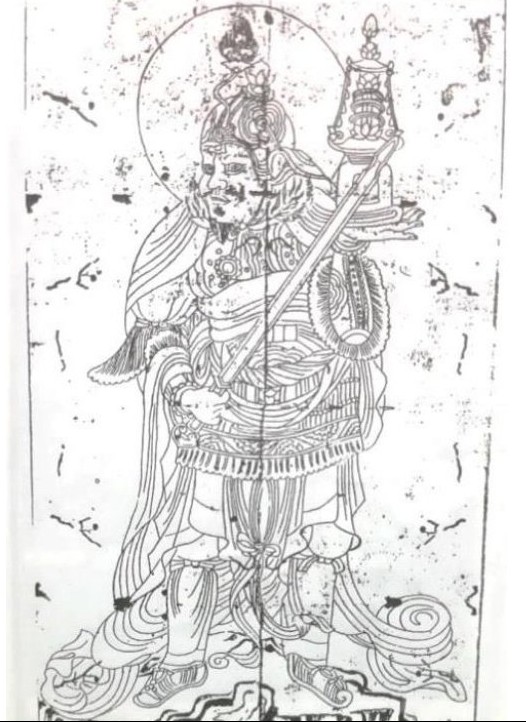
FIG. 15
This image depicts Prince Nezha during the Tang Dynasty. At that time, Nezha was portrayed not as a child, but as a fully armed, armor-clad warrior of imposing stature.《大正藏·图像部》“唐本哪吒太子像”.
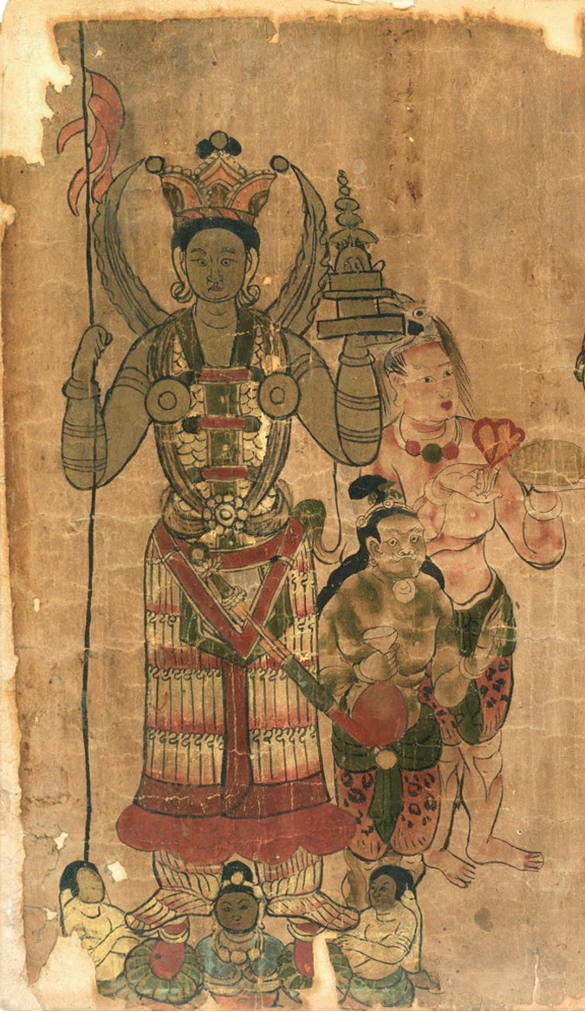
FIG. 16
Depiction of Vaiśravaṇa and Nezha from Dunhuang
In the Dunhuang painting Vaiśravaṇa Attending Nezha’s Assembly, Nezha is consistently depicted as a child attendant. The fair-skinned, rosy-cheeked youth holding a precious flower to the left of Vaiśravaṇa represents an early childlike depiction of Nezha. Among the two figures standing beside the Heavenly King, one is a child with a pale pink complexion, relatively large stature, and distinctly Chinese facial features, closely resembling the later “chubby-faced” image of Nezha. This figure can therefore be identified as the Sinicized Nezha, suggesting that the child Nezha of Ming and Qing vernacular fiction may ultimately trace its origins back to these Dunhuang representations.
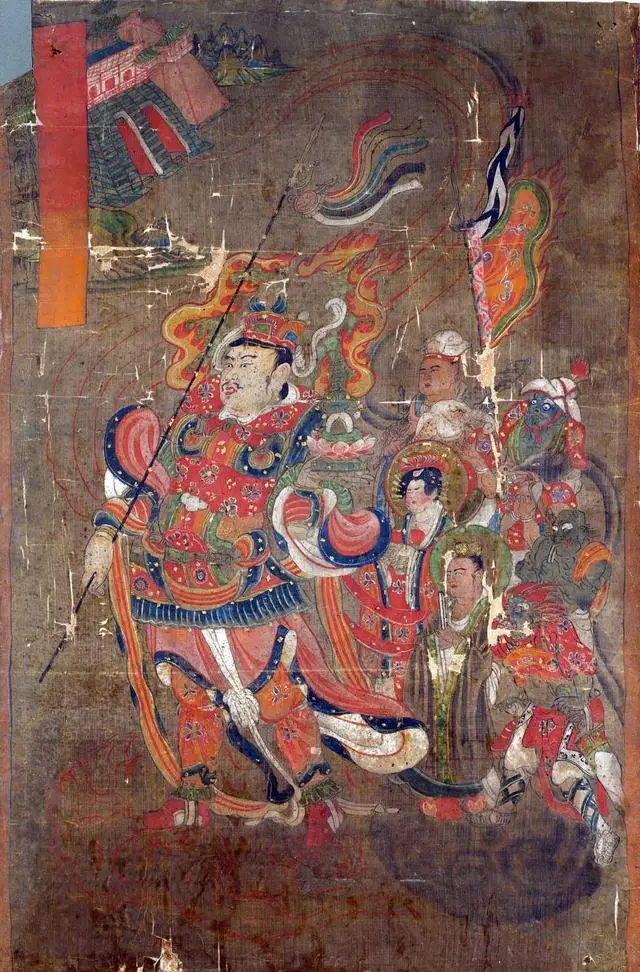
FIG. 17
The earliest identifiable image of Nezha was discovered in a Tang-dynasty silk painting of Vaiśravaṇa, unearthed from the Mogao Caves at Dunhuang. Beneath the Heavenly King’s knee stands a young warrior holding a halberd, accompanied by the inscription “Prince Nazha” (那咤太子). This figure derives from the Sanskrit name Nalakūvara, originally the third son of the Indian wealth deity Kubera. In Esoteric Buddhism, he served merely as an attendant carrying a spear.
According to the Taiping Guangji of the Northern Song dynasty, the Tang military hero Li Jing was later identified with Vaiśravaṇa himself. As Buddhism became increasingly Sinicized, Nalakūvara was incorporated into the newly constructed genealogy of Li Jing’s sons—Jinzha, Muzha, and Nezha. This transformation of a minor Indian Buddhist attendant into one of China’s most beloved divine heroes may be regarded as one of the most remarkable examples of religious and cultural adaptation in Chinese history.
SONG DYNASTY
The Son of Li Jing
Period:960–1279
Transformation:
Nezha became integrated into Chinese mythology and entered the Li family lineage.
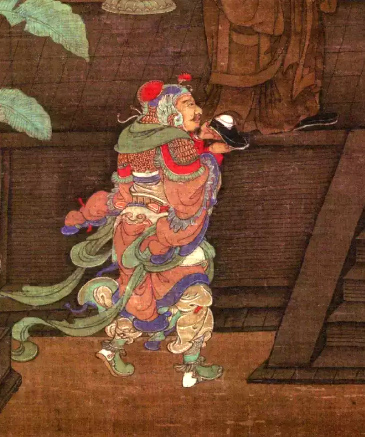
FIG. 18
This painting is a detail from The Five Hundred Arhats: Veneration at the Buddha Hall by Lin Tinggui of the Southern Song Dynasty. It illustrates a famous story about the eminent Tang monk Daoxuan. The figure supporting the monk’s feet with both hands is Nezha.
As seen in Lin Tinggui’s Buddhist painting, Nezha is still depicted as an adult rather than a child. This suggests that, in the minds of people during the Tang and Song dynasties, Nezha—as a powerful Buddhist guardian deity endowed with great supernatural abilities—was not envisioned as a youthful boy. The familiar image of Nezha as a child attendant would emerge from other, earlier traditions.
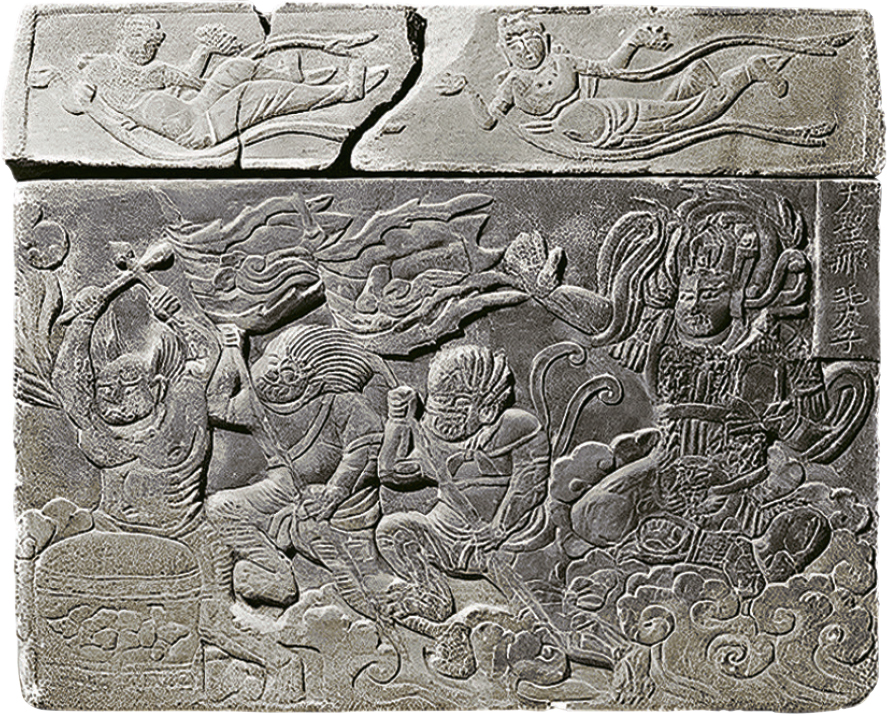
FIG. 19
During the Song dynasty, Nezha’s identity became further Sinicized. He was reimagined as the third son of Li Jing, completely severing his Indian Buddhist origins and becoming fully integrated into the Chinese pantheon.
Image of Nezha: A stone reliquary casket unearthed from the underground crypt of the North Pagoda in Chaoyang, Liaoning Province, and now housed in the Chaoyang North Pagoda Museum, is carved on its four sides with a series of scenes depicting the story of “Nezha as a Dharma Protector.” The carvings portray Nezha commanding yakshas and other divine attendants in pursuit of the rebellious Dragon King Xiuji, who was causing storms and disturbances.
It was also during the Song period that the image of Nezha as a “Prince” (Taizi) and a youthful hero began to emerge. This development may have been influenced by the widespread circulation of Buddhist stories depicting Nezha in his younger years. As a result, Nezha gradually evolved into the archetype of a heroic youth.
YUAN DYNASTY
The Divine Child
Period:1271–1368
Transformation:
The image of Nezha shifted from warrior deity to miraculous child hero.
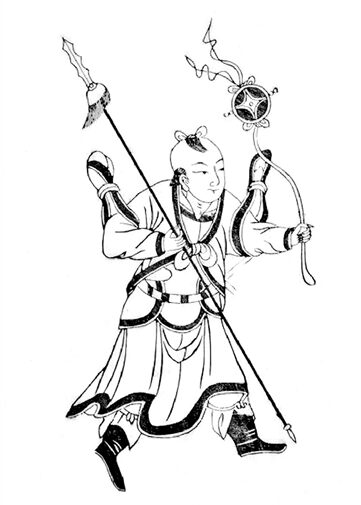
FIG. 20
元明刊本西域 哪吒
MING DYNASTY
The Canonical Nezha
Period:1368–1644
Transformation:
The mythology of Nezha was standardized through Fengshen Yanyi and Journey to the West.
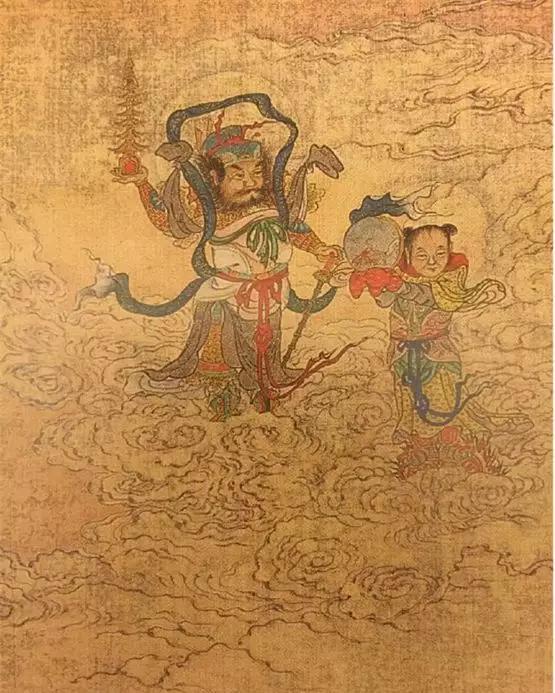
FIG. 21
国藏绢本《西游记》中的李靖和哪吒
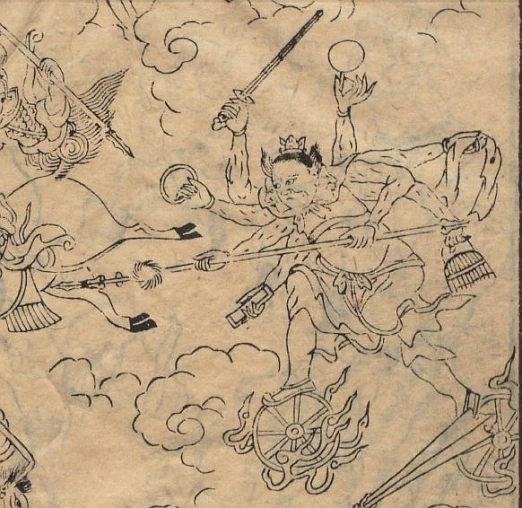
FIG. 22
Nezha as depicted in the Wanli-era Ming dynasty edition of The Investiture of the Gods (Fengshen Yanyi), published by Jinchang Zaiyangshu Wenyuan. He is portrayed as a fierce warrior figure with three heads and six arms.
QING DYNASTY
The Popular Warrior God
Period:1644–1912
Transformation:
Nezha became a widely worshipped folk deity and a popular subject in religious art.
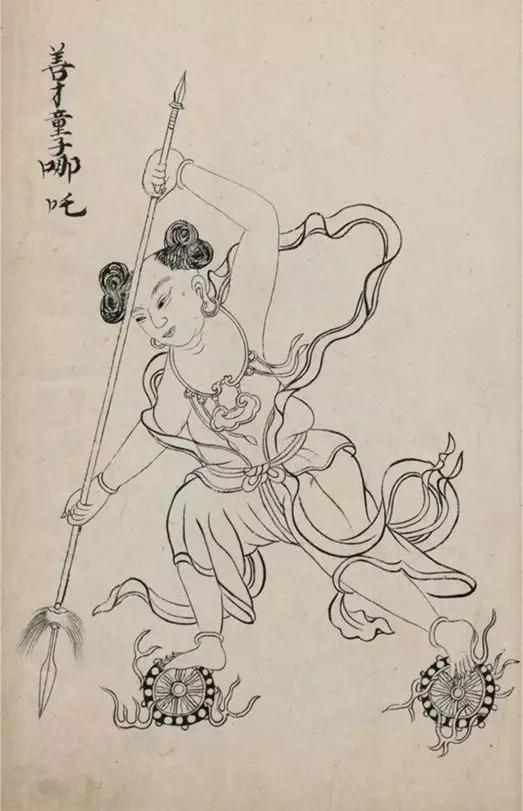
FIG. 23
清代《封神真形图》 哪吒
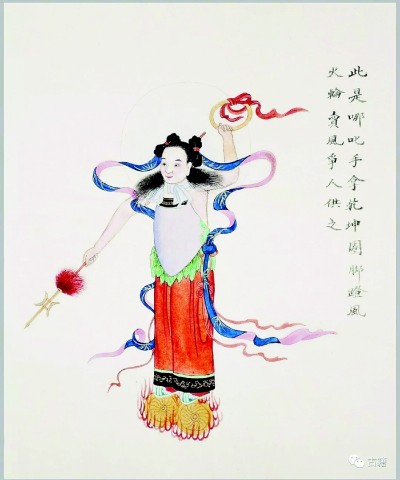
FIG. 25
Nezha, painted by Zhou Peichun in the late Qing dynasty. The inscription reads: “Worshipped by kite sellers.”
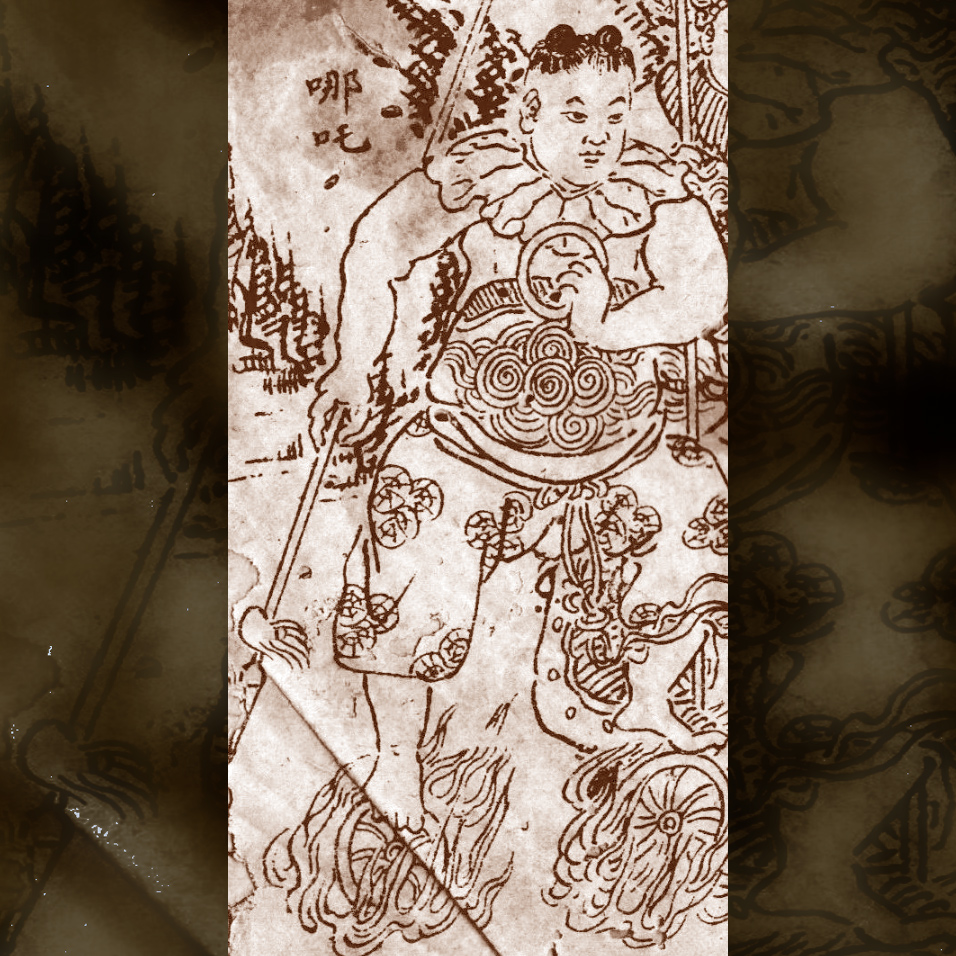
FIG. 26
清代《封神真形图》 哪吒
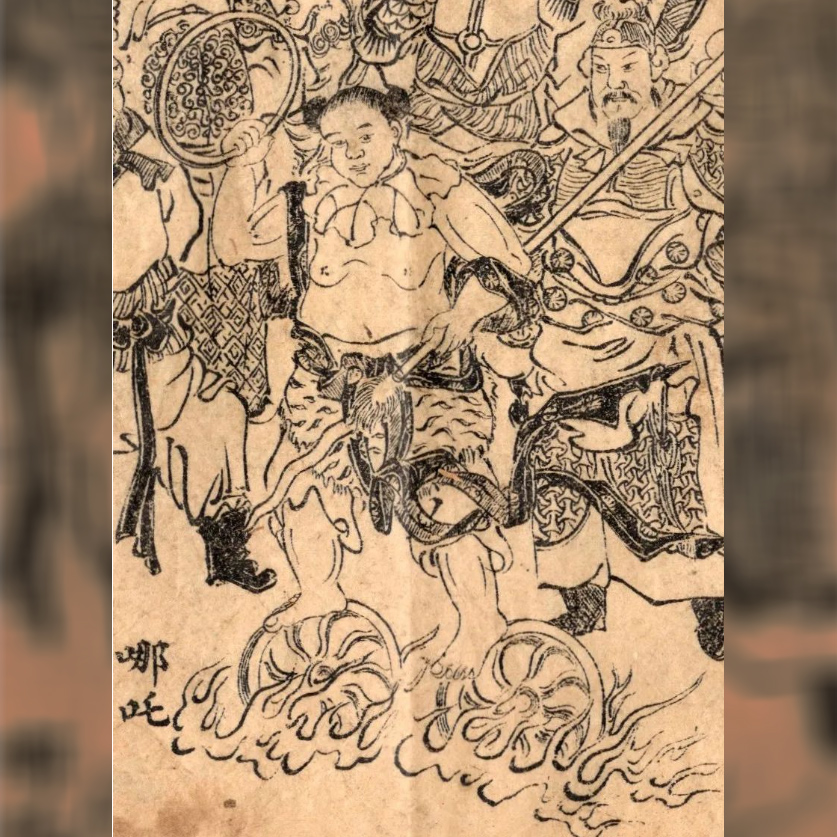
FIG. 27
清代《绣像南游记》中哪吒插图
REPUBLICAN ERA
The Hero of Popular Media
Period:1912–1949
Transformation:
Traditional religious imagery merged with commercial prints, opera, and modern illustration.
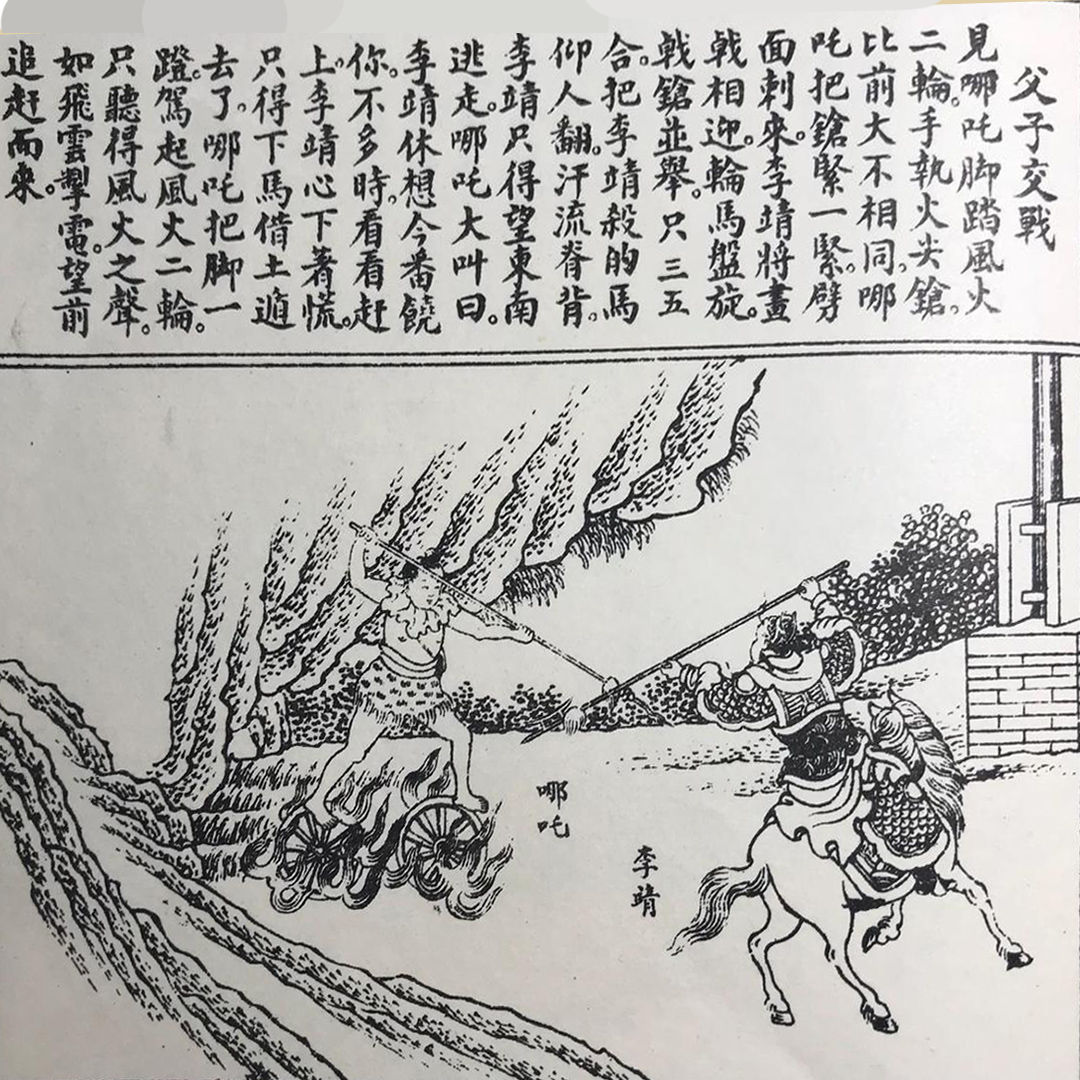
FIG. 28
Illustration from The Illustrated Investiture of the Gods (连环图画封神传), Shanghai Book Company, Republican China, 2nd edition, 1929. Reprinted by Heilongjiang Fine Arts Publishing House in 2001. Vol. 2, Chapter 14: “Nezha Appears in His Lotus Incarnation” [5]: “Father and Son in Battle.”
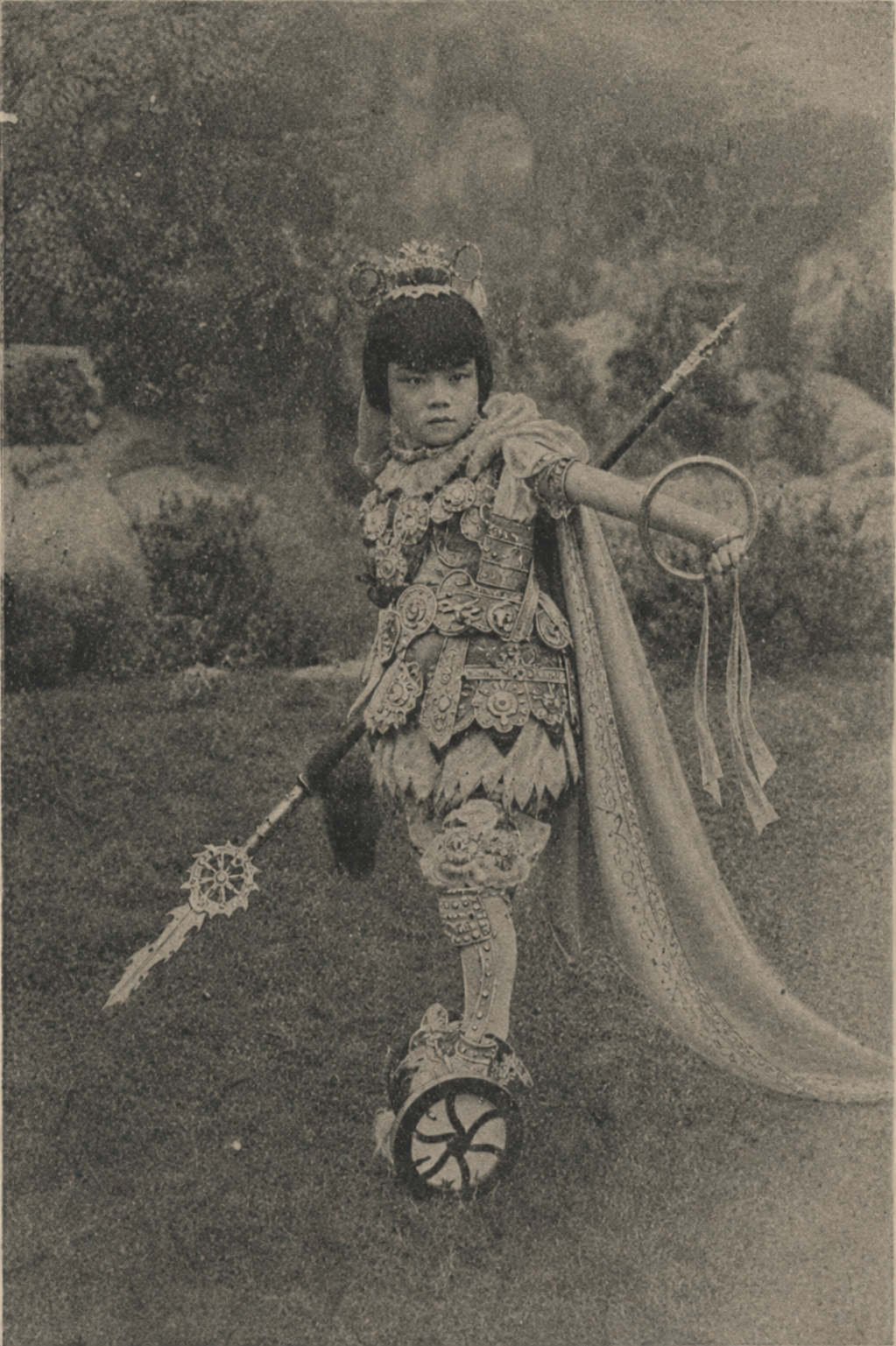
FIG. 29
Gu Baolian as Nezha in The Investiture of the Gods: Nezha Conquers the Sea (封神榜之哪吒闹海), produced by the Great China Film Company in 1927. The production was later adapted for the stage. Silver Star magazine, no. 10, 1927.
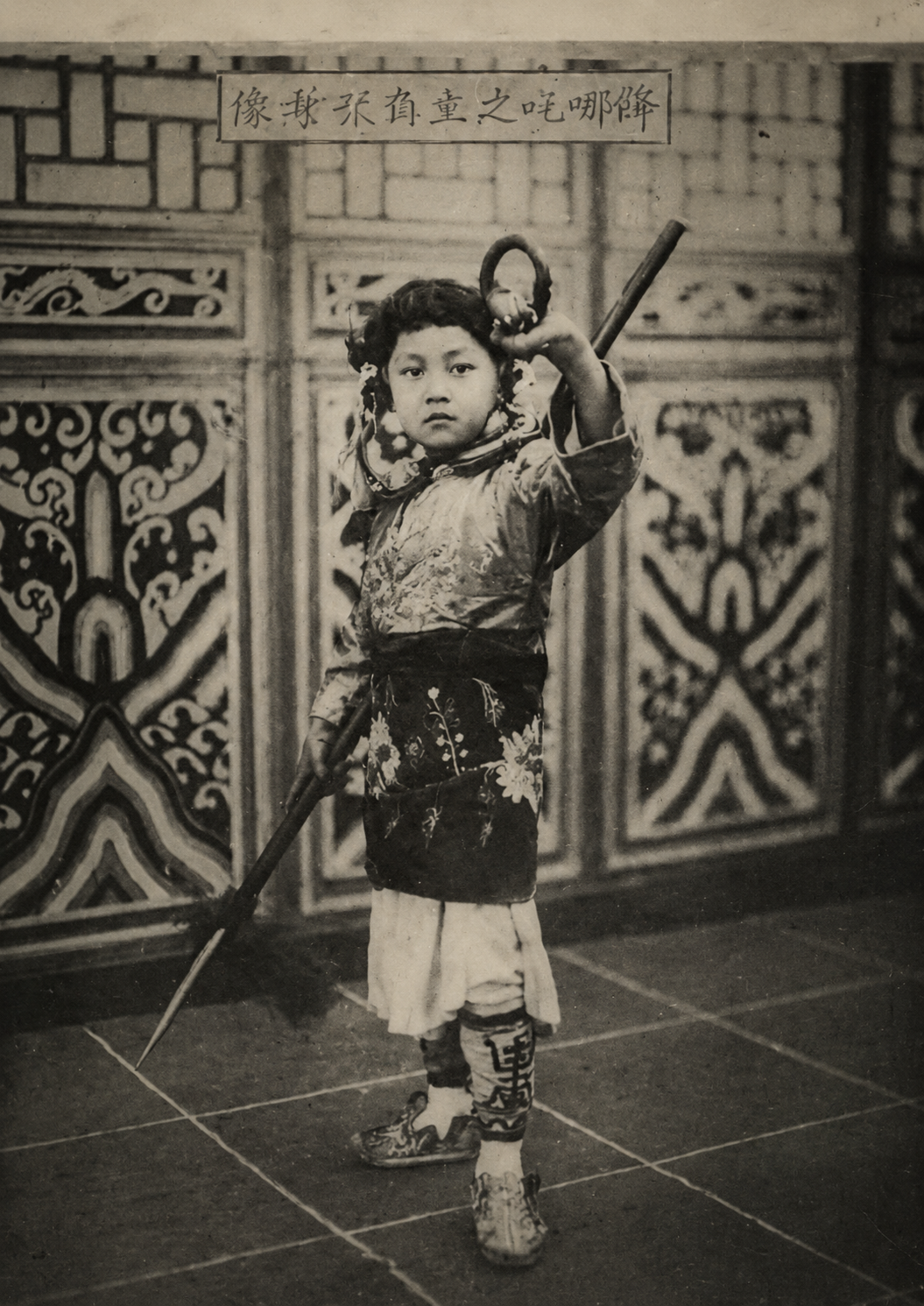
FIG. 30
Zhang Zhede as Nezha in The Birth of Nezha (1927), a film produced by the Great Wall Film Company. Image reproduced from The China Cinema Magazine, Vol. 1, No. 8 (1927).
CONTEMPORARY ERA
The Global Nezha
Period:1949–Present
Transformation:
Nezha evolved into one of the most recognizable icons of Chinese popular culture.
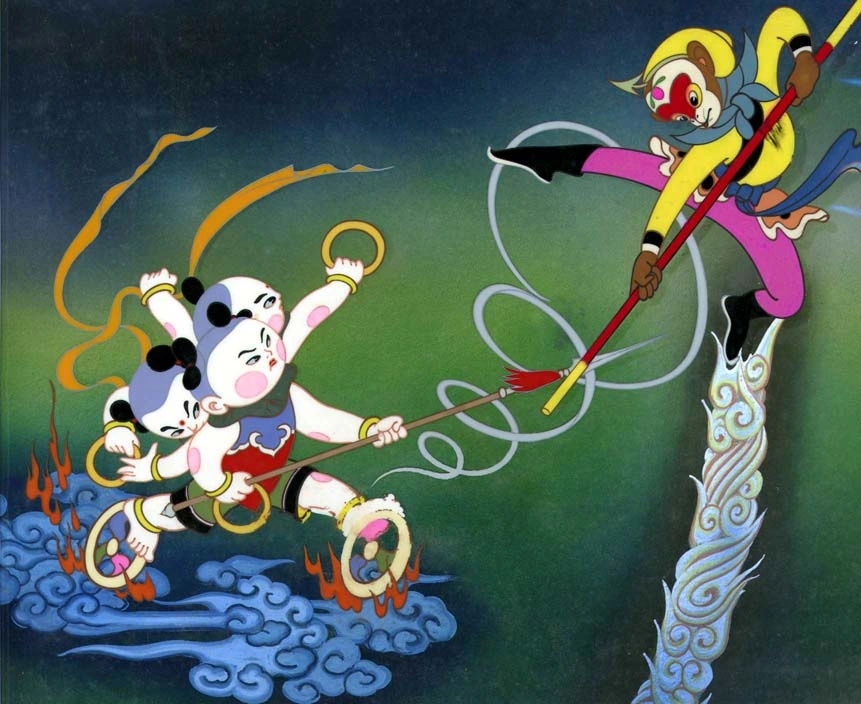
FIG. 31
In The Monkey King: Uproar in Heaven (1961–1964), Nezha’s character design was inspired by traditional yingxi tu (children-at-play New Year prints). Featuring an oversized head, a small and chubby body, refined facial makeup, fierce and haughty eyes, and brilliantly colored, ornate costume, he was depicted as an arrogant and willful child.
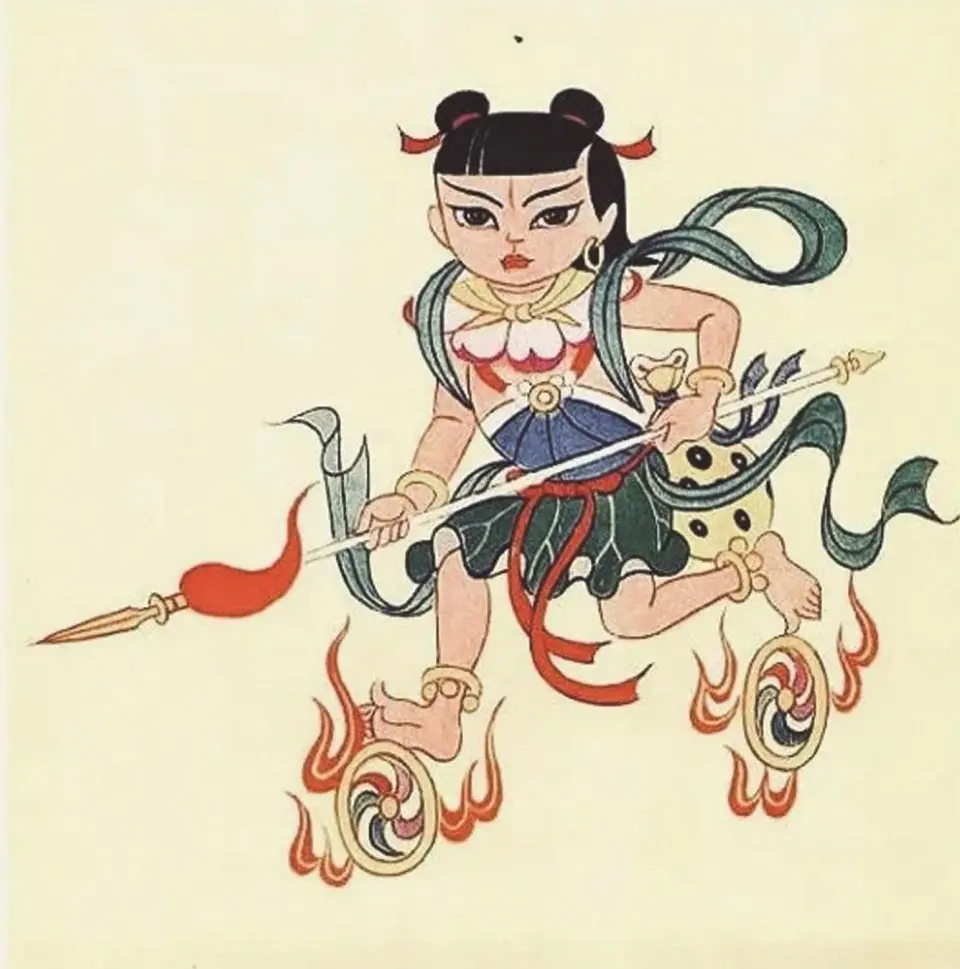
FIG. 32
In Nezha Conquers the Dragon King (1979), Nezha appeared with twin topknots adorned with red ribbons, a stern and heroic gaze, and traditional Chinese costume consisting of a white robe and red dudou. Carrying the Universe Ring (Qiankun Quan) and the Red Armillary Sash (Huntian Ling), he was portrayed as a courageous and fearless young hero.
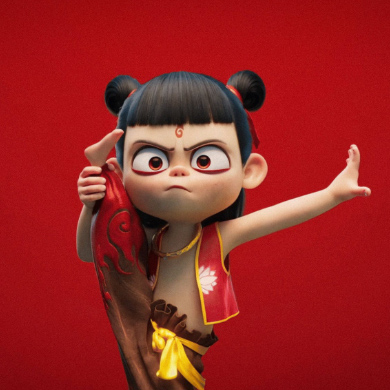
FIG. 33
In Ne Zha (2019) and Ne Zha 2 (2025), Nezha underwent a transformation from traditional two-dimensional animation to highly detailed three-dimensional representation. Featuring dark circles under the eyes, uneven teeth, a hairstyle inspired by Nezha Conquers the Dragon King (1979), and upgraded costume design, he was reimagined as a mischievous, rebellious, dark-toned child. This interpretation presents a psychologically complex character—both defiant and kind-hearted—whose strong sense of justice and destiny aligns with the “demon child” concept while subverting traditional portrayals.
Related Subjects
Explore the people, weapons, symbols, and stories connected to this page.
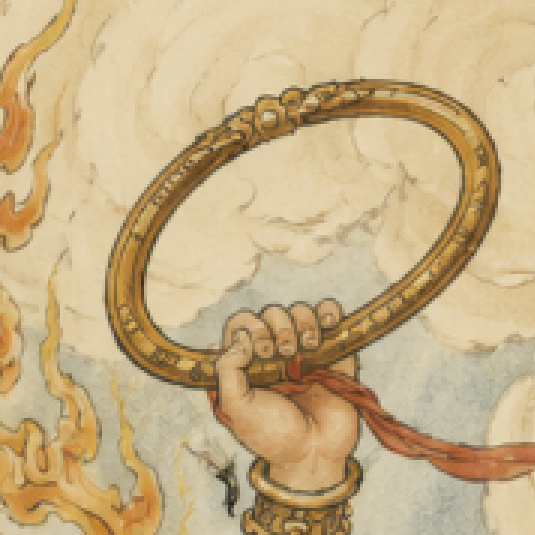
Fire Wheels
One of Nezha’s most iconic divine Transportation.
Fire-Tipped Spear
Nezha’s primary weapons on the battlefield
Red Armillary Sash
The treasures Nezha brought with him at birth