I. Two Blades in the Melting Snow
By the third day at the foot of Liangshan, Lin Chong’s blade had yet to draw blood.
Wang Lun, master of the mountain stronghold, wanted a severed head as the price of admission. Lin Chong had waited beside the track and let a wine seller pass, then a woodcutter, then a man driving animals. Their clothes were worn; none carried much worth stealing. More than that, he could not bring himself to cut one down. In the afternoon a porter came along the stream with a heavy load. Lin Chong rushed from the trees. The man dropped the baggage and fled. He had scarcely run a dozen paces when a voice sounded behind him.
“Stop! Who touched my things?”
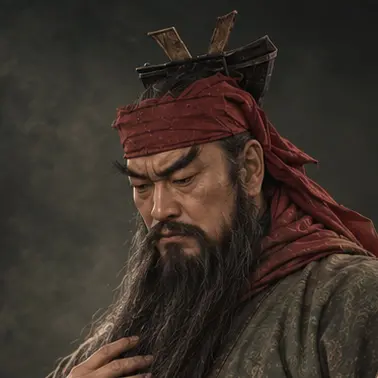
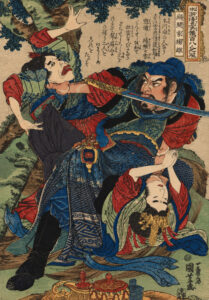
Lin Chong turned. The speaker had pushed back his felt hat, revealing the great blue mark on his face. A sash bound his white satin coat; a saber rode at his waist, and he held a pu dao level before him, its broad blade set on a long shaft.
“That load is yours?” Lin Chong asked.
“Whose would it be? Yours?”
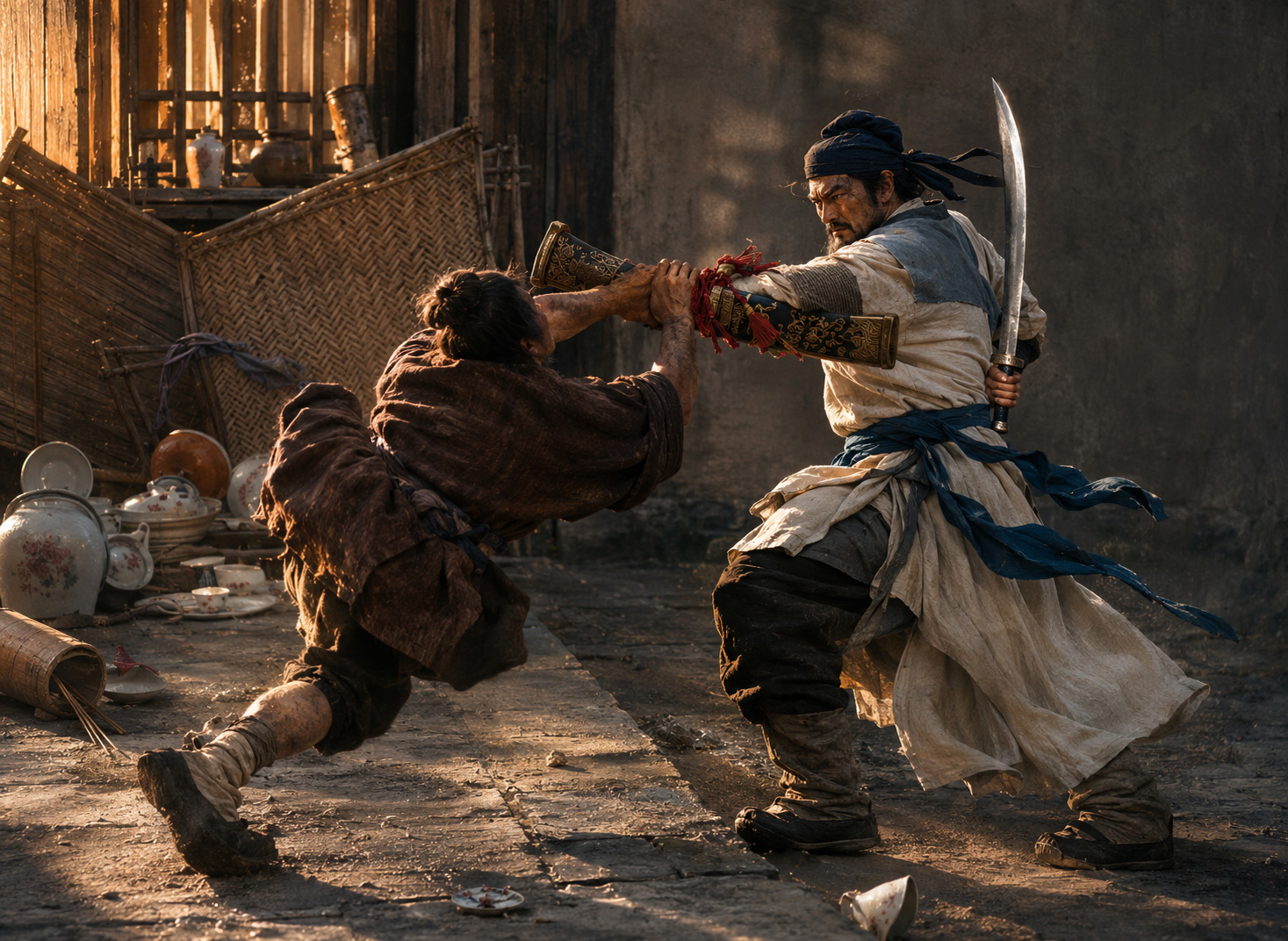
Lin Chong had endured three days of Wang Lun’s demands and had no patience left. He advanced with his weapon. The blue-faced man did not ask another question. Their blades struck over the stream, sharp against the hush of thawing snow.
They fought for some thirty exchanges without either man yielding. Lin Chong had the measured discipline of a former imperial guard instructor. Yang Zhi, trained through the martial examination and years in the ranks, was no wanderer swinging steel on impulse. Each recognized a practiced opponent. Neither pressed recklessly; neither gave away so much as a step. Edges skimmed cloth, shafts met with heavy blows, and broken ice scattered underfoot.
They fought for another dozen or so exchanges. Yang Zhi drove through an opening as Lin Chong shifted his footing. Lin Chong slipped aside and cut back; Yang Zhi caught the stroke across his shaft. The force went through both their arms. They watched each other in silence.
Then a cry came from the mountain: “Good men, hold!”
Lin Chong sprang out of range. Yang Zhi stopped too, his gaze still fixed on the stolen load. Wang Lun descended with Du Qian and Song Wan. Once they had exchanged names, the mountain men discovered that the stranger was Yang Zhi, the Blue-Faced Beast.
At the stronghold, Wang Lun listened to the story of the imperial shipment that had sunk under Yang Zhi’s charge, the years he had hidden in the west, and the amnesty that had finally sent him back toward Tokyo. He poured his guest a cup of wine.
“Gao Qiu holds the military seals,” Wang Lun said. “Even with money to smooth your way, you cannot know whether he’ll take you back. Stay here. There is room for a man of your skill.”
Yang Zhi did not touch the cup. “I lost the court’s property and was afraid to return. That was my fault. Now the pardon has come. I owe them an account.”
“And if they refuse it?”
“The frontier always needs soldiers. I have not forgotten how to fight.”
Wang Lun began again, but Yang Zhi pushed the cup to the middle of the table. “I thank you. Return my baggage, and I’ll leave tomorrow.”
Lin Chong watched from the far end of the feast. Here was another man who had fallen out of the government army. The difference was that Yang Zhi still believed he could knock on its door.
In the morning the ferry pushed off. Yang Zhi took back his load and saluted the men on the bank before turning toward the road to Tokyo. Lin Chong remained by the water and did not call him back.
Yang Zhi vs. Lin Chong
Below Mount Liang · Water Margin · 120-chapter edition, Chapters 11–12
First, some thirty exchanges without a winner; then another ten or more. The novel gives approximate counts, not an exact total.
Wang Lun, Du Qian, Song Wan and the others called a halt. Both men lowered their blades; neither had won.
Both fought on foot with Po Dao through two extended bouts without losing their form. Each showed the training of a seasoned soldier, and neither gained a decisive advantage. The novel does not say who would have prevailed without the interruption. Its approximate counts cannot be added into a fixed total or used to rank either man’s ability across the entire work.
II. The Heirloom Saber on Tianhan Bridge
Tokyo’s gates admitted Yang Zhi. The gates of the Marshal’s Office did not welcome him for long.
The Privy Council had issued his papers, but Gao Qiu reopened the old case. “The other officers who carried the stone came back to report. Your shipment was lost. Why did you run?”
Yang Zhi knelt before the steps. “I feared punishment and acted foolishly. The court has pardoned the offense. Let me serve on the frontier and make good the loss.”
Gao Qiu flung the document onto the desk. “You lost imperial property, hid for years, and now ask for your commission back? Take him out.”
Yang Zhi did not argue when the clerks pulled him away. He had sold belongings to finance the journey, spent silver at every necessary door, bowed to men who might carry a word inside. All that effort had brought him a paper marked in red and sent back.
At the inn, the keeper stood across the doorway asking for rent. Yang Zhi opened his bundle. His clothes would bring little. The one thing of value left was an heirloom saber.
“Not that,” he told the keeper.
“Then sell something else,” the man said. “I cannot take your family name in payment.”
The next morning a blade of grass marked the saber for sale.
Yang Zhi spent two hours on Horse Market Street without a buyer, then moved to Tianhan Bridge. Carts and pedestrians had crowded it a moment before. Someone shouted that the Hairless Tiger was coming, and a space opened in the crowd. A fruit seller lifted his baskets. A food hawker shifted his carrying pole. Shop doors eased half shut.
Niu Er came into the cleared space smelling of wine. He looked first at Yang Zhi, then at the weapon, and reached for its sheath.
Yang Zhi pressed it beneath his arm. “You may look. Keep your hands off.”
“Selling a saber, are you? How much?”
“Three thousand strings.”
Niu Er laughed up at him. “Is it made of gold?”
“It has three virtues.”
“Let’s hear them.”
It could cut copper and iron without turning its edge. A hair blown against it would part. And after it killed a man, no blood would remain upon the blade. Niu Er took twenty copper coins from his sleeve and stacked them on the bridge rail.
“Show me the first.”
The saber fell once. The stack split cleanly. Someone watching from a shop doorway cheered, then fell silent when Niu Er turned.
He tore a fistful of hair from his own head. “Now the second.”
Yang Zhi blew the strands across the edge. Cut hair settled on the bridge stones. Niu Er stared at the blade. His grin grew uglier.
“The third. Kill someone.”
“In the middle of the capital? Bring me a dog if you want a test.”
“You said a man.”
“What grievance have I with you that I should kill you?”
Niu Er thrust out his chest. “If you won’t, the saber is false. Give it here.”
“Three thousand strings.”
“I haven’t got them.”
“Then release it.”
“I won’t.”
Niu Er hauled at the sheath. Yang Zhi shoved him back. He stumbled, recovered, and drove himself into Yang Zhi’s arms. People crowded the bridge but drew away whenever the struggle came near. Yang Zhi held the saber close and called over their heads.
“Neighbors, hear me! I am selling my own blade. This man has no money. He is trying to take it by force, and he has struck at me. When this comes before the magistrate, bear witness.”
No one stepped in. Niu Er raised his fist. “What if I strike you?”
The blow came at Yang Zhi’s face. He slipped it. His saber came free and entered Niu Er at the corner of the forehead. Niu Er fell on his back, hands clawing at the stones. Yang Zhi followed and stabbed twice more into his chest.
Niu Er lay still.
The crowd approached slowly. Some looked at the body, others at the saber. Yang Zhi lowered the point and drew breath.
“I killed him. None of you are to blame. If you saw what happened, come with me to Kaifeng Prefecture.”
He went first. An old man followed, then the shopkeepers, then a stream of witnesses from the bridge.
The prefectural court heard what sort of man Niu Er had been and gave Yang Zhi a lighter sentence. He was beaten, marked on the face as a convict, and sent under guard to Daming Prefecture. His heirloom saber was confiscated. When the escort passed near Tianhan Bridge, business had resumed. Nobody cleared the street for Niu Er now.
III. Heroes at the Eastern Drill Ground
When Liang Zhongshu, governor of Daming, first received Yang Zhi, he saw both the blue mark with which the man had been born and the penal mark added to his face. Then he asked about his service.
“You were an officer of the Palace Command?”
“I was.”
“What weapons do you know?”
“Blade, spear, bow, horse. I trained with them all.”
Liang had his cangue removed and kept him in service. A few days later he proposed making the newcomer a deputy officer. Zhou Jin, who held the regular post, set his cup down hard when he heard.
“A newly arrived convict takes my place on what grounds?”
A platform went up outside the eastern gate. Troops lined both sides of the drill field. Liang Zhongshu came to watch.
Zhou Jin and Yang Zhi would first contest with spears. The military supervisor Wen Da had the iron heads removed, the tips wrapped in felt and dipped in lime. Each rider put on a dark coat; the marks left by a clean touch would settle the argument.
“If you lose today,” Zhou Jin said from his saddle, “do not blame the army for turning you out.”
Yang Zhi glanced at the white lime on his spear. “See to your own coat first.”
After forty or fifty exchanges, the horses parted. White marks covered Zhou Jin’s coat; only one spot showed beneath Yang Zhi’s left shoulder. The watching troops stared, then shouted approval. Red-faced, Zhou Jin demanded a contest with bows.
He shot three arrows. Yang Zhi dodged the first, knocked aside the second with his bow, and caught the third in his hand. Zhou Jin wheeled toward his own lines. Yang Zhi then drew an arrow, set it on the string, and loosed the bow with a sound but no shaft. Zhou Jin raised his shield before his face. While he waited for a shot he could not see, the true arrow came past the shield’s edge into his left shoulder. He fell from his horse. Soldiers ran to help him.
Liang Zhongshu was about to speak when another rider broke from the ranks.
“Zhou Jin has lost. The army still has Suo Chao!”
Suo Chao carried a gilded axe and had earned the name Impatient Vanguard. He reined in below the platform.
“My lord may advance Yang Zhi as he chooses. I ask only to meet him with real weapons. If he wins, I will yield the post. If he loses, let my lord decide what becomes of him.”
Wen Da frowned. “Did you not hear why we wrapped the spears?”
“Will the enemy wrap theirs when we march?” Suo Chao asked.
Yang Zhi looked to Liang Zhongshu. “If this is how the army chooses its officers, I will fight.”
The gates opened again. Suo Chao wore a steel lion helmet, a red patterned robe over iron-leaf armor, and rode a white horse. Yang Zhi wore an iron helmet and plum-leaf armor. He held a hardened iron spear and mounted the red horse Liang had lent him. Three drum rolls sounded. White and red came together in the center of the ground.
The axe fell toward Yang Zhi’s head. He did not meet its full weight; his spear shaft guided it aside as his horse passed Suo Chao’s flank. The riders wheeled. Suo Chao swept at his shoulder, and Yang Zhi bent low before sending his point toward the other man’s chest. Axe and spear made different demands: one forced a man to give ground, the other waited for the shortest opening through it.
More than fifty exchanges passed. Dust hid the horses’ lower legs. Suo Chao grew fiercer; Yang Zhi kept his rhythm. Liang Zhongshu leaned forward on the platform, while cheers rose and broke on both sides.
“If we let them go on,” Wen Da murmured, “we may lose either man.”
A signal flag rode into the field, followed by the clang of a gong. Suo Chao lifted his axe again as though he had heard nothing; Yang Zhi set his spear to meet it. The flag officer forced his horse almost between them and shouted Liang’s command. At last both men reined in.
Suo Chao laid his axe across his saddle. “No decision today. Another time.”
“Whenever you wish,” Yang Zhi said.
Liang Zhongshu had other plans. He promoted them both to military command. They entered Daming side by side, wearing the red flowers of appointment. Men who had called Yang Zhi a convict now pressed into the street to look at him.
Yang Zhi vs. Suo Chao
Eastern drill ground, Daming Prefecture · Water Margin · 120-chapter edition, Chapter 13
More than fifty exchanges on horseback; the novel gives an approximate count.
Neither prevailed. Wen Da feared they might be hurt, and Liang Zhongshu ordered the bout stopped. Both were promoted to military commanders.
Suo Chao pressed with a heavy axe; Yang Zhi used his spear to manage distance and find replies. Both sustained attack and defense through a long mounted contest, but neither gained a decisive advantage. This single encounter does not establish an absolute ranking across the novel.
IV. On Yellow Mud Ridge
A map from Daming to Tokyo lay open on Liang Zhongshu’s desk.
“The Grand Preceptor’s birthday falls on the fifteenth day of the sixth month,” he said, pressing a finger to the capital. “Gold, pearls and other gifts worth a hundred thousand strings of cash must reach him. Last year’s tribute was stolen. I will not lose this year’s.”
Yang Zhi studied the roads. “Send it with flags and wagons, and every county will know what we carry. So will the robbers.”
“What would you do?”
“Divide it among eleven loads. Dress the soldiers as porters; I will travel as an ordinary passenger. I must decide when we move and when we stop.”
Liang agreed, then attached an old steward and two attendants to the party. Yang Zhi knew what that would do to a command that was supposed to be his alone.
Across easy country he marched the men in the cool of morning and evening. As the hills rose and villages thinned, he made them travel in the heat of the day, when an ambush seemed less likely than after dark. The carrying poles wore at their shoulders. Sweat dried and returned beneath their clothes. Whenever a man set down his load, Yang Zhi’s cane struck the pole.
“Up. This is no place to rest.”
One soldier braced his burden against a stone. “In this sun we’ll die before the robbers even come out.”
“That is what they count on you thinking.”
One of the attendants laughed. “Quite a commander, Officer Yang. We serve the Grand Preceptor’s household. We are not convicts in your camp.”
Yang Zhi turned. “If these jewels disappear, will the Grand Preceptor’s men keep their heads?”
The old steward intervened. “Get us there, Officer, but remember that men must carry the loads. If all eleven collapse, will you shoulder them yourself?”
Yang Zhi allowed a short halt for water. From then on, every order passed through the steward’s displeasure and the attendants’ muttering. The men had found defenders. The more Yang Zhi feared a robbery, the harder he drove them; the harder he drove them, the more they believed he cared only to show his authority.
On the fourth day of the sixth month they reached Yellow Mud Ridge. The shade of a pine grove had just crossed the path when the soldiers threw down their loads together.
“No stopping,” Yang Zhi called. “Over the ridge first.”
No one moved. One attendant sat on a pine root. “You go on, then. Even Lord Liang could not make men march through this fire.”
Yang Zhi raised his cane. The old steward stepped between them. “Enough. I gave them leave to rest.”
Seven men selling dates watched from the grove. Presently another man came over the ridge carrying two buckets of wine. The smell reached the soldiers and made the heat in their throats worse.
The date sellers offered to buy. The wine carrier guarded his buckets. “There are bandits on this ridge. For all I know you’ve set a trap for me. I won’t sell.”
An argument broke out. One date seller snatched up a ladle and drank from a bucket. Another tried to do the same. The wine carrier chased him, seized the ladle, scooped wine and poured it back. Everyone saw the struggle. The date sellers went on talking and laughing after they drank.
The soldiers pooled their money.
“No one drinks,” Yang Zhi said, blocking them with his blade.
“Those men drank,” an attendant said. “Why are they still standing?”
“Can you tell whether they are working together?”
The wine carrier heard him and lifted his pole. “You accuse me of drugging it? Then I’ll take it away.”
The soldiers crowded round to stop him. The steward’s face hardened. “You have been cautious, Yang Zhi. Now you have gone too far. We watched them drink. Must I wait until one of our own men dies of thirst?”
Yang Zhi looked from the seven strangers to the men staring at him with open resentment. He could draw his weapon and guard the buckets. He could not begin a battle with his own escort on Yellow Mud Ridge.
The ladle went from hand to hand. The first man did not fall. Neither did the second. Yang Zhi stood apart, sweat running down the blue mark on his face. At last only half a ladle remained. He took it, smelled it, and drank.
The drug reached his legs first.
He reached for his pu dao, but his fingers would not close. The date sellers were already on their feet. The wine carrier no longer guarded his buckets. Yang Zhi understood then: the whole supply had not been drugged. The quarrel over the ladle, its seizure and return, had been performed for his eyes.
“A clever trick…” He managed no more before he fell under the pine.
When he woke, all eleven loads were gone. The steward, the attendants and the soldiers lay scattered around him. Every gaze turned toward Yang Zhi.
He walked to the edge of the ridge. Loose stones slipped down the steep slope and disappeared. He put one foot forward, then forced it back.
“Would dying here bring the tribute back?” he asked. No one answered.
He recovered his long-handled blade and the saber from beneath a tree and went down alone. After the drug wore off, the others sought a way to save themselves. They accused their commander of conspiring with the robbers. Before Yang Zhi had reached the next road, their account had reached the authorities ahead of him.
V. The Monk Before Twin Dragons Mountain
Yang Zhi came hungry to Cao Zheng’s inn. He ate and drank, then found he had no money to pay.
Cao Zheng barred the doorway. “A meal still has a price.”
“I cannot pay today. I will return with it.”
“If every guest returned tomorrow, this place would already be shut.”
Yang Zhi rested his pu dao against the table. “If you do not believe me, put me on the ground and search me.”
They went outside with weapons. After only a few exchanges, Cao Zheng felt the order in the stranger’s blade. This was no common fugitive. Then he noticed the blue mark and drew back.
“Are you the Blue-Faced Beast—the man who fought my teacher Lin Chong below Liangshan?”
Yang Zhi stopped. “Lin Chong taught you?”
The unpaid meal became a welcome feast. Cao Zheng heard of the lost stone shipment, the birthday tribute, the heirloom saber, the penal marking and exile. Then he asked why Yang Zhi did not return to Liangshan.
Yang Zhi held his wine bowl without drinking. “Wang Lun asked me to stay. I said I would rather die than become an outlaw. Now I have lost my office and my blade, and they have put another mark on my face. If I go back asking to be taken in, what will Lin Chong think of me?”
“He might not laugh.”
“I would know why I had come.”
Cao Zheng told him of the Temple of the Precious Pearl on Twin Dragons Mountain in Qingzhou. Its approaches were strong, but a bandit named Deng Long held it. Yang Zhi set down the bowl.
“If it is worth having,” he said, “why ask anyone for shelter? Take it.”
He reached the mountain at night and found its gate shut. While he searched for another way up, a heavy monk’s staff swept out of the dark. Yang Zhi ducked and answered with his pu dao. A broad, powerful monk stood before him, bare-chested, flower tattoos visible across his back whenever the moon broke through the trees.
“Blue-faced fellow! What are you doing at my gate in the middle of the night?”
“Your gate?”
“It ought to be. That is why I’m still outside it.”
“Then you have no more right to stop me than I have to stop you.”
The staff came round again. Its weight threatened to drive Yang Zhi backward with every stroke. He refused to meet it head-on. His blade followed the shaft in and out, hunting the space between the monk’s arms. They fought from the gate into the pines. Branches snapped under steel; birds burst out of the trees. After forty or fifty exchanges Yang Zhi’s arms ached from taking the blows, but he had given no clear opening.
The monk showed a gap in his guard, sprang clear, and planted his staff. “Hold. You have some skill. Give me a name before we spend the whole night at this.”
“Yang Zhi.”
The monk stared, then laughed. “The Blue-Faced Beast! I am Lu Zhishen.”
Yang Zhi knew the name. This was the former officer Lu Da who had struck down Zhenguanxi and saved Lin Chong in Wild Boar Forest. He lowered his blade and saluted.
“I did not know it was you.”
“Why apologize? If you could not fight, you’d be lying flat already.” Lu Zhishen struck the earth with his staff. “As it happens, I need a man who can. Deng Long knows he cannot beat me; he keeps his gate shut. You want this mountain too. We should find a way inside.”
They sat among the pines while Lu Zhishen told his story. At dawn they returned to Cao Zheng’s inn.
“One road up,” Cao Zheng said when he had heard them. “We cannot force it. We must persuade them to open it.”
Lu Zhishen slapped the table. “How?”
“We tie you up. We say you ate at my inn without paying and threatened to bring men from Liangshan against the mountain. We bring you up as villagers seeking a reward.”
Lu Zhishen looked at his thick wrists. “If you bind these properly, how do I break loose before Deng Long?”
Cao Zheng took a length of rope and worked it through his fingers. “A slipknot. Strain once, and it is gone.”
“And the staff?” Yang Zhi asked.
“I carry it. You come as a villager, blade turned down. Wait until we are all within the temple before you act.”
At noon the next day they brought their “drunken monk” to the gate. The guards questioned them and sent word upward. Lu Zhishen hung his head as if asleep. One gate opened, then another, and the party was led into the Temple of the Precious Pearl. Deng Long sat in the hall. Before he could rise, the cords fell from Lu Zhishen’s arms.
“Do you know me now, you wretch?”
Cao Zheng put the iron staff back into the monk’s hands. Lu Zhishen swung at Deng Long. Yang Zhi threw off his coolie hat and came up with his pu dao; Cao Zheng and their companions struck with him. Deng Long had barely moved when Lu Zhishen’s blow smashed him down with his chair. As the hall guards surged forward, Yang Zhi thrust down four or five with his long blade.
Cao Zheng barred the passage with his staff. “Surrender! Drop your weapons or share his fate!”
The five or six hundred followers in and around the temple, with their lesser leaders, lost the will to resist. Swords and spears hit the ground. They knelt and submitted. When the mountain gate closed that day, different men were keeping it.
Yang Zhi vs. Lu Zhishen
Pine woods below Mount Erlong · Water Margin · 120-chapter edition, Chapter 17
 Yang ZhiPo Dao · on foot
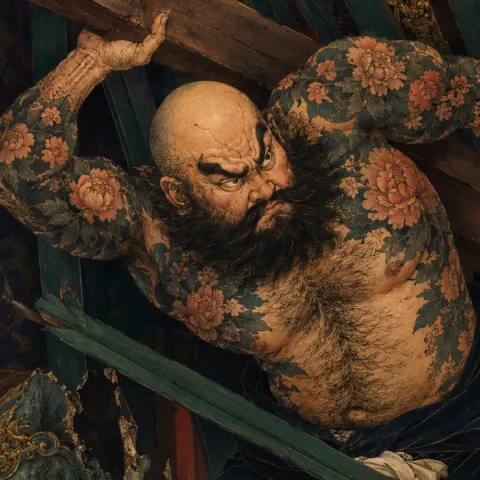 Lu Zhisheniron monastic staff · on foot
Some forty to fifty exchanges on foot; the novel does not give an exact count.
Neither won. Lu Zhishen offered an opening, sprang clear, and called a halt. They then exchanged names and became allies.
Lu Zhishen’s heavy staff put real force behind each attack. Yang Zhi held his ground with a Po Dao through a long fight, but admitted he could only just withstand the monk. The encounter shows their ability under these conditions; it does not settle how they compare in every circumstance.
VI. Twin Whips at Qingzhou
The messenger from Peach Blossom Mountain had scarcely finished reading his plea when Lu Zhishen recognized the names Li Zhong and Zhou Tong.
“Those two misers in trouble?” He tossed the letter onto the table. “I took a bundle of their silver when I left them.”
The messenger kept his eyes down. Yang Zhi picked up the letter.
“If Huyan Zhuo breaks Peach Blossom Mountain, Twin Dragons will be next. They are asking for help, but this is our fight as well.”
“Then we help them,” Lu Zhishen said, rising. “I would like a word with those twin whips.”
Yang Zhi left Cao Zheng and others to defend the mountain. He rode with Lu Zhishen and Wu Song toward Peach Blossom Mountain, taking five hundred followers and more than sixty horsemen. Lu Zhishen fought Huyan Zhuo for forty or fifty exchanges. Both sides sounded the recall and drew apart. After a short interval Huyan Zhuo came out to challenge them again.
Lu Zhishen moved toward his mount. Yang Zhi caught the reins.
“You’ve had your turn, brother. Let me meet him.”
The blue-faced rider came into the field. Huyan Zhuo separated his two whips. “Who are you?”
“Yang Zhi of Twin Dragons Mountain.”
“Another fighter in that nest, then. Tell me your name!”
Yang Zhi urged his horse forward, saber in hand. “Meet the blade first. Ask afterward what title I hold.”
The horses crossed. Yang Zhi’s edge flashed into the movement of the twin whips. Huyan Zhuo had already fought Lu Zhishen, yet his paired strokes remained controlled; one guarded what the other attacked. Yang Zhi kept his saber close to the horse’s neck and cut into the brief spaces left by the whips. After more than forty exchanges, neither had won the field. Huyan Zhuo wondered how many skilled men the mountain held. Yang Zhi saw that he could not finish this quickly.
He feinted, left a sliver of his right side exposed, and turned his horse toward his own line. Huyan Zhuo checked himself rather than follow. Each side sounded the recall.
“He did not chase you,” Lu Zhishen said when Yang Zhi came back.
“He knew the opening was false.” Yang Zhi dismounted and looked toward the government camp. “His whips are heavy, and his judgment is sound. We have only just arrived. Let us move our camp back twenty li and meet him again tomorrow.”
Yang Zhi vs. Huyan Zhuo
Before Mount Taohua · Water Margin · 120-chapter edition, Chapter 57
Yang Zhisaber · mounted; the blade type is not specified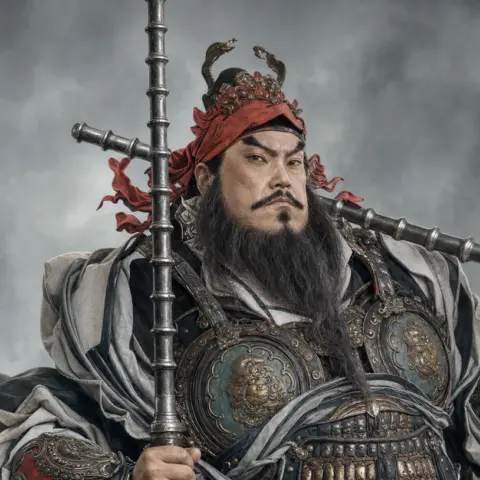 Huyan Zhuotwin whips · mounted
More than forty exchanges between Yang Zhi and Huyan Zhuo. Huyan’s earlier bout with Lu Zhishen is a separate encounter.
Neither won. Yang Zhi offered an opening and rode back to his line; Huyan Zhuo did not pursue. Both sides withdrew.
Huyan Zhuo sustained a fight with twin whips after an earlier long bout, showing endurance and mounted skill. Yang Zhi kept his blade ready and chose when to disengage. His withdrawal is not recorded as a defeat, nor does it prove he had gained the advantage.
Huyan Zhuo later returned to Qingzhou. Kong Ming of White Tiger Mountain was captured, and his brother Kong Liang came asking the three mountains to join forces. Lu Zhishen wanted to storm the city. Yang Zhi shook his head.
“The walls are strong. Huyan Zhuo is inside. Even with three mountains together, we would only spend men at the gates.”
Wu Song asked what he proposed.
“Send Kong Liang to Liangshan tonight. Ask Song Jiang to bring the main force. We can hold the enemy here until he comes. Huyan Zhuo fought Liangshan before; Song Jiang will have reason to answer.”
Lu Zhishen struck the table. “Then that’s our course. I have heard enough praise of Brother Song. I should like to meet him.”
The reinforcements came. Qingzhou fell, Huyan Zhuo joined the outlaws, and the men of the three mountains chose Liangshan too. At the marsh, Yang Zhi saw the old ferry once more. Lin Chong stood among the men waiting for him, as did Huyan Zhuo. Wang Lun’s narrow, suspicious stronghold had become a mountain city with room for fugitives from every road.
Lin Chong came forward. “Leaving again?”
Yang Zhi looked back at Lu Zhishen, Wu Song and the people who had come from Twin Dragons Mountain. “With all of them here? Where would I go?”
They boarded the ferry together.
VII. The Blue-Faced Beast in the Ranks
When the seats were assigned in the Hall of Loyalty and Justice, Yang Zhi stood seventeenth among Liangshan’s leaders, under the Dark Star of Heaven. He became one of the eight mounted vanguard commanders. Suo Chao served among them too; Lin Chong and Huyan Zhuo held places among the Five Tiger Generals. Men who had once faced one another with blades at a stream, spears in a drill ground, or whips before Qingzhou now rode beneath the same banners.
After Liangshan entered imperial service under an amnesty and marched north against the Liao, the enemy set out the Mixed Celestial Array. Song Jiang assigned his divisions. Huyan Zhuo commanded the northern black-robed force; Yang Zhi and Suo Chao served on either side of him as deputies in the assault on the Fire Star formation.
Suo Chao turned toward Yang Zhi as the orders ended. “That fight outside Daming still owes us a winner.”
Yang Zhi was tightening a wrist guard. “Break the Fire Star first. If you have any strength left afterward, ask me again.”
“I’ll hold you to that.”
The drums sounded, and the two riders left the gate together. They would not settle the old contest. Today the question was who could break the enemy line.
In the campaign against Wang Qing, Yang Zhi led a thousand cavalry with Sun An and Bian Xiang in pursuit of Xi Sheng. At the side of Mount Yique, ten thousand hidden riders poured from behind the slope and cut off their retreat. The three commanders fought to break through, but weight of numbers drove them into a deep valley enclosed by cliffs. The enemy blocked the mouth with timber and stone and left two thousand men to hold it.
Night brought no fodder for the horses and no food for the soldiers. Men feeling their way to the barricade saw arrowheads glinting above it and came back.
“One more charge?” Bian Xiang asked.
Sun An looked to Yang Zhi. Yang Zhi crouched and drew the valley mouth in the dirt with his scabbard.
“There is one exit. Pack the whole front into it, and we will lose the front without shifting that timber. Gather the men. No one rushes the barrier. When the army counts its ranks, they will see a thousand riders missing and come for us.”
“And if they do not?”
“At daylight we use what remains. Charge now, and we save the enemy arrows.”
The thousand endured the night in the valley. In the morning Liangshan horns sounded along the heights. Lu Junyi, finding the vanguard gone, had sent four parties to search. Xie Bao saw the trapped horsemen from high ground and learned the way in from villagers. The rescuers scattered the guards, cleared the barrier and brought food down to the men.
When the last timber was dragged aside, a soldier called from outside, “Vanguard Yang, the road is open!”
Yang Zhi did not mount at once. He sent food first to the men who had gone longest without it, had the wounded examined, and waited for the riders to form again. Only then did he lead them out with Sun An and Bian Xiang.
In the later battle against Wang Qing, the Nine Palaces and Eight Trigrams array spread across the field. Beneath black banners at the northwest gate, Yang Zhi led his own division, Yang Lin and Zhou Tong on either side. Years earlier he had stood beside a single stolen load with a blade in his hands. Now a whole line moved at his command.
VIII. Dantu
After the army crossed the river to fight Fang La, each roll call seemed to leave another space unanswered.
Once Runzhou had fallen, Song Jiang sent five thousand men and ten principal commanders toward Dantu: Guan Sheng, Lin Chong, Qin Ming, Huyan Zhuo, Dong Ping, Hua Rong, Xu Ning, Zhu Tong, Suo Chao and Yang Zhi. Fang La’s officer Xing Zheng barred the road. Guan Sheng killed him after fourteen or fifteen exchanges, and Huyan Zhuo drove the troops forward. The ten commanders entered the county with the army.
Yang Zhi did not come to the evening rewards. By the next day’s division of forces, he was too ill to ride.
Song Jiang and Lu Junyi drew lots for the campaigns ahead: one force toward Changzhou and Suzhou, the other toward Xuanzhou and Huzhou. Pei Xuan read out the assignments. He paused at Yang Zhi’s name.
“Vanguard Yang is ill. He remains at Dantu.”
Suo Chao glanced toward the lodging house. Pei Xuan continued with the list, and each commander went to his own men. At dawn the two armies left the county. Yang Zhi did not go with them.
After Fang La’s defeat, Song Jiang’s army gathered at Hangzhou, and the court ordered it home. A document arrived from Dantu: Yang Zhi had died of illness and been buried in a garden on the county grounds.
By then Yang Xiong and Shi Qian had also died of illness. Lin Chong was bedridden and paralyzed. Pei Xuan later placed Yang Zhi among the principal commanders who had died on the road. Back in Tokyo, the dead commanders received the posthumous title of Loyal and Martial Gentleman.
The county’s report contained no account of the Blue-Faced Beast’s life. It gave his name, his death and the place of burial. Song Jiang had it filed with the other records of men lost to battle and sickness, then ordered the army to make ready for the journey north.
Textual note: This narrative follows the 120-chapter Water Margin. The campaign against Wang Qing, the trap at Mount Yique and Yang Zhi’s position in the final formation are absent from the 100-chapter version; the 70-chapter version ends at the seating of Liangshan’s leaders. The account of Yang Zhi’s illness at Dantu, his death, burial and posthumous honor follows the 120-chapter text. The novel gives no account of his treatment, final duel or last words; none have been supplied here. Reconstructed dialogue, action, thought and scene transitions are CG literary writing; the internal Chinese research record distinguishes them from the source’s explicit events.